Book 26 for my 2025 goal of 30 books for the year! As is now default for me, my link to the book is through my bookshop dot org affiliate account.
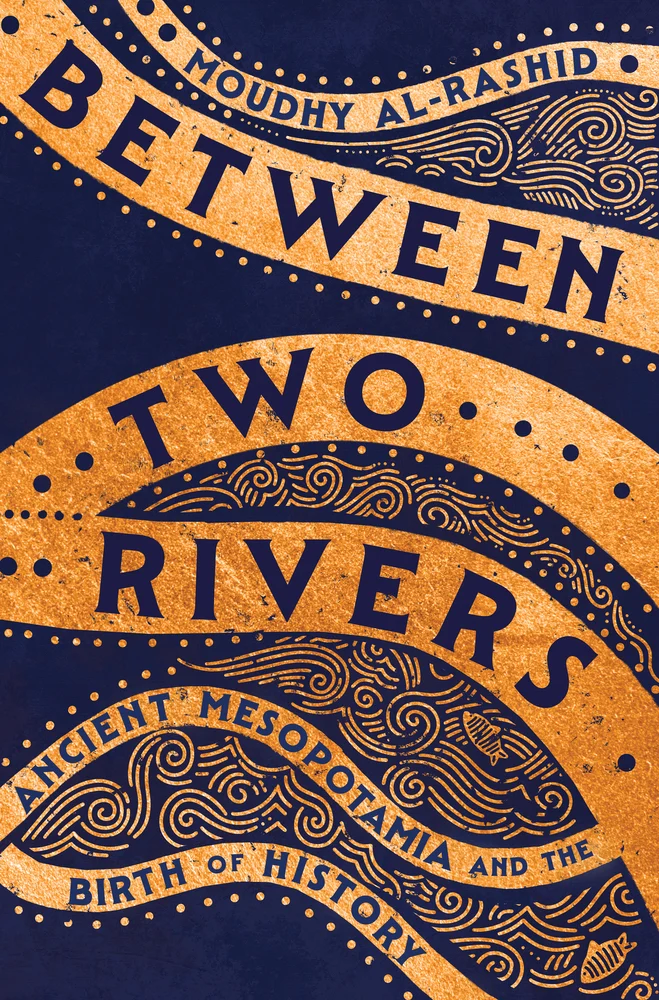
I have long had a huge fascination with the ancient Near East, fostered by my dad’s lifetime love of ancient Egypt. In fact, when I was in college, I was required to take a history and a language course, and I took a course on ancient Near East history along with a course on ancient Egyptian hieroglyphics. So when I saw that one of my internet friends Moudhy Al-Rashid had written a book on the history of Mesopotamia, I knew I would have to read it as soon as possible. Between Two Rivers came out in mid-August, and it finally made it into my hands over this past week.
This book is one of the most wonderful things I’ve ever read. Of course I may be biased thanks to my love of the history of the region, but I was captivated throughout the book and Al-Rashid made the civilizations that thrived there come alive in a way I’ve not experienced before.
I’ve recently been trying to “relearn” thermodynamics, a subject that I haven’t really looked at, or had to look at, for years. I put “relearn” in quotes because I never really learned it well in the first place! One of my jokes is that every student takes a thermodynamics course from someone who doesn’t really understand it, and then that student goes on to become a teacher who doesn’t really understand it, perpetuating the cycle of educational violence. I’ve been using a book on Basic Thermodynamics by Gerald Carrington that I’ve probably had for 30 years but never delved into in detail; it is a decent book, however, because it has a large number of exercises and provides answers to those questions that are numerical in nature.
It’s been a lot of fun — and a lot of work — trying to relearn these concepts, and I thought it would also be entertaining to talk about some of them here! One of the big fundamental concepts in thermodynamics is the Carnot engine, which operates on the so-called Carnot cycle, named after Sadi Carnot, so let’s take a look at it and why it is of such fundamental importance. A small warning: we’ll do a little bit of math here, but only simple algebra, which we’ll use to prove Carnot’s theorem about the maximum efficiency of heat engines.
As folks are probably aware from this blog, I am a big fan of Dungeons & Dragons and a longtime player. I got my start in the hobby the way a lot of people did: through reading classic sword-and-sorcery stories like Robert E. Howard’s Conan tales and wanting to play through some of that adventure myself. Thus, when I came across Appendix N: The Eldritch Roots of Dungeons & Dragons, edited by Peter Bebergal (2020), I had to read it!
A little background information is needed to understand the title. When the first edition of the Dungeon Master’s Guide for D&D appeared in 1979, it included an appendix, Appendix N, that was Gary Gygax’s personal list of “Educational and Inspirational Reading.” This included classic sword-and-sorcery like Howard’s Conan series, high fantasy like Tolkien’s Lord of the Rings, adventure novels like A. Merritt’s Dwellers in the Mirage, and stories that fall into a mix of fantasy and science fiction like Sterling Lanier’s Hiero’s Journey. This list is a treasure in and of itself, albeit one from a single person’s perspective, and others followed Gygax’s lead. For the 1981 Basic D&D set, Tom Moldvay included his own inspirational source material, and 5th edition D&D had its own list.
When Jo Jones moved to North Yorkshire to take over her family estate, she expected it would be a peaceful change of pace. Instead, she became entangled in a murder case (The Framed Women of Ardmore House) that led to the burning of the main manor house. She has plans to open the historic gardens of the estate to the public, but in the meantime has to make ends meet and opts to rent out a room in her cottage. Her first guest arrives late at night and seems like a nice enough fellow, but he is found dead in a ditch the next day. This brings in the town detective James MacAdams to investigate, and right off the bat the case doesn’t make sense. Clearly the guest was murdered, but not at Jo’s home, and he seems not even to have spent the night in the room he rented.
While MacAdams puzzles over the mystery, Jo has her own less lethal mystery to solve. She has been tracking down the history of her ancestors, including a late uncle she lost touch with and a mysterious woman in a painting that was deliberately defaced. Jo’s investigation will lead her to cross paths with MacAdams again and again, and the two of them end up drawing ever closer to a criminal conspiracy — and a murderer who is willing to do anything to keep it a secret.
Book 23 for my 2025 goal of 30 books for the year! As is now default for me, my link to the book is through my bookshop dot org affiliate account.
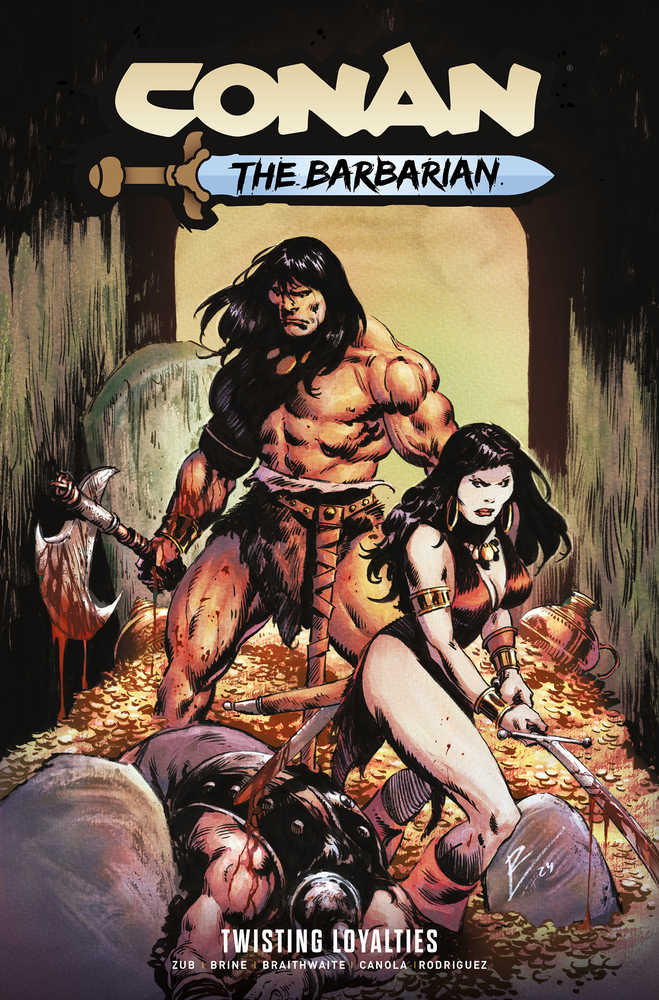
I haven’t read many comics in recent years, even though I was a huge reader in years past, though I enjoy jumping back into the format from time to time. I’m also, as the title of this blog indicates, a huge Robert E. Howard and Conan the Barbarian fan, so I was delighted when Titan Comics offered me a review copy of the most recent compilation of Conan the Barbarian comics, Twisting Loyalties, covering issues #17-20!
The four issues cover two connected two-issue stories connected to Conan’s time with Bêlit, Pirate Queen of the Black Coast. Bêlit was first introduced in Howard’s 1934 story Queen of the Black Coast, often considered one of the best of the Conan tales. In it, Conan takes passage on a merchant vessel to flee from the civil authorities of the city of Argos, but the ship is attacked by Bêlit’s pirates. The pirates slaughter the entire crew, save Conan, whose fighting spirit earns Bêlit’s love. In a striking and unusual arrangement, Conan becomes Bêlit’s mate, serving in a subservient role to her authority, and the pair build infamy for their piracy. The story ends when they take their ship in search of cursed treasure in the jungle and Bêlit is killed; in a scene that was later borrowed by the Conan the Barbarian movie, however, her spirit comes back to save Conan one last time.
I’m pretty bad with anniversaries, so I’m glad that WordPress reminded me! Today marks 18 years of blogging at Skulls in the Stars. What started as a fleeting experiment became a pretty significant part of my life.
18 years… wow.
Lots more to come, as I don’t plan on stopping any time soon! If anyone is curious, here is my very first post — published back in 2007!
Some time ago, I was browsing 150 year old popular science magazines as one does and I found an amusing editorial from 1879 in The Popular Science Monthly titled “Explanations that do not explain.” The unsigned editorial discussed a recent lecture by the famed William Thomson aka Lord Kelvin that itself was titled “Maxwell’s Sorting Demons.”
“Maxwell’s demon” is a famous thought experiment first introduced by the groundbreaking physicist James Clerk Maxwell in 1867 and which still provokes thoughtful discussions and controversy to this day. The funny thing about the editorial in Popular Science Monthly is that the editor/editors clearly did not understand the point of Maxwell’s argument and seem genuinely angry that it was introduced at all! To me, this is comparable to, albeit not quite as bad, as the infamous 1920 NYT editorial that claimed that it is impossible for rockets to fly in space! (The NYT posted a correction some 50 years later, as astronauts were on their way to the moon.)
I’ve recently been brushing up on my thermodynamics, and this all seems like a good opportunity for me to explain a little bit of the subject and how Maxwell’s demon has played a noteworthy role in trying to understand some truly fundamental physics. It’s good practice for me, though I will stress that I’m still brushing up so I might make some goofs along the way — hopefully not! We’ll wrap up by talking about the angry letter of Popular Science Monthly.
This post is quite long, because I cover a lot of background material, so I have separated it into different sections for easy reading over several sessions, if needed.
Book 22 for my 2025 goal of 30 books for the year! As is now default for me, my link to the book is through my bookshop dot org affiliate account.
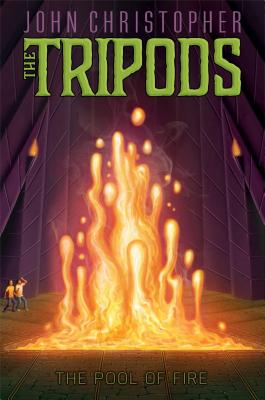
In each of the modern printings of John Christopher’s The Tripods books, Christopher gives a preface to the text. In the first two of the series, he talks about some of the behind-the-scenes of writing the novels, but in the third book he becomes much more philosophical, and asks: if humanity wins against the Tripods, what comes next? After winning the war, how does one win the peace? The novels describe how the Masters of the Tripods eliminated war and conflict by mind controlling the vast majority of the population; if that control is removed, can humanity learn from its mistakes and move forward?
The Pool of Fire follows The White Mountains and The City of Gold and Lead in following a young man named Will Parker as he flees the control of the Tripods and joins an active resistance movement of free humans. The Tripods conquered humanity many years before and now “cap” every human when they reach puberty, stifling their creativity and their will to resist the orders of the mysterious Masters. The first book follows Will and friends as they flee from home and the threat of being capped by the Tripods; in the second book, they undertake a covert operation into a city of the Masters to learn their nature and their weaknesses. In the third book, the knowledge they gain is used in a plan to defeat the Tripods; this plan is especially urgent because Will’s actions in the first book have convinced the Masters to eliminate humanity once and for all…
Book 21 for my 2025 goal of 30 books for the year! As is now default for me, my link to the book is through my bookshop dot org affiliate account.
Some books look intriguing to me when I first get them, but end up sitting on my shelf for ages before I finally get around to reading them. This is the case with The Further Adventures of Sherlock Holmes: The White Worm, by Sam Siciliano, first published in 2016.
This is one of a series of pastiches published by Penguin/Random House by a variety of authors, usually mashing up Holmes with some other classic literary story of the era, often of a supernatural form. In this case, Siciliano has placed Holmes into Bram Stoker’s infamous 1911 novel, The Lair of the White Worm.
This was presumably an interesting challenge. As I’ve blogged about before, The Lair of the White Worm was Stoker’s last novel, written when he was dealing with severe health challenges and possibly cognitive decline. The result is that the novel is extremely disjointed, incoherent, and difficult to read. There are, however, flashes of brilliance in its telling that show what might have been if Stoker had been in better health.
My training and background as a physicist is largely in the field of so-called classical optics: the study of the wave properties of light. Lately, however, I’ve been planning more investigations into quantum optics — the study of the quantum particle properties of light — which has recently culminated in my first published paper in the field.
One topic I’ve been reviewing in quantum optics is the concept of a “quantum eraser.” The idea arises from the general observation that wave interference is directly connected with a lack of knowledge about the evolution of a quantum particle. The classic example of this is Young’s interference experiment, illustrated below.
A source of light is collimated by a small hole in one screen, and then the light simultaneously illuminates two pinholes in a second screen. Light coming from those two holes propagate to an observation screen, where the waves from the two pinholes interfere with each other and produce bright and dark fringes that look something like this:
This argument stretches down to the single photon level. In that case, if we send a single photon through Young’s experiment, the probability of seeing the photon arrive at a point on the observation screen is proportional to the interference pattern. That is: the photon is more likely to arrive at some points rather than others due to the wave interference properties of the photon. If we tabulate the positions of a lot of photons over time, we find that the classical wave interference pattern emerges:
Here is where the idea of “information,” loosely defined, comes into play. The interference pattern for a single photon comes from the recognition that the photon wavefunction passes through both pinholes simultaneously — that is, we as experimental observers have no idea which pinhole the photon has gone through, so it has in a sense gone through both. But if we somehow set up an apparatus that can measure which pinhole the photon has gone through, we will find that the interference pattern disappears completely. Apparently, our knowledge of the path of the photon destroys the interference pattern or, conversely, our ignorance of the path of the photon allows the interference pattern to form.
The idea of a quantum eraser, first proposed by Marlan O. Scully and Kai Drühl in 19821, grows from this. Let us imagine we perform an experiment like Young’s experiment where we measure “which path” information — if nothing else is done, we expect that the interference fringes will not be present on the observation screen. Now suppose that we can somehow “destroy” this information after the photons have passed through the pinholes but before we actually measure the position of the photon on the observation screen. Because the information is no longer present, we expect to see the interference fringes manifest on the screen again! By “erasing” the information, we have caused the wave behavior to appear again. This is the basic concept of a quantum eraser.
However, this is another weird twist to all of this. It is furthermore possible in many cases to choose whether or not to destroy the “which path” information not only after the photon has passed through the two pinhole screen but even after the photon is measured at the observation screen! In this case, the phenomenon is referred to as a “delayed choice quantum eraser.” This bizarre result has often been describe as information “traveling backward in time,” as it superficially seems like the photon must revise its behavior in the past in order to give a consistent result — conforming to the presence or absence of interference — in the present. As we will see, however, this “time travel” interpretation of the is simply wrong, though the explanation of what is really going on is just as fascinating and subtle.
We’ll tackle the quantum eraser explanation in two parts, both of which will be based on Young’s interference experiment. In the first part, we will describe the basic principles using what I will call a trivial eraser, which doesn’t explicitly need quantum physics to explain it. Then we will dive into a full quantum eraser. Settle in for a somewhat lengthy post! It is also one of the most complicated things I’ve ever tried to explain in a blog post, so be patient with me!
The author of Skulls in the Stars is a professor of physics, specializing in optical science, at UNC Charlotte. The blog covers topics in physics and optics, the history of science, classic pulp fantasy and horror fiction, and the surprising intersections between these areas.










 Skulls in the Stars