
This blog post is based on some early experimental writing that was done for my Falling Felines and Fundamental Physics book that was cut from the final draft! As you will see, it was much too long and too much of a digression to include in the book, so I’ve posted it here sorta as a preview of not-quite-the-book!
Some of the most fascinating physics demonstrations are some of the oldest. In my office, I have several versions of a device known as a Crookes radiometer, including both quality display pieces as well as a cheap plastic version.
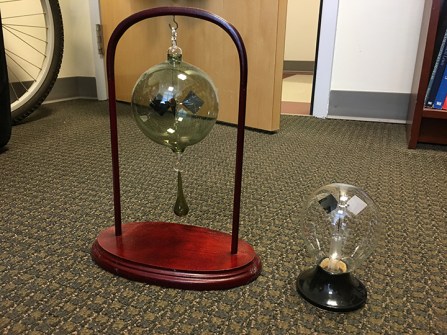
A Crookes radiometer looks very much like a four-armed weathervane, each arm of the vane having a white side and a black side, or a glossy side and a matte side. The entire vane is contained within a thin glass (or plastic) case. When direct light, from the sun or a flashlight, is shined upon the device, it begins to rotate: it is a device whose movement is entirely powered by light!
Though the radiometer is simple in design, its discovery resulted in an epic 50 year history of physicists attempting to adequately explain the origin of its motion. The device would attract the interest of some of the most famous scientists of its time, and provoke lively scientific arguments. It is, in fact, a good illustration of how the solution of problems in physics can often be trickier than they first appear to be!





 Skulls in the Stars