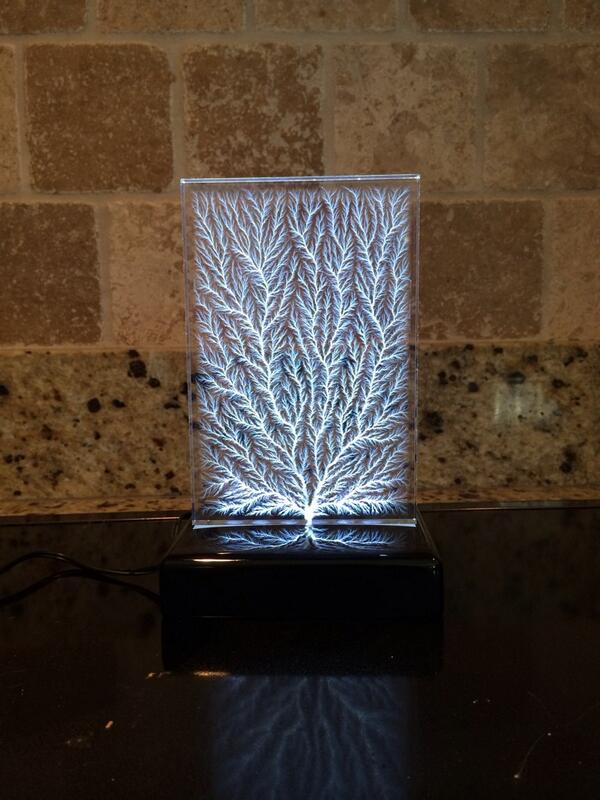
I am a big fan of nature and science-themed artwork, whether inspired by natural phenomenon or created by physical processes. In my office — which includes several pieces of work by Artologica, by the way — I have the following eye-catching piece.
This is what is known as a Lichtenberg figure, named after the German scientist Georg Christoph Lichtenberg (1742-1799), who discovered the effect in 1777. It is sometimes referred to as “frozen lightning,” which is actually more accurate than it might appear at first.
My decorative Lichtenberg figure — which I purchased online — was produced with the aid of a particle accelerator, obviously not something that people readily have on hand. However, it is also possible to create such figures at home in a crude manner not far from Lichtenberg’s original technique.
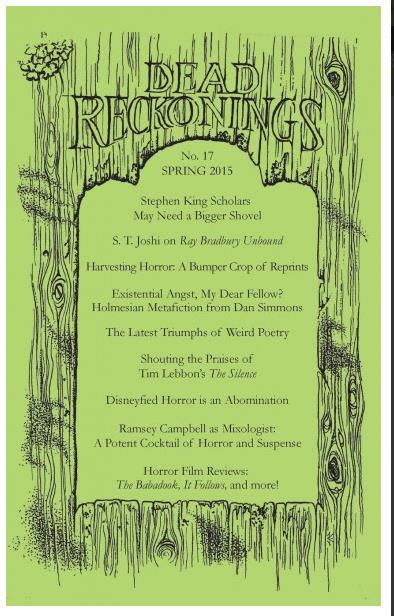
For those who are interested in reading analyses of the latest in horror literature and cinema, I’m happy to announce that Dead Reckonings No. 17 is now available!
It includes articles by some of the best writers and scholars of the horror field… and also includes articles by me!
I somehow forgot to mention on this blog that I also had an article in Dead Reckonings No. 16, which came out some months ago. This has been a really delightful opportunity for me: I could hardly imagine that my writing (albeit literary criticism!) would appear alongside such remarkable folks such as Ramsey Campbell and S.T. Joshi. I would like to thank editor June Pulliam for the opportunity!
I’ve noticed there seems to be a general unspoken rule about the relationship between mathematics and science: any mathematics, no matter how abstract or seemingly disconnected from reality, eventually finds use or representation in the natural world. For example, most people are probably familiar with the idea of an “imaginary number,” namely the square root of -1. The term “imaginary” was coined by famed mathematician René Descartes, who really meant it as a derogatory term: imaginary numbers were thought to be useless artifacts of the imagination. Today, such numbers are a fundamental part of physics, used in every branch from quantum mechanics to optics to mechanics to describe the properties of physical systems. They are almost the opposite of useless.
Other examples abound. Number theory, which is the branch of mathematics devoted to the study of the integers, i.e. 1,2,3,4,…, and their relationships, would seem to be completely devoid of practical interest. However, it plays an important role in modern cryptography, helping to keep our data secure in the information age. Another example is the study of quaternions, objects which may be considered three-dimensional generalizations of imaginary numbers. These quantities were almost forgotten by the early 20th century but have become extremely useful in computer graphics and robotics, among other technologies.
Even with a knowledge that even the most abstract math can be of real-world relevance, I still can find myself caught of guard, even stunned, when such math peeks out from within a very physical problem. Today, I was working on an optics problem when I realized that the problem in question was a direct demonstration of the strangeness of infinite sets! The optics problem in question involves light beams with so-called optical vortices in them, something I’ve talked about on the blog before. And the property of infinite sets in question is the very strange booking practices of a hotel with infinite rooms!
Still have a few posts on China to write, even though I’ve been back for over two weeks! Can’t let all of these photos sit on my laptop with nothing to do.
My last day in China was a Saturday, which meant that I had time to see more of the sites. My postdoc advisor Taco and his student Yundou and I went first in the morning to see a very historic location: the site of the starting point of the famed Silk Road, now a museum about it.
No, not the online black market known as the “Silk Road” that was shut down in 2014. The original Silk Road was an ancient and long-lived trade route that connected the West and East, beginning in 130 BCE and ending in 1453 CE. It was opened by Emperor Wu of the Han Dynasty and lasted until the Byzantine Empire fell to the Ottomans, the latter of whom cut off all contact with the West.
The Northern route of the Silk Road, which stretches West and splits into three branches in the middle of Asia, started at the ancient city of Chang’an, which is now Xi’an, which, of course, is where I was in China. As seen on the map, there were in fact many different trade paths across the continent; in modern times, historians tend to refer to the “Silk Routes” rather than a solitary-sounding “Silk Road.”
So “road” is not quite accurate, but the “silk” part is: the Silk Road got its name for all of the Chinese silk that was in great demand in the West. I would have a chance to see some samples of it during my visit to the museum. The road also brought less welcome goods to the West: the bubonic plague of 542, which is estimated to have killed some 25 million people, likely was brought via the Silk Road.
The British author Ramsey Campbell has long been my favorite writer of horror, and one of his novellas — Needing Ghosts — has the unusual distinction of being the only story I’ve ever read that made me doubt my sanity when I finished it. I’ve always had a hard time keeping up with all of his writing, however, and so it was only recently that I got around to reading his 2013 novel Ghosts Know.
Broadly speaking, almost all of Campbell’s novels can usually be divided into two categories: supernatural horror and non-supernatural murder/thriller. The former includes Campbell’s Ancient Images (1989) and The Grin of the Dark (2007), while the latter includes The Count of Eleven (1992) and The Seven Days of Cain (2011).
Ghosts Know is somewhat unique in that it not only straddles the two categories, but it is also a genuine mystery novel, something that I have not seen from Campbell before.
There have been two books sitting on the shelf in my office for as long as I can remember. They are picture books about the Terracotta Army of Qin Shi Huang, the first Emperor of China, constructed to serve the Emperor in the afterlife and buried around the time of his death in 210 BCE. The books I’ve had are children’s books, but at the time I became interested in the Army, there really weren’t any other books I could find on the subject.
I mention this to illustrate how it has long been a dream of mine to see the massive Terracotta Army in person, and on my recent trip to China I was finally able to visit this magnificent array of sculptures that has reasonably referred to as a “wonder of the world.”
I took a lot of pictures. This will be a long blog post. As always, you can click on individual photos to see them larger. But before we begin, let’s talk about what the Terracotta Army is, and its history.
A short break from my China posts to catch up on some weird fiction blogging!
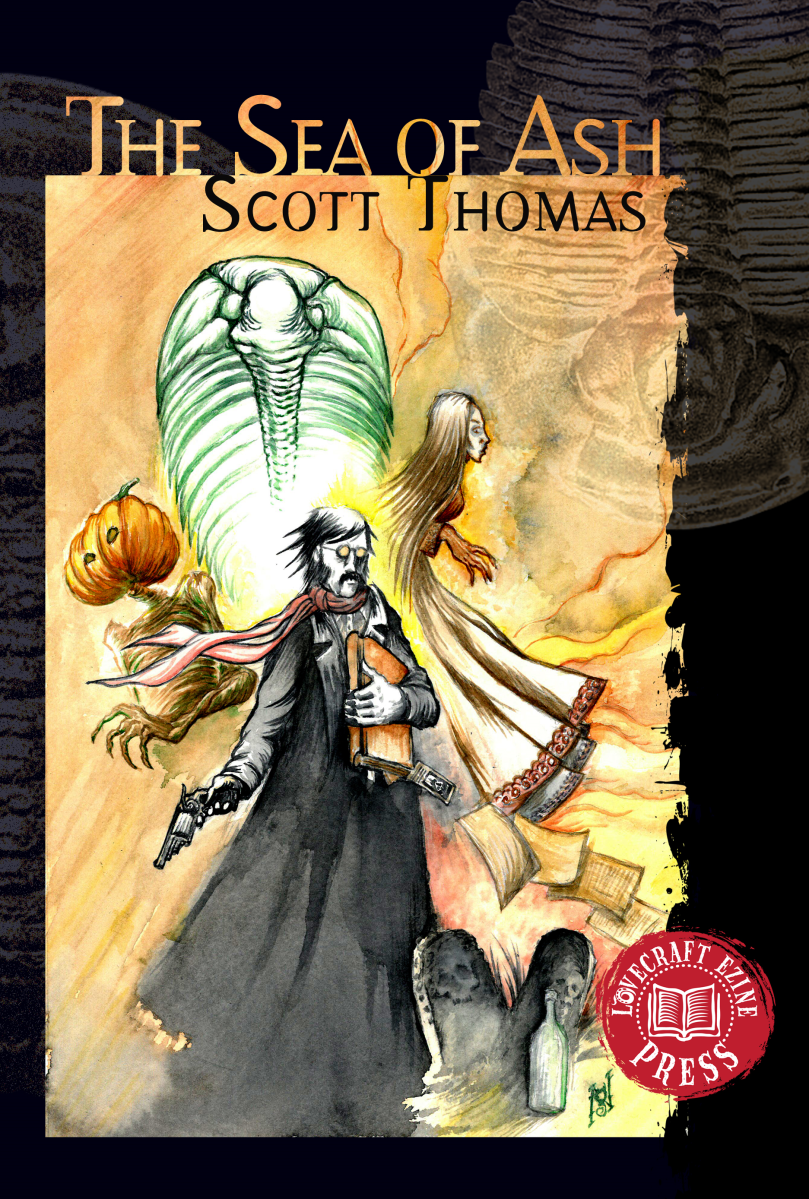
In 1870, a spiritualist named Simon Brinklow disappears as he is pulled into a barrel full of leaves at a farm in Vermont. In 1920, Dr. Albert Pond goes missing after he investigates the appearance, and strange disappearance, of a beautiful woman with teeth fashioned out of fossilized trilobites; his investigation is preceded by a bizarre murder. And, today, a retired school teacher takes a sightseeing tour across New England, retracing the path of Pond’s investigations. Though he intends to be only a spectator, he soon finds that it is not possible to be a passive observer of the secretive unnatural parts of the world.
Such is, in broad strokes, the plot of The Sea of Ash by Scott Thomas, which was first published in 2011 but only received wider attention in late 2014.
This novella is, for me, a perfect illustration of how bad I am at recognizing excellent weird fiction at a glance! I had come across it several times in my Amazon recommendations, but didn’t look at it closely or purchase it until I was taking a lengthy trip and needed to load up my eReader. Since then, I’ve read it twice, and its sublime and beautiful weirdness haunts me regularly.
I arrived in Xi’an late on a Saturday night, two hours later than expected due to a weather delay flying out of Beijing. So I was pretty exhausted on Sunday, but that didn’t stop me from wanting to get out and see some of the sights!
After a nice lunch, my former postdoc advisor and his graduate student took me to see the Giant Wild Goose Pagoda, a historic and still active Buddhist temple which is also a popular tourist destination. It was a great opportunity for me to practice making stitched panorama photographs using PTGui, an excellent piece of software which I haven’t played around with for a long time. I uploaded most of the panorama pictures, and many of the other ones, at high resolution, so be sure to click on them if you want to see details.
The blog has been quiet this past week because I’ve been literally halfway around the world! I was invited to China to give a pair of scientific talks and plan out some collaborative work. The trip was productive and fun, and already I’ve been invited to return again, which I will be seriously considering (though not right away — 20 hours of flying is brutal!).
My hosts at Northwestern Polytechnical University were very hospitable, helping arrange a number of fun activities. My former postdoctoral advisor has also been working there for several months every year, and he not only helped arrange an invitation for me but showed me around and helped me, as a clueless American, navigate a very different culture.
There was so much to see and do, and I tried to do as much as possible and take pictures of everything. I’ll write a number of posts about my trip, and I’ll start with a general overview and some impressions of China, stretching over the entire trip. This wasn’t my first visit to China — I visited Shanghai some ten years ago — but everything was still quite novel to me.
I haven’t posted any skydiving videos for a while, largely because I’ve long depended on other people, with cameras, to video me in freefall. This Christmas, my lovely wife got me a GoPro, however, and the other day I finally broke it out to video a jump or two! It so happens that this week was Carolinafest at Skydive Carolina, a week-long skydive “boogie” with lots of visitors, trainers, load organizers and, of course, cool aircraft. I took the opportunity today to make two jumps out of a helicopter, which was a perfect opportunity to try the camera in action.
I was originally planning to just stand on the strut of the helicopter and hop off, but the first group I jumped with insisted on hanging from the strut! It is not exactly easy to get down in a hanging position on a lonely metal bar 5,000 feet above the ground, and I wasn’t sure I could do it, but I managed!
There are a couple of cool things about doing a helicopter skydive. Like hot air balloons, helicopters can move with little or no horizontal motion, so one can experience genuine freefall with almost no wind resistance. It is a weird feeling — the first time I jumped from a balloon I involuntarily shouted “Holy CRAP!”
The other cool thing about helicopter jumps is the ride up. The helicopter doesn’t have its doors, so one gets an entire open-air view of the countryside for the entire ride to altitude. I included this ride in the video — if you just want to see the jump and canopy ride to the ground, skip to about 7:39.
This video is the second helicopter jump I made today — if I have time, I’ll add the first later!
Update: here’s the video of the first helicopter jump! Very much like the second.
The author of Skulls in the Stars is a professor of physics, specializing in optical science, at UNC Charlotte. The blog covers topics in physics and optics, the history of science, classic pulp fantasy and horror fiction, and the surprising intersections between these areas.





 Skulls in the Stars
