Basil Copper’s “And Afterward, the Dark”

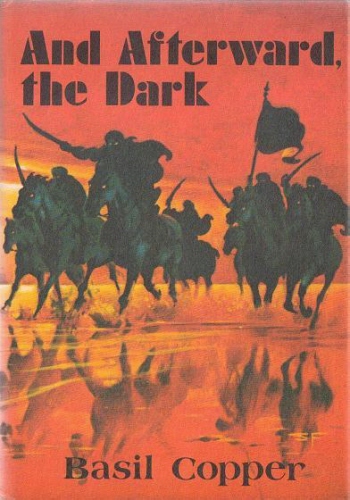
I’ve been reading and blogging about the works of Basil Copper (here, here, & here) over the past few months, and have a nice backlog of his works to go through.  Most recently, I finished the second of his collection of short stories released in the United States, And Afterward, the Dark (1977).

And_afterward_the_darkLike From Evil’s Pillow before it, And Afterward, the Dark was released by classic publisher Arkham House in a relatively small printing of several thousand copies.  Also like its predecessor, it contains a number of so-so stories and a number of very good stories, in my opinion.

Continue reading

Posted in Horror | Leave a comment

Infinity is weird: what’s bigger than big?

The second in what will (probably) be a three-part series of posts on the size of the infinite, as described in mathematical set theory.  The first post can be read here.

When I was young, there was a series of jokes of the “what’s grosser than gross?” variety.  Imagine the grossest thing you can, and then ask: what’s even grosser than that?

I don’t really want to talk about the grossest things I can imagine — learning about science and nature has exposed me to more grossness than I ever wanted to know –but on a related note, we can ask the question: what is bigger than big?  Or, to put it in more suggestive language, what is bigger than infinity?

In the previous post, we introduced what we called the “smallest” infinite number, \aleph_0.  This is the label for the cardinality, or size, of the infinite set of natural numbers: 1,2,3,\ldots.  Once we had described how to “count” the size of an infinite set, we were able to demonstrate unusual identities, such as

\aleph_0+\aleph_0 = \aleph_0,

i.e. “infinity plus infinity equals infinity,” and

\aleph_0\cdot \aleph_0 =\aleph_0,

i.e. “infinity times infinity equals infinity.”

If this were the end of the story, it would be supremely unsatisfying, and hardly even mathematics*, since the conclusion seems to be that there is one size of infinity, and any manipulation of it simply returns the same size infinity.

But this is not the end of the story!  We can demonstrate that there is a bigger infinity than \aleph_0, and it has been hiding in plain sight, so to speak, in even some of the most elementary mathematics.

Continue reading

Posted in Mathematics | 14 Comments

Basil Copper’s “From Evil’s Pillow”

It is always a great joy to discover the works of an author that I’ve previously been completely unaware of.  Recently, I started reading the works of Basil Copper (1924-2013), thanks to the Valancourt Books re-release of his 1974 novel The Great White Space.  Since then, I have read Valancourt’s edition of Copper’s Necropolis, and the as yet not reprinted 1983 novel Into the Silence.  Since then, as I often do when “discovering” a new author, I’ve gone on a buying spree of as many books as I can.  I recently finished reading Copper’s 1973 book From Evil’s Pillow:

From_evils_pillow

This collection of short stories was released by the classic publisher Arkham House, and it was the first book of Copper’s work to be released in the United States.  Arkham would publish quite a few of his books over the decade that follows, and like all Arkham House books they are lovely books to have on the shelf.

But what of the words inside?

Continue reading

Posted in Horror, Lovecraft | Leave a comment

Infinity is weird: how big is infinity?

How big is infinity?  Most people, though familiar with the general concept of infinity, would probably answer with a simple, question-dodging response of “infinite.”  To be fair, the infinite is a really difficult concept to wrap one’s head around, and still causes challenges and puzzles in mathematics to this day.

This is why I’m somewhat proud to have mused on some deeper issues from a very early age.  When I was around 8-10 years old, I distinctly remember explaining to my mother that there had to be different sizes of infinity.  My argument was as follows:

Suppose there are an infinite number of stars in the universe: that represents one size of infinity.  However, every star in the universe contains a huge amount of atoms, and the total number of atoms must also be infinite.  But since, for every star, there are a large number of atoms, the infinite size of the collection of atoms must be larger than the infinite size of the collection of stars.

This was surprisingly deep thinking for a pre-teen, and was at least partially right: there are different sizes to infinity.  However, my argument of how to imagine different sizes of infinity was completely wrong!

To understand why, we need to talk a bit about what is known in mathematics as set theory and the properties of the smallest infinite set, which has a “size” labeled as \aleph_0 (being pronounced “aleph-zero”).  What we will find, in this first post in a series, is that infinity is very weird!

Continue reading

Posted in Mathematics | 23 Comments

Halloween Treats 2013

Every year since I started this blog back in 2007, I’ve been posting a collection of “Halloween Treats”: classic short stories of horror that are freely available to read on the internet. You can read my previous editions:  2007200820092011, 2012 and my 2010 post on the true story of the “Lady of the Lake“. (Hopefully the older links still work!)  I have been trying not to repeat myself in these posts, which makes it a little harder every year to find great stories to link to, but I still managed to find a great collection! (It doesn’t hurt that I have a gazillion books of horror in my library.)

Without further ado, here are 2013’s picks:

The Gateway of the Monster, William Hope Hodgson (1910).  This is the very first of Hodgson’s classic stories about Carnacki, the Ghost-Finder, a paranormal researcher with both scientific and supernatural methods.  Carnacki shares the story of his investigation of “The Grey Room,” a chamber in a man’s ancestral home that a source of violent nighttime disturbances and was the location of a horrible set of strangulations 150 years past.  Carnacki’s studies eventually lead to him spending a night in the room, where a catastrophic miscalculation on his part puts him in deadly peril.

Pickman’s Model, H.P. Lovecraft (1927).  This is one of my favorite stories written by the master of horror H.P. Lovecraft, and possibly my very favorite.  Richard Upton Pickman is a Boston artist whose talent is immeasurable but whose horrific choice of subjects — monsters, ghouls, subterranean terror — leads him to be shunned by the art community at large.  When Pickman’s agent agrees to visit the artist’s private gallery, hidden amongst the anonymous back alleys of the Boston slums, he learns the true depths of Pickman’s depravity and the source of the artist’s inspiration.

LD50, Laird Barron (2013).  I’ve raved about Laird Barron on this blog numerous times (e.g. here, here and here), as I consider him to be one of the best authors of horror, living or dead, and he can capture the essence of the twisted and macabre like no one else can.  This year, he generously made one of his stories freely available on the internet.  In LD50, a transient woman starts an affair with a cowboy in the wilds of Washington State.  The region is in a panic because someone is horribly dismembering family pets in the area… and people who enjoy killing animals eventually start on humans…

The Thing From the Lake, Eleanor Ingram (1921).  This is an entire novel, which I’ve blogged about before! Roger Locke, a successful composer from New York City, purchases a home in rural Connecticut as a private working retreat.  On his very first night there alone, however, he is visited in the pitch blackness by two beings: a woman named Desiree Mitchell, who warns him of unholy danger, and an inhuman Thing that wages a battle of wills for Roger’s very soul.  He survives the night, but Roger is as intrigued by Desiree as he is horrified by the Thing, and he resolves to get to the bottom of the mystery.  The situation becomes even more unusual as he learns that over 100 years earlier, a woman named Desiree Mitchell was burned at the stake for witchcraft in the region.  Roger wages a psychic battle with the Thing at night, and his strength begins to wane even as he grows closer to the ephemeral Desiree.  A series of events forces a final confrontation, in which more than one soul is at stake.

Polodo, L.P. Hartley (1948?). What could be nicer than an afternoon picnic on a small remote island outside of Venice?  A brother and sister decide that the island of Podolo would make for a pleasant getaway, though their enjoyment is dampened somewhat by the discovery of a starving stray cat.  Angela attempts to do right by the animal, in her own way, but before long her actions will be writ large in a horrifying way on the island — which is inhabited by more than just a cat.

The Mark of the Beast, Rudyard Kipling (1890).  In India, a drunken Englishman, Fleete, arrogantly defiles the temple of Hanuman, the monkey god, and is bitten by the Silver Man — a leper priest of the temple.  Fleete shrugs off the action, but it soon becomes evident that he has been struck with a devastating curse, and that its cure may be even more terrible than the curse itself.

A Night at an Inn, Lord Dunsany (1916).  How about a little stage play to wrap things up? To conclude, I have to recommend this horror play written by Lord Dunsany, who is known for imagining the incredible fantasy world of Pegana.  Dunsany was absolutely brilliant in capturing the frightening spirit of old folk tales, religions and ghost stories, and he imbues this spirit into this simple tale of a band of thieves who steal from the wrong temple and suffer the consequences.

One more thing: while I’m at it, here’s a real-life unexplained horror story that happened in 1959: the Dyatlov Pass incident.

Have a Happy Halloween!

Posted in Horror, Lovecraft | 2 Comments

H.G. Wells’ zombies

These days, zombies are everywhere: from television series, to movies, to books, even to television commercials.  If you were to ask people how this craze got started, most would point back to the classic 1968 film Night of the Living Dead.  A few of those people, with more knowledge of the history of horror fiction, would acknowledge the late Richard Matheson’s classic 1954 novel I Am Legend, in which a single human tries to survive in a world filled with vampires.

If one broadens the definition of the “living dead,” however, the idea of a plague of zombies can be traced back much further, to the writing of none other than science fiction master H.G. Wells and his 1933 book The Shape of Things to Come!

Shape_of_things_to_come_dust_jacket


In the later years of his life, H.G. Wells had strong socialist political views and believed that humanity’s inevitable utopian future was to form a world government; much of his later writings reflected this belief.  I have blogged previously about Wells’ 1914 novel The World Set Free, in which the world is forced into peace by the development of nuclear weapons.  In The Shape of Things to Come, Wells takes an even more grandiose view, and predicts the future of the world from 1933 (the present, to Wells) to 2106.

Continue reading

Posted in Horror, Science fiction | Leave a comment

“How the Ray Gun Got Its Zap,” by Stephen Wilk (Updated)

There are a lots of popular science books out there, but a relatively small fraction of those books are related to physics.  And of those popsci books related to physics, there are only a small fraction that discuss optics.*  And only a small fraction of those on optics are any good.

I was therefore delighted to learn a few months ago from Stephen Wilk about his new book How the Ray Gun Got Its Zap, which was released early in October.

raygunzap

Stephen Wilk is a contributing editor of Optics and Photonics News, the news magazine for the Optical Society of America.  He writes and edits the “Light Touch” column for the magazine**, which as advertised presents lighter and fun stories about optics and science in general.  Ray Gun is a revised and expanded collection of these essays, grouped into sections on History, Weird Science, and Pop Culture.

Continue reading

Posted in Optics | Leave a comment

Basil Copper’s “Necropolis” and “Into the Silence”

Thanks to a busy workload over the past few months, I’m way behind in my blogging on a variety of topics!  I thought I’d start catching up first on my backlog of weird fiction, as I’ve been reading an immense amount in my evenings.

A few months ago I blogged about The Great White Space (1974), a novel by author Basil Copper, recently reprinted by Valancourt Books.  Basil Copper (1924-2013) was a stunningly prolific writer who penned a variety of novels and short stories in both detective and horror fiction.  The Great White Space is Copper’s take on Lovecraftian cosmic horror, and I really enjoyed it; this, of course, led me to wonder if the rest of his work is just as good.

Fortunately, Valancourt Books has also released another of Copper’s novels, the compellingly-titled detective story Necropolis (1980).

necropolis_med

But I didn’t stop there — I also scared up one of Copper’s out-of-print books, the horror novel Into the Silence (1983).

intothesilence

So what did I think?  Neither of the novels was quite as spectacular as The Great White Space, but they are both enjoyable and worth reading.

Continue reading

Posted in Horror, Mystery/thriller | Leave a comment

My appearance on WCCB TV!

In the annals of “shameless self-promotion,” I should note one more appearance I’ve made in local media!  Yesterday, a journalist from WCCB TV in Charlotte stopped by my office to interview me on camera about invisibility physics and the interesting possibilities associated with it.  The spot appeared on television in the Charlotte area last night; here’s a link to it!

I haven’t actually watched the spot yet (I get anxious about my appearances on screen), but please let me know what you think! I’ll probably watch it myself on DVR this evening.  I had a lot of fun doing the interview, as it gave me an opportunity to get a “behind the scenes” view at how news features are made.

In another bit of news, I also had a brief interview with a journalist from The Daily Tar Heel that went up last week!

Posted in Invisibility, Personal | 3 Comments

Communication via vortices?

This is the second in a series of posts about the upcoming OSA Frontiers in Optics meeting in Orlando.  This post covers research related to the presentation FM3F.1: Alan E. Willner, Multiplexing Information-Carrying Orthogonal Beams using Orbital Angular Momentum States.  To be (hopefully) cross-posted at the Frontiers in Optics blog.

Do you think your internet is too slow?  If you’re like me, you probably do, even though the speed of data transmission has exploded over the past 15 years.  When I was in graduate school, dial-up modems that could download 56 kbit/s (56 thousand bits per second) were state of the art, whereas today some broadband business connections* can download 400 Mbit/s (400 million bits per second)!  But even still I want more data, and at a faster rate — and I’m not alone!

Fortunately, it is possible that the rate of telecommunications may increase dramatically in the near future.  Over the past couple of years, researchers have demonstrated the possibility of transmitting data at a rate of over a terabit/second (one million million bits per second), in both free space** and an optical fiber***, by giving the light that carries the data a “twist” before transmission!

Continue reading

Posted in Optics | Leave a comment