Richard Le Gallienne’s “The Worshipper of the Image” (1899)

I have been arguing for some time that there is much more of a connection between horror  and science than is generally appreciated.  In fact, I explore this relationship in detail on my Tumblr, Science Chamber of Horrors.  Occasionally, however, I find a book like Richard Le Gallienne‘s 1899 The Worshipper of the Image, which dramatically highlights how a macabre event can simultaneously spur tales of horror as well as scientific and medical advances.

worshipperimage


The novel is short, only 143 pages long — I read it in its entirety in bed one night.  It tells the story of a poet named Antony, who falls in love with a beautiful death mask of an unknown woman.  This mask exerts an increasingly negative influence on both Anthony and his family, eventually leading to horrible tragedy.

The novel is a short and enjoyable read, but what makes it really stand out is that the death mask — “Silencieux” — is actually based on a real death mask that became a cultural phenomenon in the early 1900s!  This mask went on to become “the most kissed face of all time,” as I explain below.

Continue reading

Posted in History of science, Horror | Leave a comment

Simple fun with polarizers!

There is a lot of interesting optics going on around us every day that we are often unaware of!  Some of these can be investigated with very simple and inexpensive tools, if one knows what to look for.  For instance: I’ve had a set of small polarized films sitting in my office for months.  The other day, I finally broke them out and, after some fiddling, it occurred to me that there are plenty of simple experiments that one can do with them!

Of course, to describe them, I should explain what “polarization” is!  It is a property that arises from the wave properties of light, specifically the transverse wave properties.  As I have noted a number of times on this blog, light may be described as an electromagnetic wave, with electric and magnetic fields being the quantities that “wave” as light travels, as illustrated below.

ehwave

The most significant thing about this illustration is that is shows that the electric and magnetic fields “wiggle” in a direction perpendicular (or transverse) to the direction of wave travel — this is what is meant by a transverse wave.

However, this means that, for any particular direction of propagation, there are two distinct ways for the electric field of a light wave to oscillate, such as horizontal or vertical.  The direction that the electric field oscillates — horizontal, vertical, or anywhere in between — is what we call the state of polarization of the light wave.

We don’t usually notice polarization because direct sunlight and light from ordinary incandescent and fluorescent bulbs is unpolarized: it contains equal mixtures of horizontally and vertically polarized light.  However, a polarizing film such as those I have end up blocking light polarized along one direction while allowing light to be transmitted along the perpendicular direction.  We can therefore use these polarizers to play with light polarization and see what weird things can happen!

Continue reading

Posted in Optics | 10 Comments

Basil Copper’s The Great White Space

H.P. Lovecraft not only introduced a fundamentally new genre of horror — “cosmic horror” — but inspired generations of writers who have built on his ideas and taken them in interesting new directions.

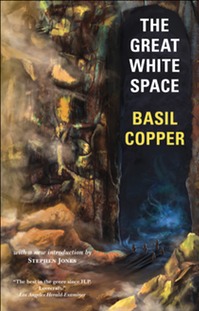
Valancourt Books recently released a new edition of The Great White Space (1974) by Basil Copper.  I snapped it up right away and devoured it (metaphorically, of course) over the course of a day.

thegreatwhitespace_med

Basil Copper (1924-April 2013) was an incredibly prolific author who wrote novels and short stories in horror and mystery.  His first professionally published story appeared in 1964, a horror story titled “The Spider.” He would go on to have a long relationship with the classic Lovecraftian publisher Arkham House, which curiously did not publish his 1974 ‘Space.

The Great White Space is a wonderful novel of cosmic horror, very much reminiscent of Lovecraft’s classic At the Mountains of Madness (with shades of The Statement of Randolph Carter, The Shadow Out of Time and a few other stories).  It is one of the best Lovecraft stories I’ve read which wasn’t written by Lovecraft himself!

Continue reading

Posted in Horror, Lovecraft | 3 Comments

My favorite video games of all time (an incomplete list)

It is not much of an exaggeration to say that I’ve been playing video games since the beginning.  I was one of those kids who spent tons of time in arcades throwing away quarter after quarter, and our family owned the very first commercial home video game system, the Magnavox Odyssey, released in 1972.  After that, I had an Atari 2600, a Commodore 64, and then moved onto PC games.

I recently was digging through a collection of those old PC games, and a few fondly-remembered titles got me thinking: what are my favorite video games of all time?  There have been so many excellent games over the years that it is difficult to come up with a definitive list, but a number of titles stood out from the others.

I figured: why not write a blog post about them?  My list literally spans thirty years of gaming, running from early Commodore 64 games to titles released this very year.  It is somewhat fascinating, looking back, to see how far games have come in that period of time — and how some things have been lost along the way.

The titles are presented in no particular order, other than to provide some variety in the descriptions.  One note: these are my favorite games, not a list of what I would call the “greatest games of all time,” so don’t write me and ask, “Why didn’t you include game X?”  I probably haven’t played it, that’s why!  However, please feel free to mention your own favorites in the comments.

Continue reading

Posted in Entertainment | 5 Comments

R.I.P. Richard Matheson (1926-2013)

Yesterday, I learned via Boing Boing that Richard Matheson, amazing author of speculative fiction, horror, and much more, died at the age of 87.

Richard Matheson in 2008, via Wikipedia.

Richard Matheson in 2008, via Wikipedia.

One of my earliest blog posts was a “horror masters” post on Richard Matheson, who I’ve referred to as “the most famous author you’ve never heard of.”  (Though, if you’re a fan of this blog, you’re more likely to have heard of him than the general public.)  He wrote many classic stories of horror and science fiction but never seemed to accrue the name recognition of an Asimov or a Bradbury.

He essentially sowed the seeds of modern zombie apocalypse stories with his 1954 novel I Am Legend, which describes the trials of the last man on Earth as he struggles against a population that has turned into vampires.  (Three movie versions have been made, none of which have managed to “get the point” of Matheson’s story.)  He essentially predicted road rage with his 1971 short story Duel, which was made into a TV movie of the same name directed by the relatively unknown director at the time Steven Spielberg.  He wrote countless stories that ended up at Twilight Zone episodes, including Nightmare at 20,000 Feet, about a passenger who spies a strange creature on the wing of a flying plane.  He wrote the novel The Shrinking Man in 1956, turned into the movie The Incredible Shrinking Man.

As far as horror goes, I like to refer Matheson as an author of “suburban horror.”  His stories regularly take mundane aspects of modern life — airplanes, cars, telephones — and shows how they can become menacing.

His influence is enduring: his 1956 short story Steel was adapted in 2011 into the movie Real Steel (with, as typical, significant changes).

I’ll really miss his work, and hope that he finds the afterlife that he believed in (and chronicled in his novel What Dreams May Come).

Posted in Horror, Science fiction | 3 Comments

Ted Kosmatka’s Prophet of Bones

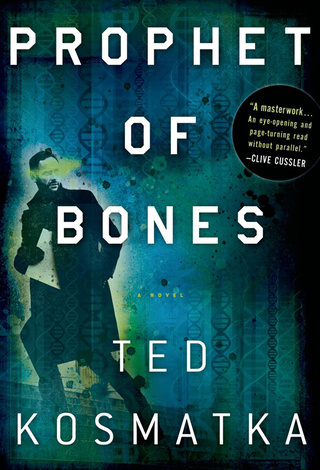
Sometimes a book comes out with an idea so compelling and intriguing and yet so simple that I wonder to myself why someone didn’t think of it ages ago!  Such is the case when I first learned about Ted Kosmatka’s recently released novel, Prophet of Bones, via io9:

prophetofbones

The idea in question?  Imagine a society where the foundation of modern science is young earth creationism (YEC): everyone believes that the world was created 5,800 years ago.  Evolution has been debunked, and radiometric dating seems to confirm these results.

In this alternate universe we meet Paul Carlsson, a talented young scientist who is a specialist in extracting DNA from ancient bones.  Paul has no reason to question the status quo until he is inexplicably pulled from his job and sent to work at a remote dig site in Indonesia —  a dig site at which primitive non-human creatures have been uncovered.  Creatures that, like humans, were tool users.  When the site gets shut down violently, Paul manages to steal away a sample of the bone.  He soon finds himself on the run, hunted down by a mysterious organization that not only employs murderous mercenaries but also controls powerful and nightmarish creatures.

Prophet of Bones is a fast-paced story that is a blend of thriller, alternate history and science fiction.  It manages to be more thought-provoking than most thrillers thanks to its unusual setting, but it doesn’t sacrifice any thrills or intensity because of it.  (There are, in fact, a few cringe-inducing scenes of particular nastiness.)

If I were to quibble about the novel at all, I would say that I wish a bit more information was presented in the end as to how the world ended up wholeheartedly endorsing YEC!  It seems like an incredible conspiracy to accomplish, requiring the suppression of knowledge of vast amounts of physics, geology, and biology.  There seems to be another story in there, though it was not the one that Kosmatka wanted to tell in this book.  Here, if I understood it correctly, we see how scientific ignorance can be used to serve the selfish ends of unscrupulous people.

This is Ted Kosmatka’s second novel, after his early 2012 release The Games, which I will have to go back and read now.  He is also a writer at Valve, known for such awesome story-centered games as Portal and Half-Life.  He also has a background in biology and chemistry, which shows in his detailed laboratory descriptions in Prophet of Bones.  It is also noteworthy that the novel includes a list of scientific references!

In short: Prophet of Bones is a fun, intense, fast-paced thriller.  I will certainly be on the lookout for any future work by the same author!

Posted in Mystery/thriller | Leave a comment

The Giant’s Shoulders #60, part 1, is out!

The first part of the sixtieth edition of the history of science blog carnival The Giant’s Shoulders is up at The Renaissance Mathematicus!  It is a look back at all 59 earlier carnivals (those that still exist!).

Check it out! The second part, concerning posts of the past month, should hopefully be up over the next day or so.

Posted in General science, Science news | Leave a comment

Hiding from time? New design of a “temporal cloak” makes waves

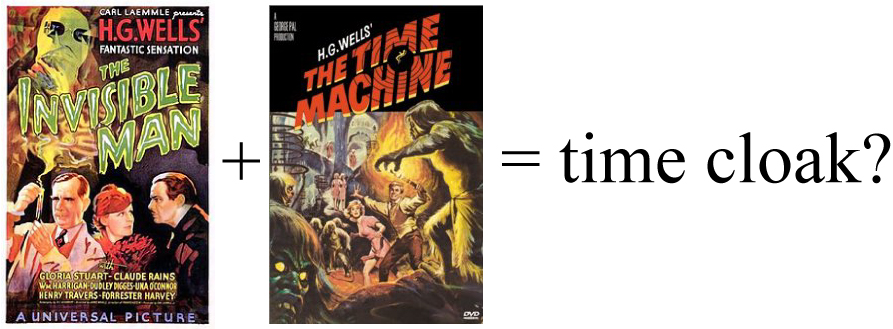
Is it possible to make something invisible in time as well as in space?  It is a fascinating question, a provocative question, a mind-boggling question… wait… what exactly does it mean to “make something invisible in time?”

Is this how one makes a time cloak?  Probably not.

Is this how one makes a time cloak? Probably not.

We’ll get to that, but it has in fact been done: several days ago, a group at Purdue University made world news when they announced a new and vastly improved experimental demonstration of a “temporal cloak.”  Of course, “new and improved” implies that this has been done before, and it has: I blogged about the first realization of such a time cloak early last year.  For those unfamiliar, however, it is worth spending some time explaining the principles behind it, and how this new version is a much simpler and more powerful design that could lead to practical applications in short order.

Continue reading

Posted in Invisibility, Optics | 2 Comments

George Stokes on science and knowledge (1877)

One thing I’ve learned about the great scientists in history is that they are almost all well aware of the collaborative progressive nature of science.  The most famous example of this is Isaac Newton’s quite-possibly-sarcastic “If I have seen further it is by standing on the shoulders of Giants,” but there are other examples.  While researching my post on physicist George Gabriel Stokes‘ 1857 courtship and romance of his future wife Mary, I came across a wonderful description of Stokes’ view on the scientific process and scientific knowledge. The account is second-hand, relayed by his daughter much later in life, but is oddly more poignant because of it.  It shows both Stokes’ wisdom as a scientist as well as his kindness as a father; I present without further comment.

In the year 1877 an Irish cousin came over to spend a long visit with us. On hearing her express a wish to study Euclid my father suddenly announced that he was going to try her paces and would take her for an hour every evening when he was at home, and that I might come too. He read through the first book of Euclid with her during the month of her sojourn with us. It was apparent during the first lesson that I was keeping them back, and that it was better to withdraw; but I felt most wretched and abased at losing the chance of learning from him. That night when bidding him good-night he kept my hand in his and said he wished to talk to me. He first spoke of things not mathematical which he wished me to study. He then gave me the most beautiful account of the growth of knowledge, and said
that even the wisest people knew very little. He spoke of himself as only apprehending slightly in advance of others, as standing on the edge and looking into the unknown, and said that people were then only born who would perhaps know far more than anyone yet dreamt of. Then after speaking of human knowledge as it had been and as it was, he passed on to imagine it in an infinite degree, and from that to Divine Wisdom as the root of all things which are or can be, and yet as willing to dwell in every creature who in humility desired true wisdom.

Posted in History of science | Leave a comment

George Gabriel Stokes in love! (1857)

Been very busy the past few weeks with work, house buying and selling, and life in general.  Catching back up on blog posts; here’s a bit of sweetness connected to a prominent physicist.

With the weather finally turning nice at last and with Spring in the air, it is natural that even a scientist’s thoughts would turn to… love!  Not being a biologist, I can’t write about the weird mating habits of the animal kingdom — besides, that role is already and masterfully taken by Dr. Bondar.

What I can do, however, is provide a revealing peek into the personal life of a famous physicist and his own efforts and insecurities in romance.  I was recently browsing the memoirs and correspondence of physicist and mathematician George Gabriel Stokes (1819-1903), published in 1907, and found to my delight that the editor had included a series of personal letters of Stokes wooing the love of his life!

Why, you might ask, would I even bother to share this information?  Well, every physicist knows at least one quirky story about a famous researcher, e.g. some sort of crazy thing that Feynman, Einstein or Newton did.  These stories are great fun, but they emphasize that great scientists are different from ordinary folks.  This in turn has the unintended side effect of making scientists appear strange, unsympathetic, and unapproachable.  Because of this, I nowadays am more delighted to read anecdotes that prove that the most brilliant researchers were, in fact, also very human at heart.  Stokes’ letters actually highlight two major aspects of his personality: his loving and insecure soul as well as his remarkable mind.

Continue reading

Posted in History of science, Silliness | Leave a comment