An American in Spain, part 7: the Plaza de España, Seville

Part 7 of a photo travelogue of my (not quite so) recent trip to Spain with my wife and her family! (Part 1Part 2Part 3Part 4Part 5, Part 6)

Our first full day in Seville was quite a busy one!  In the morning, we visited the Seville Cathedral (part 5), and around lunchtime we visited the Real Alcázar (part 6).  After that visit, we were quite exhausted, but there was at least one more “must see” location in Seville: the Plaza de España!  Madrid also has a Plaza de España*, but Seville’s is in a completely different league, as we will see.

The Plaza was a bit of a walk from the Cathedral and the Alcázar, and we were pretty exhausted, so we stopped along the way first to grab some lunch.  I didn’t get a photo of that day’s meal, but this is nevertheless a good place to share a photo of the previous evening’s dinner.
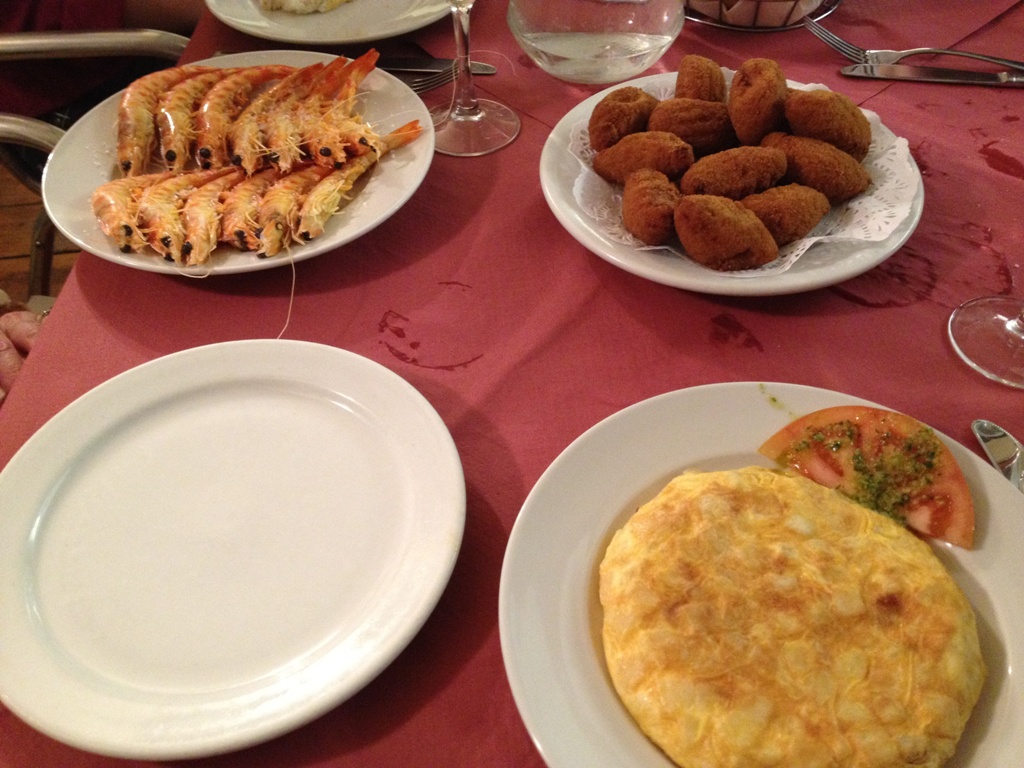
A tapas dinner in Seville.

The upper left corner is a plate of prawns (niece-in-law #2 was appalled by the huge eyes on them), and the other two plates are traditional Spanish tapas: croquetas on the top and a Spanish tortilla on the bottom.  I loved both of these plates and ate them almost every day, eventually burning out on them by the end of the trip!

Continue reading

Posted in Travel | 1 Comment

The secret molecular life of soap bubbles (1913)

Nature can be extremely devious in the way it hides its secrets.  Sometimes the most remarkable and profound insights are staring us right in the face every day in the most mundane phenomena.

For instance, we have all seen the spectacular colors that can appear in soap bubbles:

Image from Microscopy-uk.org.uk, by Michael Reese Much. Borrowing his lovely images until I can produce my own!

These colors are produced by optical interference, as we will discuss below; the “thin film optics” that creates bright colors in soap films also results in the bright colors of oil slicks.

A rainbow of color produced by white light reflecting off of a thin layer of diesel fuel on water, via Wikipedia.

Most of us would look at a soap film image and marvel at the beautiful rainbow colors; others would investigate the optics underlying them.  But it took an exceptional physicist, Jean Baptiste Perrin (1870-1942), to realize that these colors concealed something more: direct evidence that matter consists of discrete atoms and molecules!

Continue reading

Posted in History of science, Optics | 11 Comments

Physics demonstrations: Magdeburg hemispheres

Sometimes one can demonstrate very profound and remarkable physics with very simple, even mundane, tools.  Last week I received the tools to perform one such demonstration by mail:

This pair of iron hemispheres, with handles attached and a valve on one side, are a small scale model of one of the earliest and most dramatic displays of the power of atmospheric pressure.  They are now known as the Magdeburg hemispheres, and they still work as a great demo to this day.

Continue reading

Posted in Physics demos | 22 Comments

An American in Spain, part 6: Real Alcázar of Seville

Part 6 of a photo travelogue of my recent trip to Spain with my wife and her family! (Part 1Part 2Part 3Part 4, Part 5)

On our first full day in Seville, we spent the morning visiting the Seville Cathedral, as described in the previous Spain post.  That was only the beginning of the day, however, as we went directly from the cathedral to the Alcázar, a beautiful royal palace with a long  and storied history.  It is still used by the Spanish Royal family as a residence when staying in Seville.

Entrance to the Real Alcázar of Seville, the Puerta del León.

This palace-fortress has such a long history, with such extensive renovations and changes, that even its date of origin is unclear!  It seems that many of the surviving structures date from the 14th century, though some remains could date back as early at the 10th century.

Continue reading

Posted in Travel | 2 Comments

Coherence, plasmons, and me!

ResearchBlogging.orgI don’t often talk about my own research on this blog… heck, I don’t think I’ve ever talked about my own research here, come to think of it!  I thought it would be a nice change of pace to describe a paper that recently appeared in the journal Plasmonics of which I am a co-author.  The paper, titled, “Coherence converting plasmonic hole arrays”, describes how  one can use an array of subwavelength-size holes in a thin metallic screen to alter the statistical properties of a light beam incident upon it!  It has appeared online at Springer’s site and will be “officially” published later this year.

For those not familiar with optics, there’s a lot to unpack in even the title of the paper: What is “coherence”?  What is a “plasmon”?  Why do we care about “converting” coherence?  Let’s take a look at each of these ideas in turn as we build an explanation of what my collaborators and I have accomplished!

Continue reading

Posted in Optics | 10 Comments

“Arago’s inadvertent test of relativity” in Optics & Photonics News!

This is just a short post to announce that my third popular science article written for a magazine appeared online today!  “Arago’s inadvertent test of relativity” has appeared in the May issue of Optics & Photonics News, the news magazine of the Optical Society of America.  The article discusses how François Arago stumbled across the first experimental evidence for Einstein’s special theory of relativity, though he didn’t realize it!

Unfortunately, the article is only available to subscribers; however, if you’re interested in reading about Arago’s exploits, you can look at a blog post I did on the subject a few years ago at this link.

Posted in Optics, Personal | Leave a comment

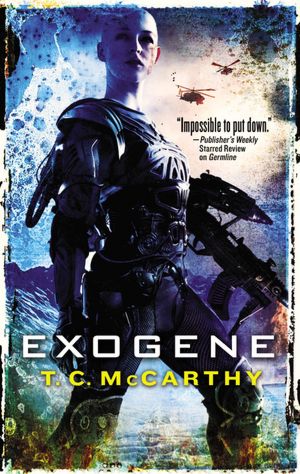
T.C. McCarthy’s “Exogene”

Most of us are familiar with the Greek myth of Pandora and her eponymous box.  In a standard telling, Pandora is given the box by Zeus but is explicitly told never to open it.  Pandora’s curiosity gets the better of her, however, and when she raises the lid she releases all the evils of the world.  She attempts to put the lid back on, but it is too late — what is done cannot be undone.

The myth of Pandora came to my mind while pondering the novel Exogene, by T.C. McCarthy.

In this second book of the Subterrene War trilogy, one gets the ominous feeling that, like Pandora, humanity is being enticed by the allure of short-term gain into making decisions that will lead to doom.  As happened with the first book in the trilogy, Germline, I found Exogene pretty much impossible to put down.

Continue reading

Posted in Science fiction | 2 Comments

Physics demonstrations: the Pythagoras cup

The past few weeks I’ve been preparing a lot of entertaining demonstrations of physics principles for a Science and Technology Expo to be held at UNC Charlotte on April 29th.  I thought I’d start writing short posts highlighting the various gadgets and gizmos I’ve encountered.

At first glance, it seems like a very ordinary, if ornate, drinking cup:

There is an odd bump in the center of the cup, but otherwise, it seems quite normal, and if it is filled to a certain level can be used without incident.

However, if the cup is filled higher than the bump, the drink starts to drain out of the bottom — in fact, the cup will completely empty itself!

This is the trick of the Pythagorus cup, also known as the Pythagorean cup or the Tantalus cup!  It can be used as a nice prank to play on someone (don’t use red wine, unless you need to replace your carpeting anyway), but also serves as a nice demonstration of some physics of fluids.

Continue reading

Posted in Physics demos | 20 Comments

The Giant’s Shoulders #46 is out!

Delayed a week due to technical issues, the long-awaited 46th edition of The Giant’s Shoulders history of science blog carnival is up at Providentia!  It’s a doozy, featuring things such as:

  • How Jewish leaders reacted to Darwin’s theory of evolution,
  • An astronomer who prepared years to record an event but fainted as it was happening,
  • A medieval cookbook that shares recipes on things as exotic as unicorns,
  • Emile du Chatelet, a brilliant female mathematician, and much more!

Thanks to Romeo Vitelli for hosting an excellent carnival!

The next edition of The Giant’s Shoulders will be hosted by The Medical Heritage Library and entries are due by May 15.  Entries can be submitted directly to the host blog or throughblogcarnival.com, as usual.

Posted in General science, Science news | Leave a comment

An American in Spain, part 5: Seville Cathedral

Part 5 of a photo travelogue of my recent trip to Spain with my wife and her family! (Part 1Part 2Part 3, Part 4)

Updated some descriptions thanks to commenter VA!

When we woke up on Monday morning, the massive crowds of Palm Sunday had to a large extent dispersed, though the city of Seville was still quite lively.  We had a lot to do, so we wasted little time in making our way to the Seville Cathedral to do some sightseeing.  There was already a lengthy queue waiting to tour the inside of the massive building.

Entrance to the Seville Cathedral.

It is hard to do justice to the size of the Seville Cathedral (Catedral de Santa María de la Sede).  It is the third-largest church in the world, with some 11,500 square feet of interior space, and the largest Gothic cathedral in the world.  Like much of the early architecture in southern Spain (Andalusia), its architectural style is a curious mix of Christian and Muslim tastes.

Continue reading

Posted in Travel | 4 Comments