The carnival was a little delayed, and my announcement of it is even more belated, but the 48th edition of The Giant’s Shoulders history of science blog carnival is up at Clerestories! In the carnival, you can read:
The history of previous transits of Venus;
The story of Mary Lacy, a shipwright who published her autobiography — in 1773;
A 1936 letter from a young girl to Albert Einstein, and his response;
A brief, painful history of dentistry;
and much more!
Thanks to Sienna for an excellent carnival!
We don’t yet have any hosts lined up, as far as I know, for the next few months of the carnival — if you’re willing to host at your blog, please please please let us know!
The final part of the seemingly-endless photo travelogue of my (not quite so) recent trip to Spain with my wife and her family! (Part 1, Part 2, Part 3, Part 4, Part 5, Part 6, Part 7)
Having exhausted ourselves with a very extensive visit to Seville, the very next day we hopped on a train to our last stop: the lovely Southern city of Granada! This was an essential stop, as the whole motivation for our Spain trip was to visit niece-in-law #1, who was doing a semester abroad in Granada. While en route, I had some fun experimenting with panorama photography to capture some of the lovely Andalusian countryside.
Panorama of the Southern Spain countryside, created by stitching together two photos taken from a moving train. I can’t believe it actually worked.
Granada, like Seville, is a beautiful city with a rich and ancient history, as we would see for ourselves on our only full day there. The present-day city was founded in the 11th century , during a civil war that marked the end of the unified Moorish caliphate but resulted in independent Moorish kingdoms sprouting up. The ruler of one of these kingdoms opted to move his residence to the high ground of present-day Granada, where it would be easier to defend from attacks. He moved into a Jewish hamlet already present there, and the city grew rapidly in size. The city remained Muslim until 1492, when it became the last city to fall in the 800 year Christian Reconquista of Andalusia.
About a week ago, NASA announced some really good and unusual news. The National Reconnaissance Office, in operation of the United States’ spy satellites, had some extra unused “hardware” to donate to the space agency: two Hubble-quality space telescopes, initially designed to spy on the Earth!
The Hubble Space Telescope, image via Wikipedia. Thanks to the NRO, NASA now essentially has two extra ones.
This is undoubtedly a great boon for NASA, which has been suffering under budget cuts for quite some time, even resulting in a recent bake sale by scientists. It will take years for the new telescopes to be used on a mission, but they could still be launched sooner, and for much cheaper, than comparable projects.
This raised an interesting question on Twitter, posed by Colin Schultz and John Rennie: if they had actually been used as spy satellites, what would these super telescopes have been able to see on the ground? It’s a fascinating question, and leads into a nice basic discussion of the optical resolution of imaging systems. In other words, what is the smallest detail that could be picked up by one of these telescopes in orbit?
I’ve been quite busy and having a hard time putting together some science posts. In the meantime, I thought I’d share a video of a couple of skydives I did a bit over a week ago at CarolinaFest 2012 at Skydive Carolina, my regular dropzone!
CarolinaFest is an event known in skydiving parlance as a “boogie”, which is pretty much a skydiving convention: people come from all over to participate in special activities and to jump out of fun and unusual planes that have been rented for the event. One of the perks of a boogie is load organizing: expert skydivers are brought in to plan and implement formation skydiving for the attendees.
My friends and I joined up with Regan Tetlow, who works at Skydive Empuribrava in Spain. I did three jumps with him, though we didn’t have video on the first jump so only the first two jumps on the video have me in them! I’m the one in the green and black jumpsuit and wearing the leather “frap hat”.
The two I’m in are an “8-way” formation jump and a “6-way” formation jump, both of which went pretty well. I’ve managed to pick up an annoying habit of pulling my legs in and sinking out on the formation (going lower than I want to), so Regan ended up keeping me pretty close to him for the jumps. (And I felt a little like an idiot by the end of the day!)
The boogie seemed really crowded this year, and in fact they had four airplanes running constantly on the day I was there! The first jump was out of a twin otter, and the second was out of my favorite plane, the CASA. The CASA is especially fun because it has a tail door, which allows for very easy and fun exits with a lot of people linked together. On the second jump of the video, we actually launched six people together off the plane, though one fellow lost his grip and had to come back to the formation.
Overall, it was a really fun time! Though my flying wasn’t at its best, I felt like I learned a few things to help improve in the future. Special thanks to Larry and Kathy Stringer, my friends who recorded and edited these videos, respectively!
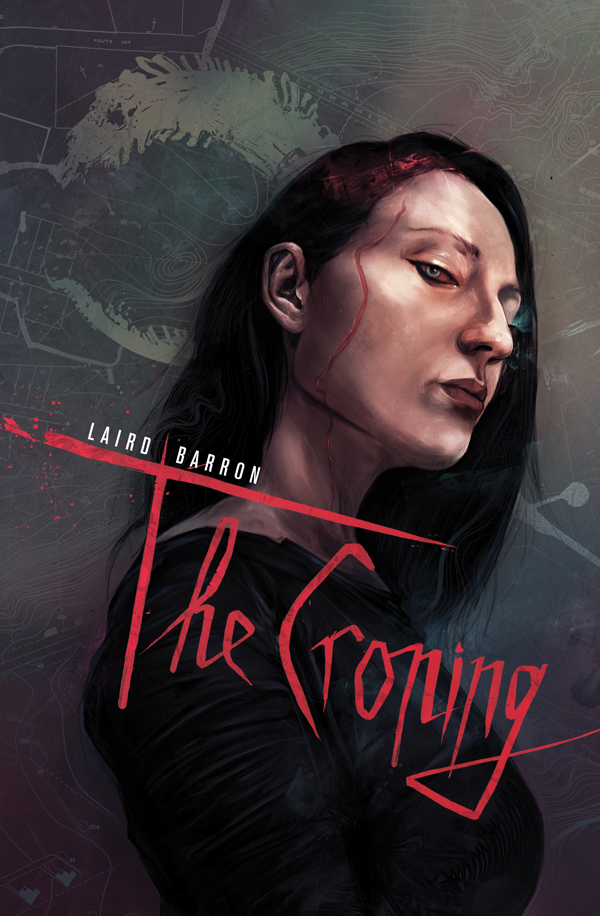
I love Laird Barron’s writing! I first came across his work in the horror collection Haunted Legends; Barron’s story, “The Redfield Girls”, really stood out to me above all the others in terms of its eloquence and eeriness. Since then, I’ve read both of Barron’s short story collections, The Imago Sequence (2007) and Occultation (2010), and been mightily impressed with both.
This year, Barron’s first novel was published by Nightshade Books, The Croning (2012):
The Croning is a very dark and modern interpretation of a classic fairy tale (which was already rather dark to begin with). I found the novel to be a little challenging, for reasons that I will mention below, but it is also an undeniably creepy and potent story and an excellent first novel for Barron.
Though I stopped doing a Twitter weird science fact (#weirdscifacts) a day several months ago, I’m still occasionally posting facts as I come across them. Here’s a collection of a few tidbits I came across over the past couple of months.
746. Apr 06: Pieter Zeeman was fired for doing the work that he eventually won the Nobel Prize for! There are plenty of stories of Nobel prize research being unappreciated when first published, but it is rare to see someone get fired for doing it.
747. Apr 07: The mystery of the glow-in-the-dark Civil War soldiers. The story of the miraculously-healing glowing wounds sounds like a supernatural story, but in fact has a scientific basis.
748. Apr 08: Versailles fountains could not be pumped all at once; gardeners watched Louis XIV and ran the ones near him as he strolled. Interestingly, this week on Jeopardy! a contestant told a modern version of this story. The contestant and his friend managed to hide in the Versailles gardens and sleep there overnight; they were awakened in the morning to the spray of the sprinkler system, and the sprinklers mysteriously seemed to turn on wherever they ran! Turns out the gardeners were having a little fun with the trespassers.
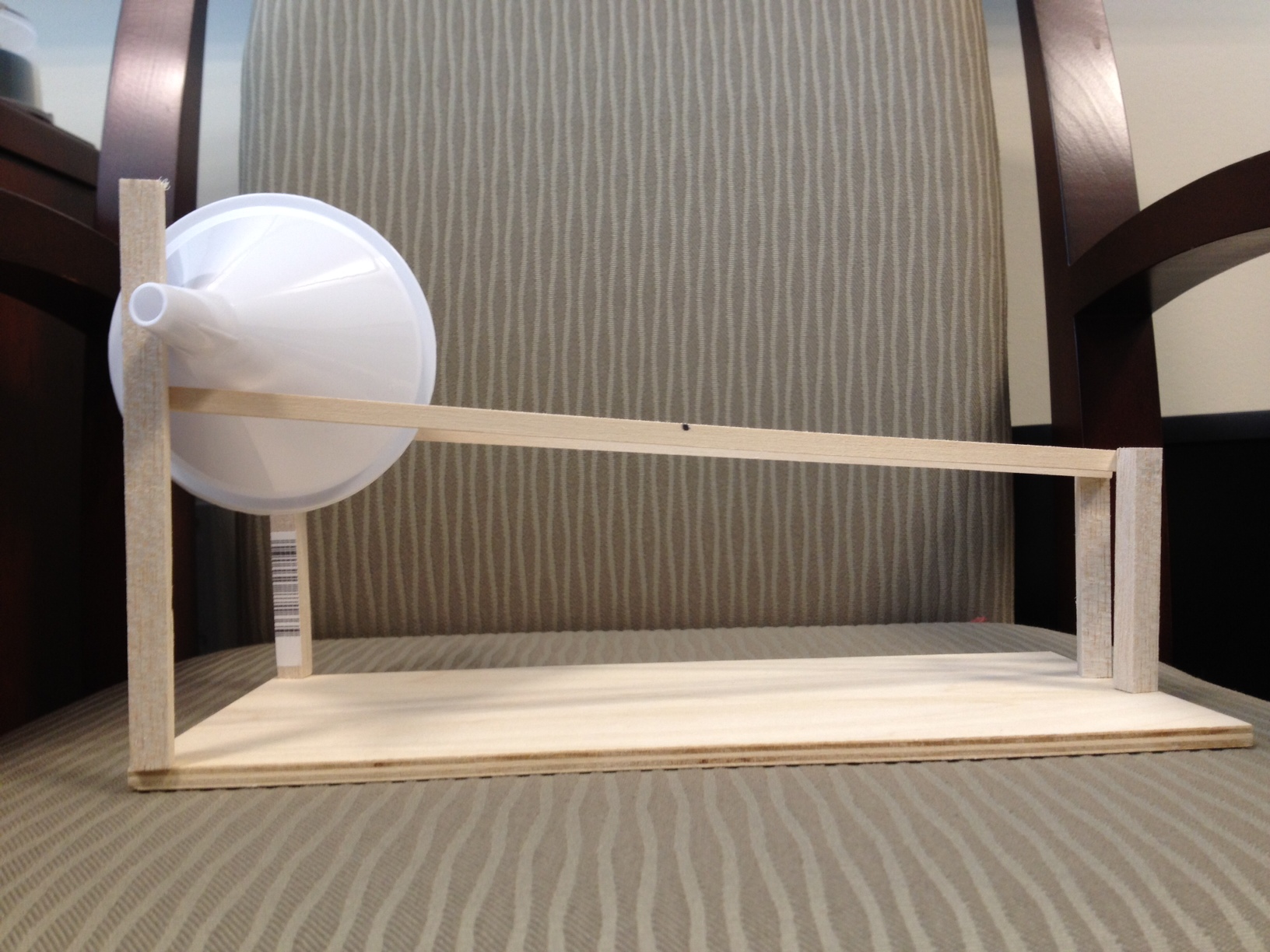
Some of the best and most enjoyable demonstrations of physics principles can be put together quite readily with very cheap materials. A good example of this was the simple version of the Magdeburg hemisphere demo I discussed previously; another example is the approximately $20 device shown below.
A pair of rails spread apart as they increase in altitude: they are 3” high on the right side, and 4” high on the left. This is easier to see from a side view.
A pair of plastic funnels have been glued together at their wide ends; when the joined cones are placed on the right, lower, side of the device, they immediately roll to the left, stopping only when they hit the uprights on the far left side. The joined cones have rolled uphill, in seeming defiance of gravity!
Of course, this simple device can be readily explained by physics, and its unusual operation can be used to highlight an important principle in the physics of forces and motion.
Stories of superheroes have evolved dramatically since the appearance of Superman in Action Comics #1 in 1938. Where many of the first, like Superman, were moral, upstanding individuals striving to do good in the world, many modern heroes are flawed, struggling with a sense of purpose and with their own sense of right and wrong. The supreme example of this modern style are the characters in Alan Moore’s graphic novel Watchmen (1986-1987), who are faced with a world with problems much greater than they can solve.
Before even Superman, however, there was a super-powered protagonist that struggled to find his place in the world: the character of Hugo Danner in Philip Wylie’s 1930 novel Gladiator.
In fact, Wylie’s Danner was likely a major inspiration for Superman! Though Shuster and Siegel never admitted as much, the similarities are striking, and it is hard to imagine that the two Superman creators were unaware of the popular novel.
the gruesome history of eating corpses as medicine,
the story of Lady Mary Montagu, who introduced smallpox innoculation to London,
the Great New York Starvation Challenge of 1881,
and much more!
A very hearty thanks to Hannah for assembling such a nice carnival!
Once again, we have run out of hosts for future editions of the carnival! If you are willing to host a future edition (including and especially June), please let myself or ThonyC, the carnival organizers, know! You can either send an email or leave a comment on this post.
Now that the semester is over and I have some time, I finally got around to writing a short book page for my Mathematical Methods for Optical Physics and Engineering textbook!
This page will serve as a place to post any new information about the book, as well as the errata and supplemental problems (as soon as I get around to writing them).
The author of Skulls in the Stars is a professor of physics, specializing in optical science, at UNC Charlotte. The blog covers topics in physics and optics, the history of science, classic pulp fantasy and horror fiction, and the surprising intersections between these areas.





 Skulls in the Stars