Jeff VanderMeer’s Finch

I’ve had the good fortune to read many good works of weird fiction since starting this blog — in fact, one of the major motivations for starting the blog was to “force” myself to get back into reading strange and creepy stories such as those that had captured my imagination as a youth.  Every once in a while, though, I come across a work so wonderful and fascinating that it will permanently haunt the depths of my psyche.  Case in point: I was absolutely blown away by Jeff VanderMeer’s recent novel, Finch (2009):

The novel defies easy characterization: it is part detective novel, part science fiction novel, part war novel, part fantasy novel — and part horror novel.  Even with that mixing of genres, VanderMeer manages to tell a very serious, intricate, and mesmerizing tale.

Continue reading

Posted in Horror, Science fiction, Weird fiction | Leave a comment

The Giant’s… ahem… Leviathan’s Shoulders #23 is up!

The special marine science edition of The Giant’s Shoulders, dubbed The Leviathan’s Shoulders, is up at Deep Sea News!  Many thanks to Kevin Zelnio for putting together this lovely oceanic edition!

What do you think of the idea of  “special editions” for the blog carnival?  Feel free to leave a comment!  If future hosts have suggestions for special editions, send me an email with your idea.

The deadline for the next edition is June 15th, and it will be held at Jost a mon.  Entries can be submitted through blogcarnival.com or directly to the host blog, as usual.

Posted in General science, Science news | 2 Comments

ResearchBlogging editor’s selections: Antikythera, sports fan anthropology, bad oil theories, and false memories

  • Planets and Anomalies in the Antikythera Mechanism. The Antikythera Mechanism is one of the fascinating relics of the ancient world — a 2000 year old clockwork “computer” that could be used to track the Sun, Moon, and calendar.  In a detailed post, Alun at AlunSalt describes recent research that highlights again how ingenious the device is.
  • For the Love of the Game: A Look at Fans and Disappointment. It’s easy to get wrapped up in the successes and failures of one’s favorite sports team, but we typically don’t think about it as an anthropological exercise.  Krystal at Anthropology in Practice relates some research on disappointment versus discouragement in baseball fans: why do we stick with a losing team?
  • Rethinking petroleum a little too hard… Most people realize that one day we’ll run out of oil, but there are some diehard skeptics who believe that new oil is naturally produced all the time in the Earth’s interior, and is effectively limitless.  Greg Fish at weird things throws some cold water on that hypothesis and describes the origins of this stubborn abiogenic theory.
  • Confidently Wrong: Correcting False Memories. Remember the time that you saw that thing happen — even though it never did?  Daniel at Ingenious Monkey talks about the phenomenon of false memories, and how we stubbornly cling to those memories.

Check back next Monday for more “miscellaneous” selections!


Posted in General science, Science news | Leave a comment

Shocking: Michael Faraday does biology! (1839)

(This is my entry to the first “special edition” of The Giant’s Shoulders, dubbed “The Leviathan’s Shoulders”, with an emphasis on oceans and ocean life.  The post is actually about a river creature, but, hey, it’s still aquatic!)

I’ve spent a lot of time talking about Michael Faraday (1791-1867) and his scientific accomplishments on this blog.  His thorough investigations into the nature of electricity and magnetism paved the way for all of modern electromagnetics as well as optics, and he is rightly viewed as one of the greatest experimentalists of all time.  Among his monumental works are the observation that changing magnetic fields induce electric fields (electromagnetic induction) and the observation that light polarization can be affected by an applied magnetic field (Faraday rotation).

Though it is natural to think of Faraday as a researcher of electricity alone, in his era the study of electricity connected to almost every aspect of the natural sciences.  In the late 1700s Luigi Galvani had shown that an amputated frog’s leg could be made to move by electrical stimulation, demonstrating a connection between biological function and electricity.   By 1800 it was known that chemical reactions can be induced by electricity, in a process known as electrolysis; Faraday himself published fundamental results on electrolysis in 1834.  Electricity could be connected to thermodynamics through the observation that an electrical current heats the wire it passes through (Joule heating); this process was rather mysterious because neither the origins of heat (atomic motion) nor electricity (electrons) were established in Faraday’s time.

Electricity could be generated through atmospheric, chemical, and mechanical means, and it was by no means obvious that these different sources were manifestations of the same fundamental electrical phenomenon.  (In fact, Faraday himself did a significant amount of research to demonstrate that all forms of electricity are in fact the same. )

A researcher of electricity could therefore be expected to make forays into quite diverse areas of study.  In 1839, Faraday published the scientific results of one of his forays, “Notice of the character and direction of the electric force of the Gymnotus,” in the Philosophical Transactions of the Royal Society (pp. 1-12).

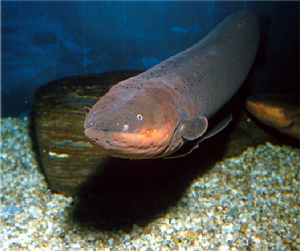
What is the “Gymnotus”?  The taxonomy of the species seems to have been changed over the years, but at this time seems to be referring to what used to be known as Gymnotus electricus, or the electric eel (image source):
Continue reading

Posted in History of science, Physics | 24 Comments

5 days until The Leviathan’s Shoulders!

Here’s one last reminder:  There’s 5 days left to submit entries for the 23rd installment of The Giant’s Shoulders, a special edition dubbed “The Leviathan’s Shoulders”!  It will be hosted by Kevin Zelnio over at Deep Sea News, and will be a special “oceans edition” of the carnival.  All ordinary entries will still be accepted, but bloggers are encouraged to submit posts on the history of science that deal specifically with oceans and ocean life!   Entries can be submitted through blogcarnival.com or directly to the host blog, as usual.

Let’s make this an extra-special carnival!

Posted in General science, Science news | Leave a comment

A trip to Savannah, Georgia

Last weekend, the wife and I celebrated our first-year wedding anniversary by taking a 3-day trip to Savannah, Georgia.  Savannah is one of those rare American cities that has maintained a significant portion of its historic neighborhood, and this neighborhood is highlighted by a large number of green open squares that were first planned when the city was founded in 1733.

Savannah is a rather hard city to photograph for a novice like myself: buildings are quite close together and there are a large number of very old trees, making it difficult to get nice scenic shots.  These same properties make it a very lovely area to walk and explore, however, and I thought I’d share some of the pictures I did manage to take, including shots of the wonderfully atmospheric Bonaventure Cemetery.

Continue reading

Posted in Cemetery, Travel | 3 Comments

ResearchBlogging editor’s selections: bilingual animals, horse-hunting hyenas, the nature of dark matter and toiletology

  • Bilingualism as a preadaptation for language. Can animals other than humans be “bilingual”?  This fascinating question is addressed in research described by Sean at The Adventures of Auck.
  • The horse-hunting hyenas of Srbsko Chlum-Komin Cave. We can learn a lot by studying what an animal eats — and what parts it eats!  Brian at Laelaps explains how the bone piles of ancient hyena dens tells us more than just what animals were hunted.
  • Dark matter confronts observations. In a detailed post, The Astronomist at his eponymous blog discusses theory and observation relating to the specific nature of dark matter.
  • Toiletology. What can the signs describing a toilet tell us about the inclusiveness of a society?  Ingrid at Language on the Move explains.

See y’all next Monday for more “miscellaneous” highlights!

Posted in General science, Science news | Leave a comment

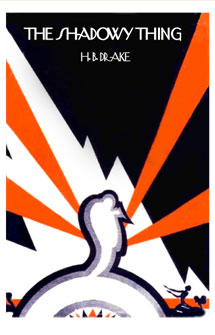
The Shadowy Thing, by H.B. Drake

I’ve been having a lot of good luck with my fiction reading lately, and have a backlog of really good (and weird) fiction to blog about.  One that actually gave me a pleasant surprise is The Shadowy Thing (1928), by Henry Burgess Drake (1893-1964):

The Shadowy Thing is another in Hippocampus Press’ “Lovecraft’s Library” series, reprinting rare works of weird fiction that Lovecraft owned and thought highly of.   Though I’ve generally been very satisfied with books Lovecraft loved (The Metal Monster, The Place Called Dagon), it hasn’t always been the case (The Dark Chamber); I admit that I wasn’t particularly optimistic about Drake’s book.

My apprehensions were misplaced!  Once I started reading, I could hardly put down The Shadowy Thing: it is a compelling story with unrelenting tension that builds to a truly ghastly climax.

Continue reading

Posted in Horror, Lovecraft | Leave a comment

Singular Optics: Light chasing its own tail

(Title stolen shamelessly from my postdoctoral advisor, who I assume will forgive me.)

As I’ve noted numerous times in previous posts, one of the fundamental properties that characterizes wave behavior (i.e. that makes a wave a wave) is wave interference.  When two or more waves combine, they produce local regions of higher brightness (constructive interference) and lower brightness (destructive interference), the latter involving a partial or complete “cancellation” of the wave amplitude.

Researchers have long noted that the regions of complete destructive interference of wavefields, where the brightness goes exactly to zero, have a somewhat regular geometric structure, and that the wavefield itself has unusual behavior in the neighborhood of these zeros.   In the 1970s this structure and behavior was rigorously described mathematically, and further research on this and related phenomena has become its own subfield of optics known as singular optics.  Singular optics has introduced a minor “paradigm shift” of sorts to theoretical optics, in which researchers have learned that the most interesting parts of a light wave are often those places where there is the least amount of light!

In this post we’ll discuss the basic ideas of singular optics; to begin, however, we must point out that most people have the wrong idea of what a “typical” interference pattern looks like!

Continue reading

Posted in Optics | 29 Comments

12 days until The Leviathan’s Shoulders #23!

There’s 12 days left to submit entries for the 23rd installment of The Giant’s Shoulders, a special edition dubbed “The Leviathan’s Shoulders”!  It will be hosted by Kevin Zelnio over at Deep Sea News, and will be a special “oceans edition” of the carnival.  All ordinary entries will still be accepted, but bloggers are encouraged to submit posts on the history of science that deal specifically with oceans and ocean life!   Entries can be submitted through blogcarnival.com or directly to the host blog, as usual.

Posted in General science, Science news | Leave a comment