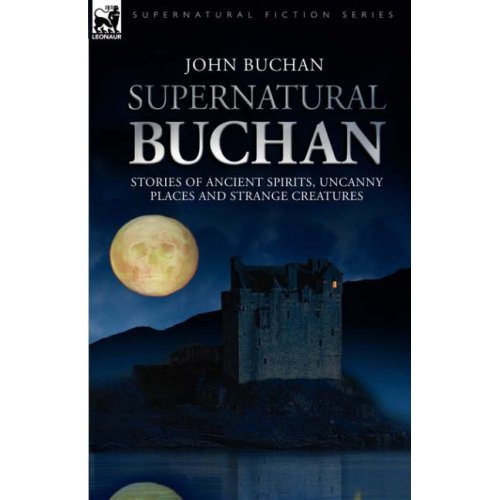
“Supernatural Buchan”, by John Buchan

One of the truly fascinating things about writers of weird fiction is how many of them are remarkably accomplished in other aspects of their lives.  We have folks such as A. Merritt, who had a very successful career as a journalist and newspaper editor, R.W. Wood, who was a very distinguished scientist, Lord Dunsany, who was, well, a Lord, and M.R. James, who was a very distinguished medieval scholar.  And, of course, there’s my pièce de résistance, Winston Churchill.

I can now add to my personal list John Buchan, 1st Baron Tweedsmuir (1875-1940).  Buchan was a politician and novelist, and his resumé includes an impressive collection of honorary academic degrees and military honors.  He was also the 15th Governor General of Canada, representing the monarchy in local Canadian affairs.

In writing, he was incredibly prolific, producing countless novels and works of non-fiction, many based on his time spent working for the colonial administrator of South Africa.  Of his fiction, the work  most likely to be known by most people is his novel The 39 Steps (1915), which was very, very loosely adapted into a great film of the same name by Alfred Hitchcock in 1935*.

Buchan also dabbled in horror stories, and many if not most of these have been collected in Supernatural Buchan, a collection by Leonaur Ltd, who have produced quite a few impressive limited editions of weird fiction:

Continue reading

Posted in Horror, Weird fiction | 3 Comments

Tensor? Tensor? I’ve been getting tenser all week!

Whew! For those not following my Twitter account, let me declare that I finished the last major section of my textbook today!  Now I’m going to do a bit of touching up of various sections that I worked on recently, and I should get rid of the whole damn thing first thing next week.

Today was a real brain-buster for me — I finally sat down to face the section on tensor analysis.  For those not familiar, tensor analysis is a very abstract and hard-to-digest field of mathematics, and the hardest one in my book.  To give you an idea of how painful it is, Einstein formulated his general theory of relativity using tensor mathematics.

I’ve been reading about tensors for months now, trying to get a good enough understanding to write a clear, concise section for the book.   The experience really drove home for me the difference between understanding something and understanding it well enough to teach it!  I was determined to get through it today, no matter what, and fortunately it finally clicked.  (Though I’m pretty sure I’ll need to revise the text significantly later this week.)

The amusing thing is that the section on tensors is one of the less important ones in the book but one that may be absolutely essential in the future.  The relatively recent introduction of “cloaking devices” has spawned a new field of optics referred to as transformation optics, in which the ideas of general relativity and the tools of tensor analysis are used to design materials that manipulate light in novel and even “unnatural” ways.  Though the field isn’t a standard topic in optics education, I didn’t want to leave out such a possible glaring omission.

Fortunately, I’m done!  Just a few revisions, and the addition of a few additional exercises, and I can get rid of it!  At least until the editor’s comments start rolling in…

Posted in Personal | 3 Comments

ResearchBlogging editor’s selections: giving climate scientists their due, “revolting” statistics, and a crystal controversy

  • Dammit, Jim, I’m a neurobiologist, not a climatologist! It isn’t his field (as he freely admits), but Björn Brembs at bjoern.brembs.blog does an excellent job clearly explaining why we should give climate scientists some credit, even if we don’t understand the research.
  • Viva la Neo-Fisherian Liberation Front! In a “revolutionary” post, jebyrnes at I’m a chordata, urochordata! explains a standard used by scientists in statistical analysis… and why it should be overthrown!
  • How dangerous are these crystals, then? Lars Fischer at EuCheMS 2010 Blog looks at a possible example of media misrepresentation of science, in which the result could be harmful consequences in the handling of radioactive waste.
  • Check back next week for more “miscellaneous” highlights!

    Posted in General science, Science news | Leave a comment

    The Giant’s Shoulders #20

    Welcome to the February 1(7)th, 2010 edition of The Giant’s Shoulders!  I seem to have had some shorted connections with the scheduled host, so I’ve ended up taking on the hosting myself this month.

    BOOK REVIEW: Emma Townshend’s Darwin’s Dogs. First up, for the pet lovers out there, Michael Barton of The Dispersal of Darwin presents a review of one of the more unconventional books about Charles Darwin to come out last year, focusing on how dogs — his pets, and otherwise — influenced his thinking.

    Primer: William Thomson. Next, Will at Ether Wave Propaganda gives a nice overview of the life and achievements of the physicist William Thomson, one of the more intriguing scientists of the 19th century.

    Like a Greek God. Over at JOST A MON, Fëanor gives the first of a three-part post on the connections in Ancient Greece between religion and astronomy, based on Allan Chapman’s TV programme on Channel 4.  Parts 2 and 3 are  here and here.

    Missing “Dots” and Not Seeing the Discovery of Platelets, 1842.  Over at Ptak Science Books, we learn of Alfred Donne, the discoverer of platelets, and the reasons why he isn’t generally remembered for the discovery!

    Ancient and modern: First science academy is 350 years old.  Over at PhysOrg.com, we have a nice article on the Royal Society of London, celebrating its 350th anniversary this year*.

    Mythbusters were scooped — by 130 years! (Archimedes death ray) My own humble contribution over at Skulls in the Stars looks at an early article on the mythical “burning mirrors” of Archimedes, which have a long and contentious history of being tested experimentally.

    S. W. Mitchell and Phantom Limbs.  Over at the blog of the Philadelphia Center for History of Science, we hear of the first description of “phantom limb” symptoms, as described by a surgeon who studied the long-term effects of amputations on Civil War veterans.

    NASA and the Ghosts of Explorers Past. Michael Robinson and Dan Lester of Time to Eat the Dogs discuss the future of NASA by looking back at historical explorers whom we can learn lessons from.

    James Voelkel on Bringing Newton’s Alchemy to the Masses.  In another nice article from the Philadelphia Center for History of Science, we get a summary of an interesting project that intends to put all of Newton’s alchemy papers (and there are a LOT) online, and some of the difficulties that have arisen.

    A man with a strange name. One thing I always find fascinating are the occasional and often little known intersections between famous scientists.  Over at The Renaissance Mathematicus, ThonyC describes the ephemeral communication between two giants: Kepler and Galileo.

    Tweeting a history of science.  From Educate Daily, we get a different sort of challenge related to the history of science: tweet a historical paper in about 130 characters!

    Erik Rau on Terry Christensen on Cold-War Liberals.  One more from the Philadelphia Center for History of Science: John Wheeler and Edward Teller were both “cold war liberals”, seeking peace through proliferation.  But the former was loved, the latter reviled: how to account for the difference?  This post summarizes a talk by Erik Rau on the subject.

    Bright Idea: The First Lasers — A history of discoveries leading to the 1960 invention.  Not a blog post, but here is a very nice history of science resource: a history of the discoveries leading up to the first laser, appropriate for the 50-year anniversary!  Posted at the American Institute of Physics.

    A Valentine from Leeuwenhoek.  Finally, with Valentine’s Day just behind us, what could be more romantic than a Valentine from Antoni van Leeuwenhoek?  Via Antoni van Leeuwenhoek Centraal.

    This concludes this edition of The Giant’s Shoulders!  Look for the next edition on March 16th at the blog of the Philadelphia Center for History of Science.

    (I should add a special thanks to ThonyC of The Renaissance Mathematicus for recommending a large number of articles for this edition of the carnival!)

    *****************************************************************

    *ThonyC notes of the title of this article, “It wasn’t the first but otherwise the article is OK.”


    Posted in General science, History of science | 5 Comments

    A little delay…

    We seem to be having a little delay in the posting of The Giant’s Shoulders #20.  I’m trying to figure out what’s up, and hopefully it’ll be published within the next day.

    In the meantime, this seems to be a good time to beg for more hosts — we really need to fill up a few more months in the schedule!  Remember that you don’t have to be a historian of science to host — just someone with an interest in science and its history.

    Posted in Science news | 4 Comments

    What is science? Answers to a high school student

    In my official capacity as a professor, I recently was contacted by a local high school student who asked some questions for a research paper on science.  I asked for permission to repost the questions and the answers I gave here:

    1. In your own words what is science? I view science as a process by which we test our ideas about the natural world, and revise those ideas accordingly based on the results.  The tests, or experiments, are key – ancient philosophers spent lots of time speculating about the nature of the natural world, but they never got very far because they didn’t really test their ideas.
    2. Do you believe that science can be proven? Well, yes and no!  As scientists, we come up with specific hypotheses to explain what we observe, or think we will observe, in nature, and those specific hypotheses can be tested and shown to be correct.  However, no scientific idea is ever considered “set in stone”: scientists are always refining their theories and coming up with more precise experiments to explain the natural world.  It could be said that we are always striving to come closer and closer to “the truth”.
    3. In all the years as a scientist, what has caught your eye the most? One thing that really surprised me about science is the very social nature of the process. People often have the stereotypical impression that scientists are antisocial and spend all day hiding away in the laboratory.  Well, lots of us do spend all day in the lab (or in the office, if you’re a theorist like me), but when we get together at meetings to discuss our research we’re very social and have lots of good interactions.  Scientific meetings for me are like vacations with good friends – friends whom occasionally I get into heated scientific arguments with!
    4. How does science apply to us? Pretty much every piece of technology that we use today, computers, iPhones, vaccines, owes its existence in large part to scientific research.  Also, learning to think critically and scientifically about problems is an important skill in understanding complicated problems that the world currently faces, such as the world’s energy consumption and global climate change.
    5. Are there any scientists that inspire you? My former Ph.D. thesis advisor, Professor Emil Wolf of the University of Rochester, is my biggest inspiration.  He is now in his 80s and still doing excellent research and advising graduate students!  Not only has he transformed the field of optical science during his long career, he has been an amazing advisor, being a friend as well as a teacher.  (And he also has a wonderful sense of humor.)  I will be happy if I manage to be half as amazing a scientist and teacher as Professor Wolf.  Historically, Michael Faraday (1791-1867) is another inspiration.  He was one of the greatest experimental scientists of all time, and made fundamental discoveries in physics and chemistry – and even dabbled in a little biology!  I’ve read many of his original papers and they’re absolutely brilliant.
    6. What has been your greatest discovery? My career is still young, so it’s hard to say!  One of the achievements I’m most proud of is the development of a new type of inverse scattering, called “intensity diffraction tomography”.  It is a technique that is a generalization, of sorts, of the CAT scans that are used in hospitals around the world to produce images of the interior of the human body.  I don’t know if my technique will prove to be as successful or useful, but it is a piece of work that I’m very pleased with.
    7. How does science affect your life? My scientific training has taught me to think skeptically about the world around me, and to pursue vigorously answers to questions that come up in any aspect of my life.  Also, it sounds a little corny, but understanding a little bit about how the natural world works has increased my appreciation of its beauty.

    So, how did I do?  I wrote this relatively quickly during the week as I had plenty of other deadlines to meet.  Feel free to critique my answers, or provide your own takes, in the comments.

    Posted in General science | 7 Comments

    Some thoughts on the recent tenure-related shooting

    In the wake of the tragedy in Alabama, there has as expected been a lot of discussion on the internet about the nature of the shooting and its implications.  In some sense, my impression is that the case has become a Rorschach test for lots of people, and they’ve seen reflected in it their own concerns or political crusades.  In that spirit, I thought I’d share a few thoughts on the incident and my impressions of some of the other commentary out there.

    To summarize, last Friday afternoon at the University of Alabama in Huntsville three professors were killed and three others seriously wounded when a shooter opened fire at a biology faculty meeting.  Biology professor Amy Bishop was taken into custody and charged with murder.

    The “twist” to the story is that Bishop had been denied tenure in April, and had appealed the decision.  The appeal was turned down on Friday, and this decision is what evidently precipitated the shooting.

    Continue reading

    Posted in Politics, Science news | 9 Comments

    ResearchBlogging editor’s selections: slime mold traffic planners, synthetic marijuana, and evolution vs. morality

    Check back next week for more “miscellaneous” highlights!

    Posted in General science, Science news | Leave a comment

    Captain America has a tradition of social commentary

    If you haven’t seen it yet, the most recent issue of the Marvel Comics series  Captain America has drawn the ire of teabaggers because of its negative portrayal of them.  Via Yahoo news,

    Since 1941, Captain America has been one of the most popular comic book characters around. The fictional super-patriot fought Nazis during World War II, took on those who burned the American flag during the Vietnam era, and raked in hundreds of millions of dollars for Marvel Comics along the way.  Now, the appearance that he is taking on the Tea Party Movement in a storyline about investigating white supremacists has forced Marvel to apologize for the comic hero.

    The Yahoo article also includes the relevant pages from issue 602 of Captain America:

    I am of somewhat mixed feelings about the whole “controversy”, if indeed it is one.  On one hand, I probably wouldn’t be thrilled if a right-winger wrote a comic caricaturing liberals as fanatical communists (though I wouldn’t be whining about it), on the other hand in my opinion the strip doesn’t depict anything that isn’t spot on.  I’m sorry to see that Marvel felt like they had to apologize for an artistic decision by a writer, though I can somewhat understand that they are an entertainment business that doesn’t want to alienate any customers.

    One thing I’d like to point out, though, is that the Captain America comic has a long history of addressing  social issues.  This isn’t the first time that its writers have used the book and the character as a mirror to show its readers some of the unpleasant traits of America.

    Continue reading

    Posted in ... the Hell?, Entertainment, Politics | 3 Comments

    Vrije Universiteit goes for Open Access publishing!

    This is interesting news!  Via BoraZ on Twitter, I find that the Vrije Universiteit, Amsterdam, has pledged to have 90% of its published articles available on Open Access:

    Within ten years, VU University Amsterdam wants to make 90% of its published articles available on Open Access. This ambition represents the university’s clear commitment to Open Access, along with that of all the faculties which will support the initiative in the years to come. As Rector Lex Bouter explains “Research which has been partly financed with public money should also be available to the public.”

    In adopting this policy, VU University Amsterdam has become part of an Open Access policy which enjoys wide support, particularly within Europe, and is backed by such key players as the Netherlands Organization for Scientific Research (NWO).

    This is a nice trend, as it means that the articles will be openly available to the public (and not behind a pay wall), and researchers will retain copyright on their own research.  On a personal note, the VU was where I did my postdoctoral research!

    Posted in Science news | Leave a comment