Ecoli is also offering a $20 gift certificate for the most popular entry, so don’t forget to vote to reward your favorite history of science blogger!
This edition also marks the first full year of The Giant’s Shoulders! Next month I’ll be bringing the carnival right here, for the edition to be held July 16th.
Those who have been reading this blog for a while know that I’ve become a really big fan of Bertram Mitford (1855-1914). His novels, written in the late 1800s, are on the surface adventure novels which draw on his experiences living and working in South Africa. Valancourt Books has been valiantly reprinting many of Mitford’s novels, and I’ve discussed three of them here: The Weird of Deadly Hollow, Renshaw Fanning’s Quest, and The Sign of the Spider. All are excellent novels which possess much more depth of character and meaning than one would expect. The Sign of the Spider, with its anti-hero protagonist and descent into darkness, both literal and metaphorical, is now one of my favorite novels.
Already some time ago, I picked up the first book in Mitford’s tetralogy of Zulu novels, The King’s Assegai, also published by Valancourt:
Curiously, I waited a long time before actually reading it, unlike Mitford’s other books. I suspect I had a little dread about reading a Westerner’s fictional interpretation of “African savages”, or perhaps I simply didn’t think I could get into a novel about African warriors. (I had a discussion to this effect on an earlier Mitford thread.) In any case, I shouldn’t have been worried — though I didn’t enjoy it as much as I did Mitford’s other work, The King’s Assegai is an excellent adventure story which gives a very human (and not stereotypical) view of tribal Africa.
Via Rachel Maddow and Keith Olbermann, I was reminded that today, June 9, is the anniversary of the day that red-baiting Senator Joseph McCarthy was given his comeuppance on national television by soft-spoken lawyer Joseph Welch.
In 1954, a series of meetings were convened by the United States Senate’s Subcommittee on Investigations to investigate counter-allegations between McCarthy and the U.S. Army. On June 9th, McCarthy had been pressured by Army lawyer Welch to provide evidence of Communists in the defense industry, and he responded by singling out a young lawyer in Welch’s firm as an alleged sympathizer. Obviously, McCarthy hoped to put Welch on the defensive, but Welch responded with a mellow but devastating criticism of McCarthy’s reckless cruelty. This confrontation is generally considered the beginning of the end for McCarthy, the moment when the nation got to see how ugly his politics really were.
The speech of Welch is amazing, and moving; I never get tired of hearing it. It is a timeless testament to the real human cost that the politics of fear can exact.
I’m currently in Oklahoma visiting a collaborator, so my time is rather short. While I’m away, I’ve been reading through Lovecraft’s Supernatural Horror in Literature, and came across descriptions of some of the short plays of Lord Dunsany (1878-1957). They’re really quite good; I can heartily recommend (as did Lovecraft) the plays A Night at an Inn and The Gods of the Mountain.
Both plays tell a story of unscrupulous characters whose actions bring down retribution from the gods, and not those wishy-washy “turn the other cheek” type gods — we’re talking the old-style, pissed-off and foul-tempered gods.
Now I’ve got an urge to go home and watch my DVD of Daimajin movies again. If you don’t know what I’m talking about, here’s a sample.
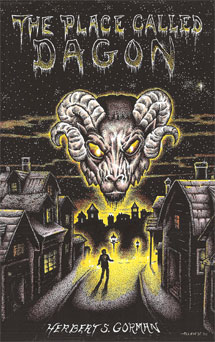
As I’ve noted previously, H.P. Lovecraft had a voluminous library of weird fiction, and basically defined himself as the foremost expert on such tales in his time with his essay Supernatural Horror in Literature. Hippocampus Press, in collaboration with Lovecraft scholar S.T. Joshi, have been reprinting select novels that Lovecraft owned and thought highly of. Up until now, I’ve read A. Merritt’s The Metal Monster, which is now one of my favorite weird tales of all time, and M.P Shiel’s The House of Sounds and Others, which has its own moments of weird awesomeness. With those pleasant experiences in mind, I turned to Herbert S. Gorman’s The Place Called Dagon (1927):
The name “Dagon” will jump out at any fan of Lovecraft immediately. In fact, The Place Called Dagon clearly influenced a number of Lovecraft’s stories, as I mention below.
What did I think of it? Though I found the first third of the novel rather slow, it picked up quickly after that and I found it immensely enjoyable!
It is one of the quirks of scientific progress that many great experiments are forgotten as the things they demonstrate become common knowledge in the scientific community. A good example of this is the 1890 experiment of Otto Wiener, which I blogged about as my very first “official” science history post. Wiener constructed a beautiful experiment to demonstrate that it is the electric field, not the magnetic field, which is the “active” ingredient in light. Nowadays, this observation is just taken for granted, and relatively few books discuss the experiment which proved it. This is not an injustice, though, as much as an expedience: certain physical phenomena can be understood perfectly well without going into the historical origins of the discovery, and physics students have plenty of much more relevant topics to worry about. Nevertheless, there’s a lot of interesting work that isn’t talked about much anymore.
As research for my in-progress textbook, I’ve recently been looking into the original X-ray diffraction experiments of the Braggs circa 1912. While reading through their 1915 book on X-rays and Crystal Structure, I found a passing reference to the first observations of polarization of X-rays. Not being able to help myself, I tracked down the original source…
Just a friendly reminder/request, as always: there’s 10 days left until the 12th edition of The Giant’s Shoulders! I seem to be unable to reach the originally scheduled host of the carnival for this month, so ecoli over at Thoughts from gut bacteria has graciously agreed to fill in on short notice. Ecoli is sweetening the pot with a $15 Amazon gift card for the best submission, judging TBD! Let’s get some good entries going!
I posted this notice over at The Giant’s Shoulders today:
Hi folks,
Over the past couple of months, the number of submissions to The Giant’s Shoulders has been a little light. Entries have been great, but it would be nice if we ended up with a few more of them, at least if we want to keep TGS as a monthly carnival.
Up until now, I’ve had the (unofficial and unannounced) policy that authors should submit their own posts to the carnival, but there seems to be no reason why you could nominate other posts that are out there on the history of science. I know that there’s a lot out there, but relatively few seem to get into the carnival these days! Keep in mind that there’s no requirement that posts be massive, erudite essays (though we like those, as well); any post which highlights interesting and significant events/people/discoveries in the history of science is welcome.
So far, every month we’ve ended up with a healthy number of acceptable posts, but it always seems to be a nail-biter for me, worrying if there’s going to be a ‘carnival’ with one entry! I humbly ask everyone to keep an eye out for good science history posts on the internet, and consider submitting them for the carnival…
At times I’m simply dumbfounded by the idiotic stories the big news organizations can come up with. In a short article titled, “Obama keeping up with Bush’s reading pace?”, CNN’s Political Ticker reported, on June 2,
It appears President Obama has to step up his reading pace if he wants to beat his predecessor in one particular measure: how many books a president can polish off a year.
…
If Obama is close to finishing the novel, that puts him on less than a 10 book-a-year pace, far less than the close to 100 books President Bush was reportedly able to finish in the same amount of time.
According toformer top Bush aide Karl Rove, he and the former president engaged in a friendly wager every year to see who could read more books.
…
While Obama may have had to put aside “Netherland” last month in favor of pages of court briefs with a Supreme Court vacancy to fill, it nevertheless appears the president has some summer reading to do.
Let’s put aside the fact that maybe it isn’t a virtue for the “leader of the free world” to have lots of spare time to read two books a week, and also take Karl Rove at his word (ha ha) that Bush actually read that amount of books.
Reading isn’t a horse race — it’s not just about how fast you read a book, it’s about how well you understand and retain the information you’ve read. I was immediately reminded of an anecdote from Al Franken’s Lies (and the Lying Liars Who Tell Them):
In an early Republican presidential debate, Bush was asked what book he was reading. A biography of Dean Acheson (Truman’s secretary of State), he answered. Twelve days later, in the next debate, moderator Judy Woodruff asked him what he had learned from the biography. Bush couldn’t think of anything directly related to the life or work of Dean Acheson and went directly into his stump speech about how we have to be strong to keep the peace. When John McCain fielded his next question, he answered it quickly and used the rest of his time to talk in great detail about Acheson’s role in the creation of NATO and the Marshall Plan.
Or, to put it more succinctly, as others have before,
There’s a new science blog out there: The X-Change Files, which is the official blog for the Science & Entertainment Exchange. What, you may ask, is the Science & Entertainment Exchange? From their website,
The Science & Entertainment Exchange is a program of the National Academy of Sciences that provides entertainment industry professionals with access to top scientists and engineers to help bring the reality of cutting-edge science to creative and engaging storylines.
If I understand this correctly,their purpose is to: (a) help scientists present an accurate picture of what science is all about through the entertainment industry, and (b) help filmmakers develop science-themed stories that are entertaining and for the most part accurate. (And maybe a little less like this all the time.)
The blog will cover news related to science and the entertainment industry, and will feature contributions from many distinguished folks, including Jennifer Ouellette of Cocktail Party Physics and Twisted Physics and Janet and Jerry Zucker of Zucker Productions!
This will be one to keep an eye on, I would say!
(Thanks to Jennifer for letting me know about it!)
The author of Skulls in the Stars is a professor of physics, specializing in optical science, at UNC Charlotte. The blog covers topics in physics and optics, the history of science, classic pulp fantasy and horror fiction, and the surprising intersections between these areas.




 Skulls in the Stars