A radioactive test of special relativity (1960)

Einstein’s special theory of relativity still is met with disbelief by a lot of non-physicists, and it is probably one of the most active areas of physics science denial out there. Write about relativity, and it is quite likely that you’ll get an angry commenter arguing that the entire theory is nonsense.

To be fair, it is extremely shocking and non-intuitive at first glance, as it forces us to reevaluate our notions of space, time, and simultaneity. In short: in response to a baffling inability to measure variations of the speed of light in vacuum with respect to relative motion, Einstein suggested that our laws of relative motion needed to be changed and he introduced two new postulates. The first postulate is that all the laws of physics are the same for every observer in acceleration-free motion. This was a big change from the Newtonian relativity picture, which said that the laws of kinematics (forces and motion) are the same for every observer, but not the laws of electromagnetism. The second postulate is that the speed of light is constant for every acceleration-free observer, regardless of the motion of the source or the observer.

This second postulate is the one that directly leads to some of the most bizarre consequences for physics. In order for observers to agree on the speed of light regardless of their relative motion, they must disagree on the length of moving objects (length contraction) and on the clock rate of moving objects (time dilation). Furthermore, the speed of light, c = 300,000,000 meters per second, ends up being an absolute speed limit that nothing can beat. Objects with mass always move slower than the speed of light, and light itself moves at c (though that is a bit of an oversimplified statement). Perhaps the strangest consequence of special relativity is the relativity of simultaneity: observers in relative motion will disagree about whether spatially separated events happen at the same time or not. Time and space cannot be considered separate independent quantities, and instead we must think about a unified spacetime.

These effects typically become significant only at speeds comparable to the speed of light, so in our day to day activities we don’t experience them. This is why relativistic effects are so perplexing at a first look: they conflict directly with our intuition.

Nevertheless, physicists are quite confident in special relativity, because it has been tested experimentally in many, many different ways since Einstein first introduced it in 1905. Some of these are so common that they hardly classify as “experiments” anymore! For example, high energy particle colliders like the Large Hadron Collider at CERN know how fast their particles are moving, and they’re always moving slower than c and in accordance with special relativity. Unstable muon particles that are created in the upper atmosphere can be detected at ground level because of time dilation: their average rate of decay is slower because of their high speed.

I’ve been looking into some of the actual laboratory experiments to test special relativity recently, and thought I would share a very elegant one that tests time dilation. Titled, “Measurement of the Red Shift in an Accelerated System Using the Mössbauer Effect in Fe57“, it is work done in 1960 by researchers at the Atomic Energy Research Establishment in Harwell, England1. It is a relatively simple and straightforward test, so let’s take a look!

Continue reading
Posted in History of science, Physics, Relativity | 3 Comments

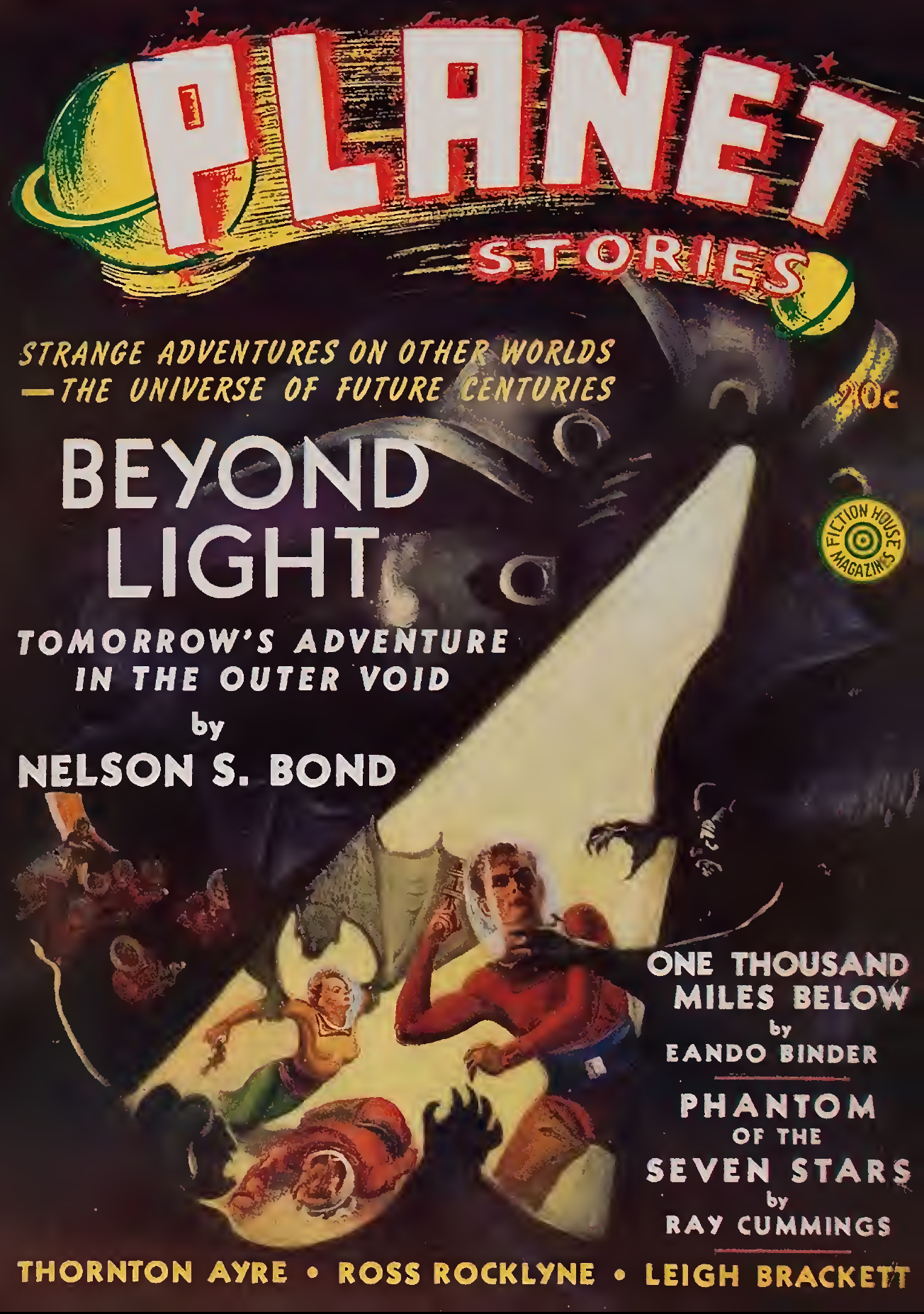
Phantom of the Seven Stars, by Ray Cummings

I’ve been trying to post something every day to the blog for as long as I can, and it has been quite an exhilarating ride! I’m nearing the end of that run, and what better way to celebrate it, and the release of my book on invisibility, than to talk about another invisibility story that I just found!

In a random bit of inspiration, I realized today that I hadn’t looked at the classic magazine Planet Stories for invisibility fiction, and in looking I was instantly rewarded! “Phantom of the Seven Stars,” by Ray Cummings, appeared in the 1940 winter issue of the magazine.

The story “Beyond Light” was what caught my eye as a possible invisibility story, but Cummings’ tale fits the bill perfectly!

Continue reading
Posted in Invisibility, Science fiction | Leave a comment

Dark Horse, by Mary H. Herbert

There is a quite long history of novels published by TSR based on Dungeons & Dragons, and the quality is definitely a mixed bag! Some of the earliest were the classic Dragonlance novels by Weis and Hickman, the first of which came out in 1984. Those are quite highly regarded, but other early novels, such as the 1987 Darkwalker on Moonshae, have been remembered less fondly. The irregularity, especially for the early novels, likely stems from the fact that the books were written by the same people who wrote D&D adventures, who often had no prior experience writing novels.

With all this in mind, I was quite surprised a while back when I came across the TSR-published 1990 novel Dark Horse, by Mary H. Herbert!

This novel is not, as far as I can tell, based on any existing Dungeons & Dragons setting, and is original to the author. Even though it is her first novel, it is also quite well-regarded, and has generally excellent reviews. So of course I had to take a look at it, and let’s see what it’s all about!

Continue reading
Posted in Fantasy fiction, role-playing games | 1 Comment

1975: Neutrons go right round, baby, right round

Another reblog from the archives! One of my favorite posts, talking about the weird properties of quantum spin.

skullsinthestars's avatarSkulls in the Stars

Some time ago, I wrote about a fascinating 1975 experiment in which the relationship between quantum mechanics and gravity was tested.  The experiment was made possible by the new — at the time — technique of neutron interferometry, in which the wave properties of matter are exploited to test quantum effects.  The experiment confirmed a very odd theoretical prediction: that the particle-like aspects and the wave-like aspects of matter are effected differently by a gravitational field.  What, exactly, this implies about the nature of the universe is still, as far as I know, unclear!

Not long after this work was done, further investigations using essentially the same neutron interferometer tested, and confirmed, what I consider to be one of the strangest aspects  of quantum mechanics, and another powerful illustration of how the universe obeys really different rules on the atomic scale.

View original post 2,099 more words

Posted in Uncategorized | Leave a comment

What the heck is the “speed of light?” Part 2

In Part 1 of What the heck is the “speed of light?”, we noted how light in matter can move much slower than the vacuum speed of light c, or even appear to move much faster than c, under the right circumstances. We even noted that, thanks to the phenomenon of dispersion, there are cases where a single number cannot adequately describe the speed of light of a pulse in matter, because the pulse may break up into multiple pieces, each traveling at its own speed.

All of this may be summarized by saying that a pulse of light is “squishy,” and not a rigid object like a car or a softball. To measure the speed of an object, we look at how long it takes some part of the object to travel the distance from point A to point B. For a car, we can use the front bumper; for a softball, we can use its center of mass. But a pulse of light, which can change shape or break into multiple parts, there isn’t in general a clear mark we can use to define its absolute speed.

This problem of “squishiness” even arises when we look at light propagating in vacuum, and it leads to more unexpected surprises. This is what we look at in this post: the speed of light can be tricky to define sometimes, even in vacuum!

Continue reading
Posted in Optics, Physics | Leave a comment

What the heck is the “speed of light?” Part 1

Most of us have heard a statement similar to the one that follows: “The speed of light is constant.” That particular phrasing of the statement comes from none other than the American Museum of Natural History’s Einstein exhibit, so I think it is fair to say that most people have heard it phrased in this way at one time or another.

Most physicists would add one very important caveat to this statement to reduce confusion: “The speed of light is constant in vacuum.” It is in this sense that it forms part of the foundation of Einstein’s special theory of relativity: any observer measuring the speed of a light wave traveling in vacuum will measure exactly the same result, about 186,000 miles per second or 300,000,000 meters per second, usually labeled c in physics. Different observers moving relative to one another will agree that a given light wave is moving at c, even if one is moving towards the light source and one is moving away from the light source! This is in contradiction to our day-to-day intuition: if I am driving towards a car that is approaching me, it will move towards me faster than if I am driving away from it.

From Einstein’s special theory of relativity, and the observation that “the speed of light is constant in vacuum,” comes all sorts of non-intuitive phenomena, like length contraction and time dilation and the idea that, as far as we know, nothing can move faster than c! Apparently the “speed of light” is the speed limit of the universe.

The statement “the speed of light is constant” is therefore arguably more accurate than not, but leaves out a lot of subtlety in discussions of the speed of light! I recently started thinking about the speed of light from an optical science perspective due to a question from a Twitter friend, and I thought I would muse a bit on all the ways that the speed of light is harder to define than you might think, even without talking about objects in relative motion.

Continue reading
Posted in Optics, Physics | 2 Comments

Michael Faraday, grand unified theorist? (1851)

While I’m working on a new optics blog post, here’s a classic post about Michael Faraday and gravity!

skullsinthestars's avatarSkulls in the Stars

At long last, I get to blog about the paper that first piqued my interest about the research of Michael Faraday!  If you haven’t been following my Faraday posts, let me give a quick recap: Michael Faraday (1791-1867) was one of the greatest experimental physicists of all time, and the discoverer of some of the most important effects related to electricity and magnetism.  I’ve blogged previously about his discovery of electromagnetic induction, his work in proving that all forms of electricity have the same common origin, and his demonstration of the relationship between light and magnetism (Faraday rotation). I haven’t even had time to discuss Faraday’s contributions in formulating the laws of electrolysis, understanding diamagnetism, and inventing the Faraday cage.

The common thread of many of these discoveries is their goal: demonstrating that all the physical forces of nature are but different manifestations of a…

View original post 2,712 more words

Posted in Uncategorized | Leave a comment

Old School Dungeons & Dragons: Part 31

This is the 31st installment of old school Dungeons & Dragons! There’s nothing special about that milestone, other than me realizing that it’s a lot of posts. Anyway, let’s jump right to it…

X6: Quagmire! (1984), by Merle M. Rasmussen. Here we delve into one of the more obscure members of the E(X)pert series of modules!

Continue reading
Posted in Entertainment, Fantasy fiction, role-playing games | Leave a comment

Night of the Big Heat, by John Lymington

I don’t know exactly what first drew my attention to Night of the Big Heat (1959), by John Lymington. I suspect I was browsing through some Wikipedia posts about alien invasion movies, and caught sight of the 1967 film adaptation of the book, which starred none other than Christopher Lee and Peter Cushing, and that drew me to the novel. In any case, I bought a copy well over a year ago and just now finally decided to give it a look!

I really didn’t have high hopes for it when I read it, but this alien invasion story is surprisingly fun, and filled with clever ideas!

Continue reading
Posted in Horror, Science fiction | Leave a comment

The Dark Host, by Archie Roy

Let’s take a look at one of the most obscure books I’ve ever read!

So, I’ve written about the work of Archie Roy before, in particular his novel Devil in the Darkness (1978), a remarkably good haunted house story. In fact, I wrote the introduction for the Valancourt Books edition of the novel, and discussed the remarkable career of Roy, who was not only a novelist but an astronomer and paranormal researcher!

With this in mind, a few months back I decided to track down another Archie Roy novel, and went with the one he wrote just before Devil in the Darkness, titled The Dark Host (1976).

The Dark Host is an unusual thriller, and not a supernatural one, but it definitely has a very macabre twist in it! I enjoyed it greatly, though maybe not for the reasons one would expect!

Continue reading
Posted in Mystery/thriller | 2 Comments