Just a short note: my editor pointed out to me that my book made the “top ten” list of Spring 2023 science books at Publishers Weekly! Saving the relevant part of the page for my own personal record:
This is a nice boost that will hopefully draw more attention to the book, including foreign translations and appearances in bookstores!
Just for the record again: you can pre-order the book at:
Have you ever remembered a book that you read as a child that you were curious to read again but you can’t remember the name of the book or the author or even enough detail to track it down? That was my dilemma for a few years, as I remembered reading a series of fantasy novels in grade school, one of which featured an evil skeletal horse. Initial efforts to track it down were unsuccessful, as depending on the wording you use on an internet search you either find skeletal horses from Minecraft or the Mari Lwyd from South Wales:
About six months ago, however, by some dumb luck I finally found what I was looking for: The Dark Is Rising sequence, five novels written by British author Susan Cooper from 1965 to 1977. The first book, Over Sea, Under Stone, was written much earlier than the others, in 1965; I opted to begin my re-read with the second book, The Dark Is Rising, which was originally published in 1973:
This was the young adult fantasy series to read of my generation; everyone I knew in grade school got around to reading it at some point! But would it hold up for an adult reader?
As I’ve said a number of times, the pandemic really destroyed my ability to read, and now that I’ve achieved some sense of mental stability again I’m working to catch up on a bunch of the books that I just hadn’t had the energy to read.
This includes science books as well as fiction, and recently I decided to dive into Consider the Platypus (2019), a book by one of my Twitter friends Maggie Ryan Sandford!
This book is a fun exploration of evolution and all its modern developments, told through the descriptions of a variety of animals, from relatively mundane creatures such as cows, dogs and cats to truly unusual beasts such as axolotl, hoatzin and the titular platypus.
It’s been a while since I did some Old School Dungeons & Dragons on Twitter, but I’ve finally gotten myself back into the rhythm! (I am now also posting the threads on Mastodon, given the instability of Twitter.) Hopefully I’ll keep up the routine. So let’s get started…
X10: Red Arrow, Black Shield (1985), by Michael S. Dobson. This is one I wanted to get my hands on some time ago!
So, for some reason, my ten year old video on the Barkhausen effect went viral on YouTube the past few weeks, and brought me quite a few new followers there. I thought I’d do a short video to say “thanks for following” to folks and try out a demonstration that I’ve been meaning to get around to for a while related to invisibility.
The video, about the so-called oculus mundi stone, is embedded below.
Oculus mundi (“eye of the world”), also known as hydrophane opal, is a stone that is largely opaque under normal circumstances, but when it is submerged in water, it becomes quite transparent. As noted in the video, the reason for this is that the stone is highly porous in a dry state, and all those pores strongly scatter light that shines upon them, making the stone opaque. The same sort of thing happens with milk, which is a bunch of fat molecules in water: the fat molecules make the light bounce around and generally scatter it away from the liquid. When dumped in water, the pores in oculus mundi become filled with water, and we get a rough “index matching” situation: water has a refractive index closer to opal than air does, so light gets scattered less by the water-filled pores.
I came across reference to oculus mundi while writing my upcoming invisibility book, because Isaac Newton used it as evidence for his hypothesis about the relation between opacity of a material and its microscopic structure. In his own words, from Opticks:
But farther, that this discontinuity of parts is the principal Cause of the opacity of Bodies, will appear by considering, that opake Substances become transparent by filling their Pores with any Substance of equal or almost equal density with their parts. Thus Paper dipped in Water or Oil, the Oculus Mundi Stone steep’d in Water, Linnen Cloth oiled or varnish’d, and many other Substances soaked in such Liquors as will intimately pervade their little Pores, become by that means more transparent than otherwise; so, on the contrary, the most transparent Substances, may, by evacuating their Pores, or separating their parts, be render’d sufficiently opake; as Salts or wet Paper, or the Oculus Mundi Stone by being dried, Horn by being scraped, Glass by being reduced to Powder, or otherwise flawed…
Newton felt that opacity must arise from light getting scattered as it interacts with the gaps between the “least parts” of matter. This is not a general explanation of opacity, but it does work for oculus mundi, milk, and paper. Paper is made up of a bunch of transparent fibers woven together; light gets “trapped” and repelled by these fibers, making the paper look white. If you soak paper in oil, however, for instance if you eat a greasy piece of pizza on a paper place, you’ll find that the paper becomes translucent or even close to transparent.
Hopefully the transition to transparency for the oculus mundi stone is clear in the video; it was much easier to see it in person than it is to see it on the video. Anyway, this is another rather fun little science experiment that one can do at home. Hydrophane opal can be tracked down for sale online for quite cheap.
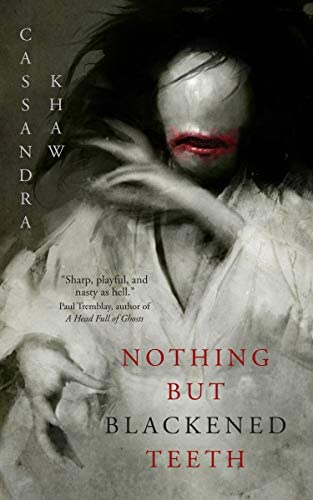
Now that I’m back in the book reading habit, I’m also back in the book impulse-buying habit. A few weeks back, I happened to see Cassandra Khaw’s Nothing but Blackened Teeth (2021), on the shelf, and was intrigued.
It is a very short book, really a novella, of 124 pages. That makes it a quick read, and I finished it over the course of two nights.
The premise will summarize why it caught my attention in the first place: a group of friends arrange to rent out a Heian-era mansion in Japan for the wedding of two of them. Though the day starts pleasant enough, there is history between members of the group, and tensions start to build quickly.
Those tensions are nothing, however, compared to the threat that awaits them all. One of them had heard stories that a jilted bride had been buried in the basement of the house, and that every year a maiden had been sacrificed to keep her company. That bride does not rest, however, and she is looking for more companions…
Nothing but Blackened Teeth is a very fast-paced story. It is narrated from the point of view of Cat, one of the guests and a woman with a history of mental illness. Cat is very aware of horror story tropes, and she is constantly pointing out where her companions are making all the wrong choices. It ends up being very meta, in a Scream-movie sense.
My one criticism is that I kinda wish the novella spent a little more time with the characters before everything goes to hell. Their backstories are well thought out and interconnected, but it feels like the main threat manifests just as we’re really digging into their conflicts. But part of the charm of Nothing but Blackened Teeth is that it moves along at a rapid pace, giving it the feel of a TV horror anthology episode.
The supernatural horror is well done, and there are enough twists and turns in its short run to keep readers guessing. Overall, Nothing but Blackened Teeth is a fun creepy story that will keep you entertained for a few nights. I’m curious to look into more of Cassandra Khaw’s work now…
The destruction of Twitter at such a fast rate that you can pretty much watch it collapse in real time is a bit melancholy for me. Though I’m happy to see Billionaire Baby demonstrate clearly his level of actual competence, I’m sad to be losing a platform that I met so many good friends on and had so many positive memories on.
Of course, not every memory is a positive one, and that’s sort of the point of this next story, which is kind of my greatest moment of glory on the platform. I took on one of the worst internet trolls of the time, confused the hell out of her, and not only walked away without a scratch, but with a laugh.
It’s been a few years so it’s about time that this story be told.
I first encountered the work of Attila Veres in the first volume of The Valancourt Book of World Horror Stories, which came out in late 2020. The series, now on volume 2, collects the best works of foreign horror authors from around the world, and brings their works together for an English speaking audience, often for the first time. The collection is fantastic all the way through, but the story of Hungarian author Attila Veres stood out to me as “one of the most impressively horrific and nasty things I’ve ever read.” Evidently many people agreed, because Valancourt Books has published the first English edition of the short stories of Attila Veres, The Black Maybe.
The full collection does not disappoint. Veres’s stories are disturbingly imaginative, impressively dark, and utterly unique.
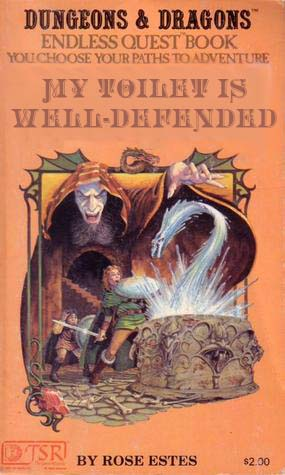
For those who don’t recall, this is a weird little activity I got into with my Twitter pal @bhaal_spawn a few years ago, and we just keep going! We find odd vintage book covers and give them humorous alternate titles, or at least try to. So let’s go…
Original title: Dungeon of Dread.
This next one became one of my all-time favorites.
“So your favorite social media site has been taken over by a bumbling fascist-friendly narcissist.”
Mine, too. With Twitter under new management that leaves me very pessimistic about its future as a viable communications site, I’ve been taking a look at some other options again. Two of these are Mastodon and Counter Social, both of which have a posting and following structure similar to Twitter (and are kinda related, but I’ll get to that).
I actually joined both a few years back, sometime around 2017, when Twitter was already making some dubious and infuriating decisions in how it runs things. I haven’t spent much time on either, until recently, but having the accounts set up made it easy for me to jump back in.
There’s a lot of concern and confusion about the sites, particularly about Mastodon, and its at-first-glance strange home server system. Now that I’ve gotten a bit oriented, I thought I’d write a post trying to explain things as I understand them, from the perspective of a relative newcomer myself. I actually enjoy both, so hopefully I can help others to get a bit comfortable, too! I will update and correct this post if I learn that I’ve gotten anything wrong.
The author of Skulls in the Stars is a professor of physics, specializing in optical science, at UNC Charlotte. The blog covers topics in physics and optics, the history of science, classic pulp fantasy and horror fiction, and the surprising intersections between these areas.





 Skulls in the Stars