This is part 4 in a lengthy series of posts attempting to explain the idea of quantum entanglement to a non-physics audience. Part 1 can be read here, Part 2 can be read here, and Part 3 here.
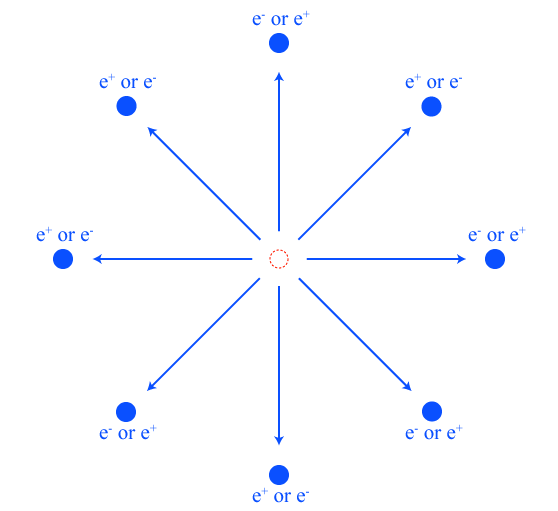
In the last post, we finally introduced the concept of quantum entanglement. An example of an entangled state between two quantum particles is given by the decay of a spin-zero pion into a spin-1/2 positron and a spin-1/2 electron, as illustrated below.

This results in a combined quantum spin state for the electron and positron that may be written as:

We may read this as “the two spin-1/2 particles end up in a quantum state which is an equal superposition of the positron being spin-up and the electron being spin-down with the positron being spin-down and the electron being spin-up.”
This suggests that the electron and positron, when produced in the decay, might be considered to exist simultaneously in a state where the electron (-) is up and the positron (+) is down, and vice-versa — their fates are “entangled.” When we measure the state of one of the particles, say the electron, it is 50% likely to “choose” the spin-up state and 50% likely to choose the spin-down state. When it does, the positron, no matter how far away, must instantly take on the opposite spin state — at least according to the original Copenhagen interpretation of quantum physics. In short, after measurement, the combined state of the electron and positron is either:

But, note the use of the word “instantly.” Because angular momentum is conserved, if the electron is measured spin-down, the positron must be in a spin-up state. This collapse of the wavefunction must happen as soon as the electron is measured, otherwise there would be the possibility of measuring the positron also in a spin-down state, which would violate angular momentum conservation.
This would seem to suggest that the electron must send a “message” to the positron, and this message arrives instantaneously, regardless of the distance between them. However, according to Einstein’s special theory of relativity, nothing is supposed to be able to move faster than the vacuum speed of light.
This raises the question: does entanglement violate special relativity? And, if it does, can we use it to communicate over vast distances at superluminal speeds?
As it turns out, the correct answer is “neither.” Entanglement, when considered carefully in the context of the full quantum theory, turns out to be perfectly consistent with relativity. But, as we will see, it is quite a theoretical adventure to come to that conclusion!
Continue reading →