
I haven’t blogged about any of his books recently, but I have said many times before on this blog that Ramsey Campbell is my favorite horror author of all time. As I noted in a recent post, his novella Needing Ghosts is perhaps the only work of fiction that I’ve ever read that made me doubt my own sanity.
What makes his work so powerful? Campbell is a master of subtle, creeping horror. His monsters do not typically jump out at the reader, but rather lurk in the shadows, skittering in one’s peripheral vision. The cumulative effect is to leave the reader increasingly unsettled, struggling to understand the nature of the threat. On top of this, Campbell is simply a masterful, beautiful writer. It was once aptly said of him that in his writing, it is “the words that count.” (Which he turned into a 1975 story of the same name.)
This past week, I read one of his more recent works the 2013 novella The Last Revelation of Gla’aki.
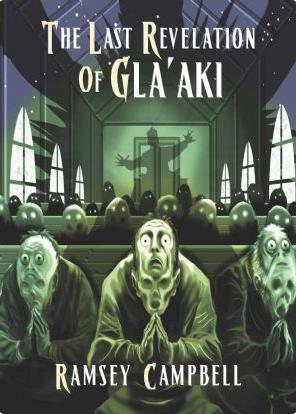
This book is quite different from Campbell’s work of recent years, as it is explicitly Lovecraftian in nature, featuring monstrous, uncaring elder gods and books filled with forbidden knowledge. Like many horror authors, however, Campbell got his start by writing Lovecraft pastiches; his first collection, The Inhabitant of the Lake and Less Welcome Tenants, was published by Arkham House in 1964 and featured a variety of Lovecraft-like stories. In the titular story, Campbell introduced the ancient monstrous god Gla’aki, who dwells in a lake in the bottom of a remote English lake.
The Last Revelation of Gla’aki, then, would appear to be a bit of an homage to the work that got Campbell started in his writing career in the first place!





 Skulls in the Stars