The Giant’s Shoulders #54, a sleigh-load of history, is out!

The 54th edition of the history of science blog carnival, The Giant’s Shoulders, is out at the blog Contagions!  In this carnival, you can read about:

  • the forgotten Victorian romance between science and religion at Christmas time,
  • interesting discussions of how the research of pseudoscience has sometimes been helpful to actual science,
  • skeletal weapon trauma in medieval Ireland,
  • how wind power won the American West,
  • and much more!

Many thanks to Michelle Ziegler for putting together an excellent holiday history of science carnival!

The next edition of The Giant’s Shoulders will be posted on January 16th (assuming the apocalypse hasn’t struck) at The Sloane Letters Blog, hosted by Lisa Smith aka @historybeagle.  Submissions as always can be sent either directly to the host, or to me or to ThonyC at Renaissance Mathematicus.

Posted in General science, Science news | Leave a comment

Duel in the clouds — the world’s first air combat in 1870?

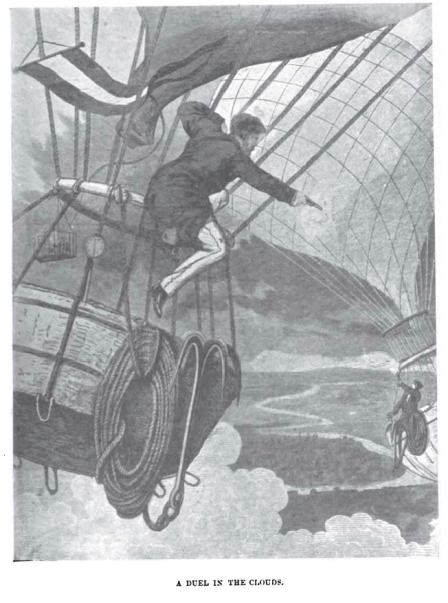
While I was researching my post on Tissandier’s ill-fated 1875 high-altitude balloon ride, I happened to come across a very curious image, pictured below.
duelintheclouds

Apparently the 1870 Franco-Prussian War not only resulted in the first airmail: it also spawned the very first aerial combat!  As described in the 1902 book Travels in Space, by E.S. Valentine and F.L. Tomlinson,

During the war an incident of great dramatic interest is narrated as having occurred in full view of Paris. A French war-balloon, the “lntrepide,” was floating in the air 3,ooo metres above the fort at Charenton. Almost at the same time a second balloon, also flying the French colours, was observed on the horizon. When within a short distance of each other, a loud report was heard high in the heavens, followed by a series of explosions.

“The voices,” writes an eye-witness, “were at first thought by the cheering garrison below to be demonstrations or signals of victory, until one aeronaut was seen to fling himself into the network of his balloon and to cling to its sides. During this time the other continued discharging shots which were traced in the sky by the luminous effects.

“The ‘Intrepide descended rapidly, and it appeared to the spectators below that some incomprehensible event had taken place above. Suddenly the French flag of the second balloon was removed, and a  black and yellow standard was perceived to be floating in its place.

Flag of Prussia from 1803-1892.  Via Wikipedia.

Flag of Prussia from 1803-1892. Via Wikipedia.

The cry went up ‘Treason ‘-it is a Prussian balloon ! The Prussian balloonist has fired on the ‘ Intrepide’! The ‘Intrepide’ was, however, safe, for her aeronaut was seen to descend rapidly in his car and the balloon nearly to reach the earth. He cast out the ballast and re-ascended, having hastily closed the hole made in his balloon by his adversary. Shots were instantly fired from the ‘Intrepide’ into the Prussian balloon, which, losing all power, fell with terrific velocity. A detachment of Uhlans who were in the plain and had been following the course of the exciting aerial combat, rushed forward and surrounded their champion. He was carried off injured, but how great were his injuries none ever knew.”

Was this incident the very first air combat?  It’s hard to imagine any battles happening earlier.  It is hard to imagine that this was a common occurrence in the history of ballooning — considering the complete lack of control in horizontal motion, it would be extremely uncommon for two lighter-than-air craft to get close enough for a fight.

Update: See comment below by Mike Monaco!

Posted in ... the Hell?, History of science | 7 Comments

Light “tying itself in knots,” at Aeon Magazine

Those who are familiar with my blog know that one of my fields of specialty is so-called “singular optics,” the study of the behavior of light in regions where the light intensity is zero and the phase is singular.  I’ve blogged about it a number of times; see, for instance, here and here.

The singularities of light form lines in three-dimensional space, and these lines can actually get tangled up, forming knots and braids in a light beam!  Yesterday, I was sent a link to a nice article in Aeon Magazine introducing the concepts of singular optics and optical knots.

It’s a nice article, and worth taking a look at!

Posted in Optics, Science news | 1 Comment

The balloon ride of death (1875)

It is easy to forget that the early years of scientific pursuit were times when one could potentially risk not just wealth and reputation, but one’s very life.  A little-known but perfect example of this is the horrifying and deadly balloon flight taken in 1875 by Gaston Tissandier, Joseph Croce-Spinelli and Théodore Sivel.  In a scenario reminiscent of a horror movie, of the three men who ascended to the heavens from Paris on that April day, only one would return alive — and he would be forever damaged by the experience.

Continue reading

Posted in History of science | 4 Comments

RIP Milo

I hate to have to do a post like this, but I don’t think I’ll be able to get peace of mind until I do.  Last week, we took in a trio of foster kitties — Trixie, Milo and Bailey — to care for until we can find them a good home.  Trixie and Milo are pictured below: two beautiful Siamese kittens.

IMG_1164

We’ve been keeping them in a separate room to protect them from household dangers as well as to gradually introduce them to our other cats.

Last night, I went up to check on them to find that Milo had caught his head in a hole in a cat “pop-up” tent and had passed away.  It was a freak accident that nobody could have foreseen, though already others in our rescue group are disposing of similar tents.

I rushed Milo to the emergency vet’s office, but it was too late to save him.  I am completely devastated by this — Milo was a loving, sweet kitten who I loved dearly even though I had only known him for a week.

It was inevitable that I would feel guilty about this, though I couldn’t watch the kittens continuously all day long and he almost certainly passed away very quickly.  I’m trying to focus on the good home we gave him for the short time he was with us, as he and his siblings were originally slated to be put down at animal control.  I am also trying to focus on Trixie and Bailey, who are also wonderful cats who are very happy to be with us, and will make sure that they get the forever home they deserve.

RIP Milo: you will be missed.

Update: If anyone feels like making a donation in Milo’s memory, we work with the rescue group S.O.S. Feline Rescue.

Posted in Animals, Personal | 15 Comments

Weird science facts: October — December 2012

While I work on some more detailed physics posts, I thought it would be a good time to recap some recent weird science facts that I’ve posted to Twitter under my longtime hashtag #weirdscifacts!

Oct 24: Aww. Nineteen Species Of Ferns Named After Lady Gaga.  This one speaks for itself!  (Via @kyliesturgess)

Oct 24: Edgar Allen Poe – writer and mollusk expert? Who knew that Poe had a  scientific connection?  (Via @NMNH)

Oct 30: 12-yr-old uses D&D to help  dad w/ research, gets 1st-author paper in Roy. Soc. journal! (Post by @edyong209)

Nov 11: Spider accident-induced priapism. Short on Viagra?  Getting bitten by the right spider could do the trick, too, though it wouldn’t exactly be a pleasant experience. (h/t @seelix)

Nov 26: Project A119, the top secret U.S. military project to boost public morale by… detonating a nuke on the Moon?

Dec 5: Prowling Catfish Catch Pigeons on Land.  This is freaky — invasive species of catfish in France have adapted to nabbing pigeons for food out of the water. (Via @plosblogs)

Posted in Weirdscifacts | 1 Comment

George Soane’s “The Stranger Knight” (1812-14)

Note: In the interest of disclosure, I wanted to mention that Valancourt Books has graciously asked me to write an introduction to an upcoming release, John Blackburn’s Broken Boy (1959)!  Very excited, but I don’t think it affects my blog posts on their work — I’ve been a fan of Valancourt’s releases since I began this blog.

In general, I’m not a terribly big fan of Gothic novels.  Admittedly, I haven’t read too many of them, but those I have read have been of rather uneven quality.  I was intrigued, however, by Valancourt Books’ release of this work by George Soane (1790-1860), The Stranger Knight, originally serialized from 1812-1814.

strangerknight

This book is the continuation of Valancourt’s (semi-) annual Halloween tradition, in which they release a short volume of rare and unusual material.  In this case, The Stranger Knight is at the center of a bit of a mystery: in 1812, a book by George Soane titled Knight Daemon and Robber Chief was supposedly published; however, nobody has ever seen a copy of it!  Valancourt suggests that The Stranger Knight may be connected in some way to Soane’s mysterious missing novel.

The book also includes one of Soane’s unfinished Gothic stories, The Bond of Blood, (partially) written in 1815.  Even with this addition, there isn’t a lot of material in the book — both stories and the introduction total 97 pages — but the tales are surprisingly charming and nice examples of Gothic horror.

Continue reading

Posted in Horror | 2 Comments

2012 Macy’s Thanksgiving Parade, from the street

This Thanksgiving, my wife and I went to New York City!  It’s been one of her dreams to visit NYC and attend the Macy’s Thanksgiving Parade.  This was the first time I’ve ever been, despite having done my PhD in upstate New York.

The parade was a great time! It officially started at 9:00 am Thanksgiving Day, but it took 30 minutes to reach us at our vantage point at 6th Avenue and 48th Street.  We arrived very early to see it — reaching the parade route at 7:30 am — but still ended up about three rows back from the street.  This wasn’t a big deal, because we still had a great view and the parade goers around us were remarkably friendly and enthusiastic.

I took TONS of photographs at the parade!  I’m posting the highlights in a gallery below the fold, for those who are interested in seeing what Macy’s parade looks like when not carefully edited for television.

Continue reading

Posted in Personal, Travel | 1 Comment

Priestley’s account of Franklin’s historic kite flight (1767)

Now that I’ve spent a post defending the possibility that Benjamin Franklin could have performed, and likely did perform, his experiment demonstrating the sameness of electricity and lightning, it occurs to me that I haven’t shared in detail the most complete account of that historic experiment, published by Joseph Priestley in 1767, some 13 years after the event.

Joseph Priestley (1733-1804) was an English theologian, clergyman and natural philosopher who is credited with a number of discoveries, including the invention of soda water and the official discovery of oxygen (though the Swede Carl Wilhelm Scheele in fact discovered it earlier, Priestley was the first to publish).  When he became a fellow of the Royal Society in 1766, he decided to publish an account of the history of electricity along with descriptions of the state of the art research of the time.  He actually had a chance to meet and speak with Benjamin Franklin in person during a visit of the latter to London, and got many details about Franklin’s own electrical researches.

The result is the only historical account of the famous June 1752 kite-flying experiment (aside from Franklin’s own short and technical letter to Peter Collinson, which I have discussed previously).  The account of Priestley follows.

Continue reading

Posted in History of science | 6 Comments

More on Franklin and the electrical kite (1752)

The history of science is filled with exaggerated and even untrue stories of scientists and experiments; there are a lot of people about (such as the Renaissance Mathematicus) who endeavor to debunk some of the more egregious myths out there, and the scientific hero worship that often comes with it.  A good example is the infamous “death ray” of Archimedes, which has been shown quite conclusively to have been an impractical weapon.

Myths are often spread and propagated by people passing along imperfect information uncritically across generations.  I am usually quite forgiving of such errors, but sometimes an article comes out that gets really under my skin and I need to go off on a rant.

Benjamin Franklin, c. 1767.

Case in point: the question of Benjamin Franklin’s famous flight of a kite in a thunderstorm!  An article appeared on io9 the other day about “5 historical myths about real scientific discoveries,” which argues that Franklin never actually performed his experiment.  The io9 article also references a Mythbusters’ episode, “Did Ben Franklin really discover electricity with kite and key?

Both of these articles end up confusing the issue of Franklin’s kite experiment more than they clarify it.  There seems to be an almost contrarian glee in suggesting that Franklin was, in fact, outright lying to the scientific community and, indeed, the world.  I can’t speak with certain on what Franklin did or did not do, but I certainly can point out the flaws in the posted articles, which fail to make as strong a case as they think.

Continue reading

Posted in ... the Hell?, History of science | 5 Comments