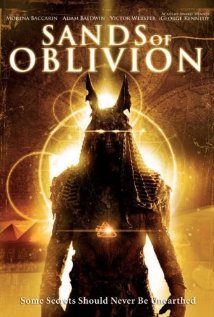
Twitter “Mock the Movie” tonight: The Sands of Oblivion!

Following in the tradition of MST3k, tonight I’ll be participating in “Mock the Movie”, a new Twitter event that involves watching a lousy sci-fi movie and ridiculing it live on Twitter!  To quote from JAYFK:

Smart-ass science fiction fans love nothing more than making fun of deliciously awful  sci-fi movies.  Join us in watching & mocking ‘Sands of Oblivion‘ tomorrow (10 August 2011) night at 9PM EST.   Sands of Obilivion has Eyptian mythology, archaeology, cursed objects, people who know better than to mess with cursed objects, and to guarantee it’s campiness – it’s a SyFy Original Movie!

Feel free to join us and add your snark on Twitter!  To participate, simply start watching Sands of Oblivion (available for free on Hulu) at 9PM EST and tweet your snarky comments with the Twitter hashtag #MTM.

How can you resist? Doesn’t the following movie poster just cry out, “Mock me”?

Posted in ... the Hell?, Silliness | 1 Comment

Isaac Newton… Father of invisibility physics?

My blog has been a good impetus to research a number of interesting scientific topics more deeply than I would otherwise have had the ambition to do.  For instance, since the blog’s inception, I’ve been pushing the origins of “invisibility physics” further and further back in time.

When I wrote my Ph.D. dissertation on the subject, I believed the earliest article connected with invisibility was a 1910 article by Paul Ehrenfest on radiationless accelerations of charged particles.  However, blog-related research eventually turned up a 1902 paper on a curious and crude invisibility device, and that paper in turn was inspired by a comment made by Lord Rayleigh in an encyclopedia article in 1884.

I’ve had a suspicion for some time, though, that the trail must go back further.  The evidence for this, albeit thin, is a weird tale written in 1859 by Irish-born American writer Fitz James O’Brien, titled “What Was It? A Mystery“.  In the story, a group of lodgers take up residence in an abandoned house that is widely reputed to be haunted.  Their initial amusement turns to horror when one of the group, the narrator Harry, is attacked by a creature that is invisible but very much of flesh and blood.  They manage to subdue the monster, alive, and tie it to the bed.  What follows is colleague Hammond’s attempt to explain the seemingly supernatural phenomenon:

We remained silent for some time, listening to the low, irregular breathing of the creature on the bed, and watching the rustle of the bedclothes as it impotently struggled to free itself from confinement. Then Hammond spoke.

“Harry, this is awful.”

“Aye, awful.”

“But not unaccountable.”

“Not unaccountable! What do you mean? Such a thing has never occurred since the birth of the world. I know not what to think, Hammond. God grant that I am not mad, and that this is not an insane fantasy!”

“Let us reason a little, Harry. Here is a solid body which we touch, but which we cannot see. The fact is so unusual that it strikes us with terror. Is there no parallel, though, for such a phenomenon? Take a piece of pure glass. It is tangible and transparent. A certain chemical coarseness is all that prevents its being so entirely transparent as to be totally invisible. It is not theoretically impossible, mind you, to make a glass which shall not reflect a single ray of light—a glass so pure and homogeneous in its atoms that the rays from the sun shall pass through it as they do through the air, refracted but not reflected. We do not see the air, and yet we feel it.”

“That’s all very well, Hammond, but these are inanimate substances. Glass does not breathe, air does not breathe. This thing has a heart that palpitates,—a will that moves it,—lungs that play, and inspire and respire.”

Though invisibility has played a large role in mythology through the ages, O’Brien’s story is evidently the very first story that provides a scientific explanation for the phenomenon.  Though O’Brien was ahead of his time, by the late 1800s/early 1900s a number of fiction authors would propose their own quasi-scientific theories of invisibility, including H.G. Wells in his famous 1897 novel The Invisible Man.

But what inspired these stories?  Clearly O’Brien and, as we will see, H.G. Wells had some specific science in mind when they concocted their tales of invisibility, but what science, and from whom?  In this post, I would like to engage in some speculation and propose that they were inspired, directly or indirectly, by Isaac Newton!

Continue reading

Posted in Horror, Invisibility, Science fiction | 2 Comments

6 days until the deadline for The Giant’s Shoulders #38!

There are only 6 days left until the deadline for The Giant’s Shoulders #38, to be hosted by The Board of Longitude Blog!  This will be a “Georgian Special Edition”, with an emphasis on posts related to 18th century science — though of course entries from all eras will still be allowed!  Please submit your entries directly to the host or Blog Carnival.com by August 15th!

Posted in General science, Science news | Leave a comment

Nick Mamatas’ Sensation

I hadn’t thought about it much before, but secret societies have long been a reliable element in weird fiction of all varieties.   These societies range from the legendary Illuminati to the very real (and less sinister) Freemasons, to fictional organizations of vampires and cults of Cthulhu worshippers.

Why is the idea of such hidden groups so compelling?  I would venture to guess that, in a modern world beset with problems, secret societies give us a simple scapegoat to focus our fear and anger upon.  It is simultaneously terrifying and reassuring to imagine that those really in charge are in fact nefarious and not stupid!

Even more drama arises when multiple secret organizations end up battling it out for world supremacy.  There are as many varieties of conflicts as there are societies: for instance, recent years have brought us werewolves vs. vampires as well as the Priory of Sion vs. Opus Dei.

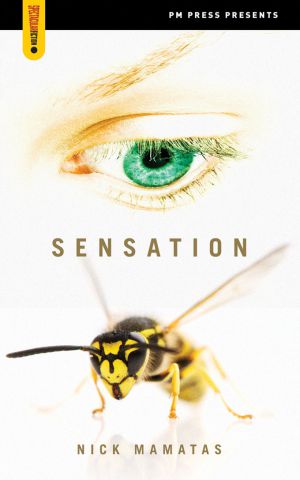
However, in terms of weirdness, I don’t think anything can beat the conflict featured in Nick Mamatas’ recently released novel, Sensation:

In this very odd and offbeat tale, a chance circumstance thrusts two people into the middle of an ancient conflict that has influenced all of human history — and none of those fighting it are human!

Continue reading

Posted in Weird fiction | 4 Comments

Weird science facts, July 27 — August 2

Time for your weekly dose of weird, courtesy of my Twitter #weirdscifacts!

501. July 27: Sand tiger shark: only shark known to adjust its buoyancy by burping! I don’t know about you, but I never thought to put the words “shark” and “burp” together.  (h/t @aliholden @natlaquarium)

502. July 28: Animating the dead — with soy sauce? A great explanation of a rather macabre Japanese delicacy, written by @NerdyChristie.

503. July 29: 1848: An execution, a painter, a hypnotist, and a question of whether a decapitated head remains aware.  The seems to have been a recurring interest in the physiological effects of decapitation through the 1700s and 1800s.

504. July 30: Drs using urbandictionary.com find man’s odd speech is Cockney slang not schiozophrenia.  h/t @discoveryplace

505. July 31: Infinity is weird… even in infinity mirrors!  Here I indulge in a little self-promotion, linking again to my post on the area and width of images in an infinity mirror.

506. Aug 01: Yesterday was anniversary of the worst shark attack in history — USS Indianapolis. The Indianapolis is known to most people because of the eerie description of the event by the shark hunter Quint in “Jaws”.  h/t @hectocotyli

507. Aug 02: Imagine if you could hear your own eyeballs moving – all the time.  (h/t @_ColinS_ and @laurenonizzle)

Posted in Weirdscifacts | Leave a comment

Infinity is weird… even in infinity mirrors!

Even very simple optics can reveal very interesting and surprising phenomena, if one looks carefully enough!  I was recently looking into the optics of a so-called “infinity mirror”, which in its simplest incarnation is simply two parallel mirrors on opposite sides of a room or elevator.  The result is a multiplication of images, seemingly stretching out to infinity (source):

I started mulling over the nature of the images — assuming one could see all of the images in an infinity mirror, all the way to infinity, would their total apparent area be finite or infinite?  It is probably clear from the photo that they’re finite, but there is nevertheless a surprising twist, which I will reveal below, after some math!

Continue reading

Posted in Mathematics, Optics | 54 Comments

Weird science facts, July 20 — July 26

Here are the week’s #weirdscifacts from Twitter!  This marks the 500th weird fact I’ve done, as well!

494. July 20: A migration strategy for some snails: get eaten by birds? How did snails manage to spread across so many islands separated by vast seas?  It turns out that a surprising number can survive a passage through a bird’s digestive tract, suggesting they were eaten and pooped out at a new destination! (by @theatavism)

495. July 21: May earthquakes in Maine due to ground relaxing from weight of ice during last Ice Age!  During the Ice Age, massive sheets of ice a mile high stretched across Maine.  This compressed the ground, and since the ice has receded the ground has been expanding out, giving little tremors.

496. July 22: Sometimes, injured muscles grow back as … bones.  The origin of this odd complication to injury is only now being determined.  (h/t @erikmal)

497. July 23: Fishing spiders — hunt fish while walking on water!  I always find it particularly ghastly when arachnids or insects prey on “higher” animals.  (h/t @timrs2001)

498. July 24: Scientist Robert Cornish, who in 1934 worked on “raising the dead” — namely, dogs. A Time Magazine article written about the experiments at the time can be read here.  A “see saw” was used to circulate blood in the victims to be resurrected.

499. July 25: Coronal mass ejections from the sun can eject 220 billion lbs of material at 2 million mph! That is a *lot* of material!  Many of these ejections can happen every year.

500. July 26: The stone-age Tasaday tribe, “discovered” in 1971 — a complete hoax, authentic, or in between? The original 1971 Time Magazine article can be read online.

Posted in Weirdscifacts | Leave a comment

John Jacob Astor’s A Journey in Other Worlds

The exploration of old and relatively unknown science fiction can be rewarding on many levels.  In addition to seeing the author’s vision of the future, one also gets a snapshot of the accepted science of the time, usually riddled with surprising misconceptions.  When the author himself is famous for reasons other than writing, the book has in a sense hit the “trifecta of interesting”.

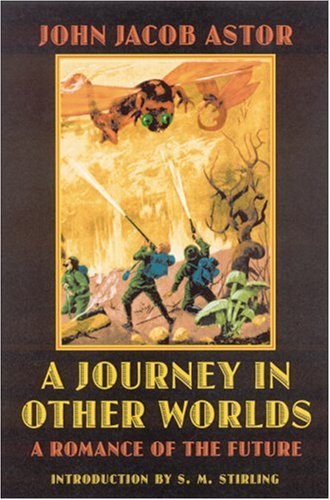
Such is the case with A Journey in Other Worlds, published in 1894:

The author of the book is John Jacob Astor IV (1864-1912), American millionaire and inventor, builder of what eventually became the Waldorf-Astoria Hotel in New York — and one of the wealthiest victims of the 1912 sinking of the RMS Titanic .

The book is a science fiction adventure, following the exploits of a handful of intrepid explorers as they take the first interplanetary voyage, visiting Jupiter and Saturn.  The tale is set in the far future, but also amusingly filled with 19th century mores and views.

(Images from original edition of book, via Project Gutenberg.)

Continue reading

Posted in Science fiction | 4 Comments

Weird science facts, July 13 — July 19

Back from Toronto, and working on some more posts.  In the meantime, here are the past week’s Twitter #weirdscifacts!

487. July 13: Half he, half she. A rare chimeric butterfly has been born in London.  (via @lucasbrowers)

488. July 14: Technicolour toad spotted after 87 years.

489. July 15: Lobsters that buzz?  (post by @doctorzen, h/t @jenlucpiquant)

490. July 16: Canadian physician Wilder Penfield, known for evoking vivid memories through direct brain stimulation.  (h/t to @Namnezia!)

491. July 17: French chemistry teacher and balloonist de Rozier became the 1st known air crash fatality in 1783. 

492. July 18: Apropos to recent journalistic scandals: the 1835 “great moon hoax“.  (via @beckyfh and @rmathematicus)

493. July 19: Temperatures on Mercury can range from -280 F to 800 F — in a single day.   Of course, a “single day” on Mercury is 58 earth days.  Nevertheless, the range of temperatures on Mercury is quite remarkable.

Posted in Weirdscifacts | Leave a comment

The Giant’s Shoulders #37 is out! (The Wunderkammer Edition)

The Giant’s Shoulders #37 is up at Providentia, and is a veritable cabinet of curiosities!  Many thanks to Romeo Vitelli for putting together an excellent edition of the carnival!

The next edition will appear on the Longitude Blog on August 16th.  Entries are due by the 15th of the month, and can be submitted directly to the host blog or through BlogCarnival.com.

Posted in General science, Science news | Leave a comment