ResearchBlogging editor’s selections: chimps with tools, moon-bases, shrinky dink science, and earthquake predictions

  • Uncovering the “Chimpanzee Stone Age”. First, from Brian at Laelaps we have a discussion of stone tool use in chimpanzees — and the archaeology of such tool use!
  • Will the Moon mess up a moon-base? For all the talk of setting up a base of operations on the Moon, it is quite easy to forget that it is a relatively hostile environment.  Emma at we are all in the gutter discusses clever attempts to evaluate damage to equipment that was left behind on our previous visits.
  • Shrinky Dinks Thermoplastics: Toying With Cutting Edge Research. In a technological advancement I would never have seen coming, Robert at Promega Connections discusses a new, potentially easy and inexpensive, technique for performing microfluidic research.  The inspiration for the work is Shrinky Dinks!
  • Science predicted the Chile’s Earthquake. Finally, Pablo of Astu’s Science Blog, who experienced the earthquake in Chile firsthand, explains how science predicted the force and the location of the earthquake remarkably well.

Check back next week for more “miscellaneous” suggestions!

Posted in General science, Science news | 2 Comments

The oldest LOLcat?

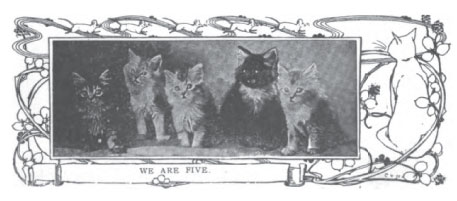
While researching another science post, I came across the following image:

The image is from The Harmsworth Monthly Pictorial Magazine, vol. 1 (1898-1899), at the end of the introduction to the magazine by Alfred C. Harmsworth.  This seems to be an early version of an LOLcat, popularized by I Can Has Cheezburger!  Though I wouldn’t exactly call it “laugh out loud”, the picture is a captioned image of cats with the caption in the cat’s own voice (hence the “we”).

I’m wondering if this is the oldest LOLcat found yet — the oldest one I’m aware of comes from 1905, seven years after the Harmsworth image.

I’ve said it before, and I’ll say it again — one finds all sorts of interesting things while wandering through old journals and magazines…

Posted in ... the Hell?, Animals, Silliness | Leave a comment

ResearchBlogging Awards voting open!

I should remind folks that voting is now open for the ResearchBlogging Awards 2010!
Research Blogging Awards 2010
If you are a research blogger and have an account on ResearchBlogging.org, don’t forget to vote for your favorite research blogs in a variety of categories, including the Research Blog of the Year, for which I have been nominated!

I would encourage people to vote for me, but I don’t want to overstep my bounds and get banned from the awards ceremony and accompanying party.  (There is going to be a ceremony and party, right?  Right?)

Posted in Personal, Science news | Leave a comment

Rolling out the (optical) carpet: the Talbot effect

ResearchBlogging.orgOne of the wonderful things about having a career in science is that a deeper understanding of the science leads to a greater appreciation of its beauty.  In physics, this usually requires a nontrivial amount of mathematics, but there are some phenomena that are self-evidently beautiful; unfortunately, many of these are also not very well known!

In working on my textbook on optics, I delved rather deeply into one of these phenomena, known as the optical Talbot effect.  First observed in 1836 by Henry Fox Talbot, the effect went unnoticed for nearly fifty years before being rediscovered by the great Lord Rayleigh in 1881. The true subtlety of the phenomenon was still not understood, however, for another hundred years!

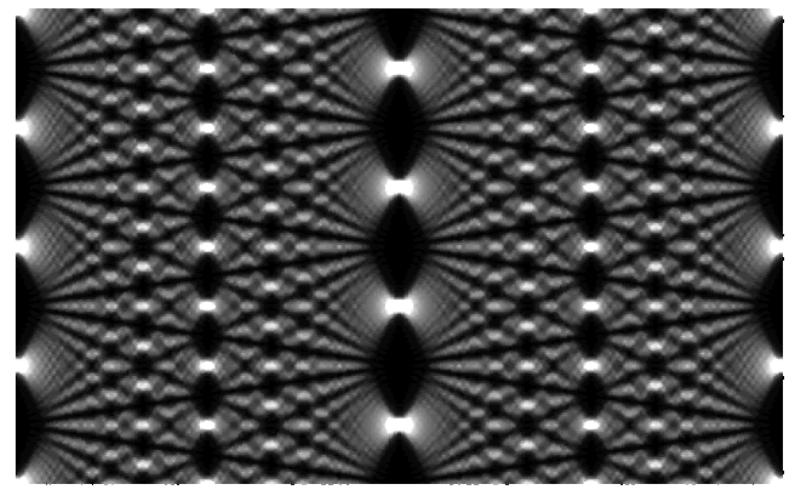
In short, the Talbot effect can be described as the self-imaging of a diffraction grating: at regular distances from the grating, the light diffracted through it forms a nearly perfect image of the grating itself. This simple statement does not do justice to the Talbot effect, however, which results in stunning images such as:

This is an example of what is known as a Talbot carpet,  presumably because it is reminiscent of an ornate Persian rug:

(Why isn’t it called a “Talbot rug”?  That I can’t answer.)

There’s a lot to explain in order to understand the significance of the Talbot carpet, starting with an explanation of what exactly a diffraction grating is!

Continue reading

Posted in Optics, Physics | 31 Comments

ResearchBlogging editor’s selections: archaeoacoustics, baboon friendships, and the teapot effect

  • Echoes of the past. We begin with teofilo at Gambler’s House, describing fascinating speculation that the former residents of Chaco Canyon may have chosen the site for their home based on its acoustic properties.  (I’ve resolved to visit the site one day.)
  • “You just call out my name…”: Friendships in Male and Female Baboons. Male and female baboons have long been known to form friendships not related to reproduction, but why?  Brian at Laelaps discusses research done in Kenya to answer this question.
  • The teapot effect, end of. Finally, aimeew at misc.ience shows again how science, in this case physics, is constantly working to make our lives better!  Researchers have come up with a solution for “the teapot effect”; I’ll let you click through to the link to find out what that is…

Check back next week for more miscellaneous highlights!

Posted in Uncategorized | 3 Comments

Research Blog of the Year finalist!

Today I received a very pleasant surprise: this blog has been nominated as a finalist for Research Blog of the Year!  This is the highest award of a new series of awards based on ResearchBlogging.org and sponsored by Seed Media Group.  My blog is one of ten finalists that were picked by an expert panel of judges from a set of some 400 that were nominated.

I don’t think it really hit me right away how much this means to me, and how much I appreciate being chosen as a finalist.  This blog really started, like many do, as a hobby that I never necessarily thought would garner much attention, and it is really great to get such an affirmation that I’m doing something right!

The final choice for “blog of the year” will be made by the community of research bloggers, namely those who are registered and blog through ResearchBlogging.org.  From the announcement:

Voting for the winners will be conducted by invitation to bloggers registered with ResearchBlogging.org. Invitations will be sent on Thursday, March 4. If you’re registered with us, you may want to check your account to make sure your email address is up-to-date. If you’re not registered (and you blog about peer-reviewed research), you still have time to register so you can vote. Visit this page for more information.

I don’t really expect to win — I’m up against some really stunningly awesome competition — but if you’re a research blogger, I hope you’ll consider throwing me a vote!

In any case, I’ve always heard that “It’s an honor just to be nominated,” and now that I’m in that position I can really say that it’s true!  (I should also say “thank you” to the person or persons who put my blog up for the awards in the first place.)  I’m also delighted that I get to put this badge on my blog:

Research Blogging Awards 2010 Finalist

Speaking of research blogging, I really need to get back to some — my impending book deadline has been eating up all my non-work time recently!  I do have a post on the Talbot effect that I’ll hopefully put up in a few days; it took me almost a month to decide how to explain the effect with a minimum of mathematics!

Update: For those stopping by from the “finalist” page, to see some of my research blogging please check out my “physics“, “optics“, and “history of science” categories!  As I noted above, my blog has been a little quiet lately due to numerous deadlines.

Posted in Personal | 7 Comments

A WTF scientific paper from Edinburgh, 1884

I’m still quite busy finishing off my book, and a grant proposal in the meantime, but I thought I’d share a very odd paper from the Proceedings of the Royal Society of Edinburgh 13 (1884), 23-24, entitled, “Extraordinary occurrence at House No. 7 York Place”.

One of the fun things about old journals are the miscellaneous “reports” sent in about unusual phenomena seen in the field, often by non-scientists.  Perhaps my favorite example of this comes from the very first volume of the Philosophical Transactions of the Royal Society in 1665, “An account of a very odd monstrous calf,” by Robert Boyle.  This was the fifth paper ever published in a scientific journal, a fact that I find very amusing for some reason.

The paper I want to describe carries the sub-heading, “(The following notice was sent to the General Secretary, from the Office of Messrs Hunter, Blair and Cowan, W.S.)”.  I can’t really do it justice without quoting it in its entirety:

Continue reading

Posted in ... the Hell?, History of science, Physics | 11 Comments

“The Wicker Tree?” (Updated)

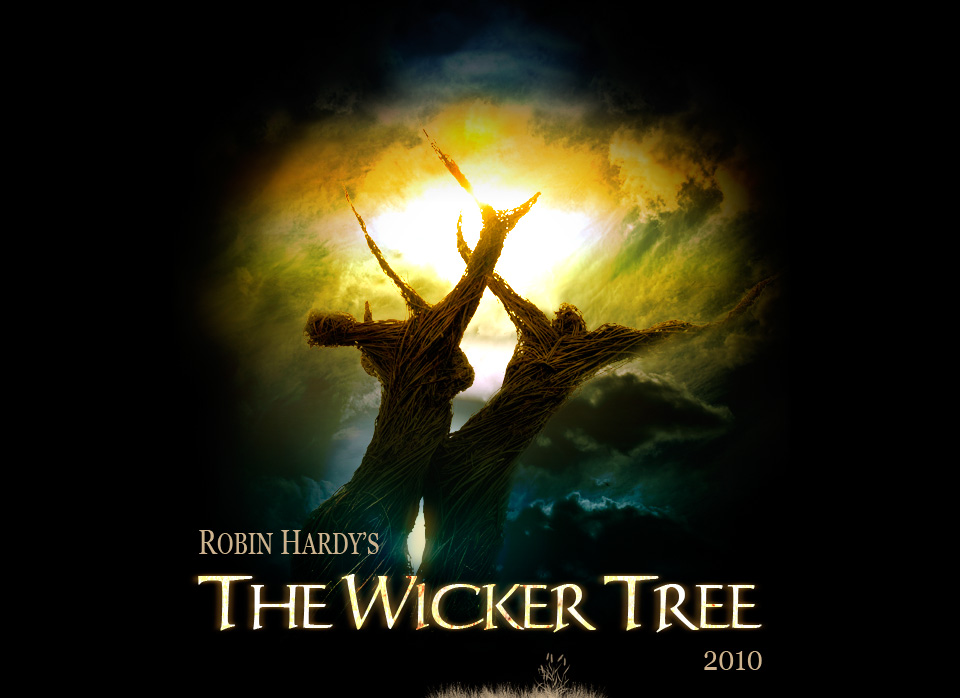
This one was an immediate WTF moment for me: Robin Hardy, the writer/director of the original version of the film The Wicker Man (1973), is “reimagining” his film as The Wicker Tree, slated for release sometime this year:
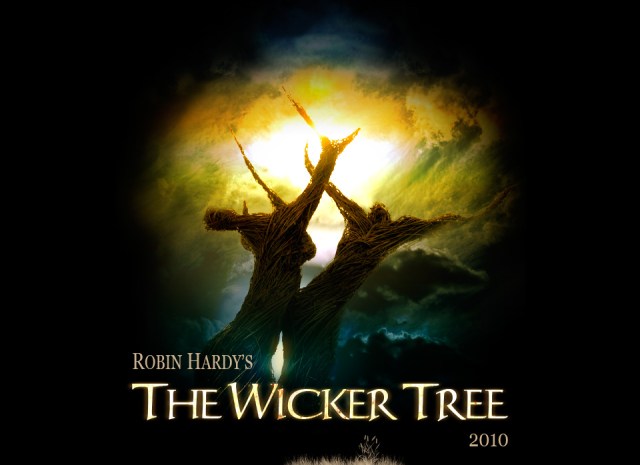
For those who aren’t familiar with the original film, it is undeniably a classic of the horror genre and in my opinion one of the greatest horror films of all time: subtle, atmospheric, darkly humorous, and genuinely horrifying*.

Details are sketchy as it stands; the official movie site is little more than an image right now.  IMDB has the following summary, which may or may not be accurate:

Young Christians Beth and Steve, a gospel singer and her cowboy boyfriend, leave Texas to preach door-to-door in Scotland . When, after initial abuse, they are welcomed with joy and elation to Tressock, the border fiefdom of Sir Lachlan Morrison, they assume their hosts simply want to hear more about Jesus. How innocent and wrong they are.

I’m definitely of mixed emotions about this news.  On the one hand, I’m horrified (and not in a good way); an abysmal remake of The Wicker Man was just recently released in 2006 and illustrates that there is no lower limit on the quality of such projects.  On the other hand, The Wicker Tree is by the original writer/director, and he has seen fit to bring back Christopher Lee as Lord Summerisle, one of the most inspiring castings of all time.

I suppose we’ll just have to wait and see…

***********************************************

* Seriously — this film has one of the most cringe-inducing moments of any horror movie I’ve ever seen, and shames a lot of the “extreme” modern horror films.

**********************************************

Update: As long as I’m talking about unusual movie projects, I see IMDB has a trailer up for the Solomon Kane movie, “based” on the character by Robert E. Howard.  I’m not sure what to think, as yet: it might end up being an enjoyable movie, but it doesn’t look, or sound, much like Howard’s Solomon.  The IMDB summary says a lot:

A mercenary who owes his soul to the devil redeems himself by fighting evil.
Howard’s Solomon is a fanatical Puritan who fights the devil’s works overly wherever he goes!  It is pretty much impossible to imagine that character having made a deal with the devil, as the summary and trailer implies.
Posted in ... the Hell?, Entertainment, Horror, Robert E. Howard | 2 Comments

“Supernatural Buchan”, by John Buchan

One of the truly fascinating things about writers of weird fiction is how many of them are remarkably accomplished in other aspects of their lives.  We have folks such as A. Merritt, who had a very successful career as a journalist and newspaper editor, R.W. Wood, who was a very distinguished scientist, Lord Dunsany, who was, well, a Lord, and M.R. James, who was a very distinguished medieval scholar.  And, of course, there’s my pièce de résistance, Winston Churchill.

I can now add to my personal list John Buchan, 1st Baron Tweedsmuir (1875-1940).  Buchan was a politician and novelist, and his resumé includes an impressive collection of honorary academic degrees and military honors.  He was also the 15th Governor General of Canada, representing the monarchy in local Canadian affairs.

In writing, he was incredibly prolific, producing countless novels and works of non-fiction, many based on his time spent working for the colonial administrator of South Africa.  Of his fiction, the work  most likely to be known by most people is his novel The 39 Steps (1915), which was very, very loosely adapted into a great film of the same name by Alfred Hitchcock in 1935*.

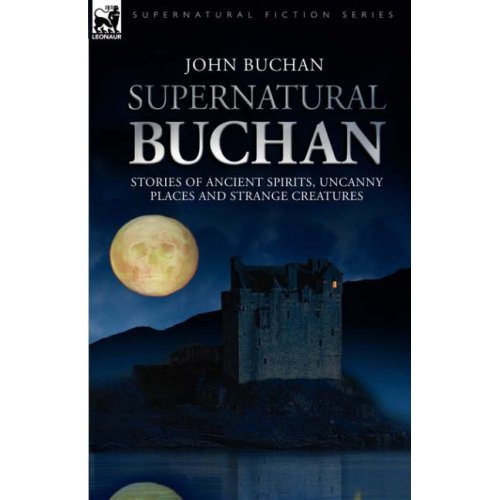
Buchan also dabbled in horror stories, and many if not most of these have been collected in Supernatural Buchan, a collection by Leonaur Ltd, who have produced quite a few impressive limited editions of weird fiction:

Continue reading

Posted in Horror, Weird fiction | 3 Comments

Tensor? Tensor? I’ve been getting tenser all week!

Whew! For those not following my Twitter account, let me declare that I finished the last major section of my textbook today!  Now I’m going to do a bit of touching up of various sections that I worked on recently, and I should get rid of the whole damn thing first thing next week.

Today was a real brain-buster for me — I finally sat down to face the section on tensor analysis.  For those not familiar, tensor analysis is a very abstract and hard-to-digest field of mathematics, and the hardest one in my book.  To give you an idea of how painful it is, Einstein formulated his general theory of relativity using tensor mathematics.

I’ve been reading about tensors for months now, trying to get a good enough understanding to write a clear, concise section for the book.   The experience really drove home for me the difference between understanding something and understanding it well enough to teach it!  I was determined to get through it today, no matter what, and fortunately it finally clicked.  (Though I’m pretty sure I’ll need to revise the text significantly later this week.)

The amusing thing is that the section on tensors is one of the less important ones in the book but one that may be absolutely essential in the future.  The relatively recent introduction of “cloaking devices” has spawned a new field of optics referred to as transformation optics, in which the ideas of general relativity and the tools of tensor analysis are used to design materials that manipulate light in novel and even “unnatural” ways.  Though the field isn’t a standard topic in optics education, I didn’t want to leave out such a possible glaring omission.

Fortunately, I’m done!  Just a few revisions, and the addition of a few additional exercises, and I can get rid of it!  At least until the editor’s comments start rolling in…

Posted in Personal | 3 Comments