On passing adult bronze ‘moves in the field’

Whew!  One more stressful deadline is passed, and successfully!  On Sunday, I passed my adult bronze ‘moves in the field’ figure skating test!  Of course, most readers probably have no idea what that means.

The USFSA (U.S. Figure Skating Association) is the official organization for U.S. figure skating, and they administer ranking tests which can be used as personal achievement goals or to determine one’s level for competition.  I’ve been figure skating for some thirteen years, and haven’t bothered with testing for about ten years.  This year, though, my skating coach convinced me (i.e. bullied me!) into testing again.

Apparently I don’t have enough going on, with classes, tenure planning, book writing, blog writing, research, and house stuff!

I decided to follow the “adult track” of testing, which is more compressed and less rigorous than the standard track that the young kids do.  The adult track consists of pre-bronze, bronze, silver and gold levels.  I was grandfathered into the pre-bronze level from my previous tests, and therefore took the bronze test.

Moves in the field” refers to skating elements such as various turns and edge transfers, basically all those techniques that can be used to get from point A to point B.  To give you an idea of what is involved, here is the official test book figure of the “5-step mohawk” pattern I had to perform:
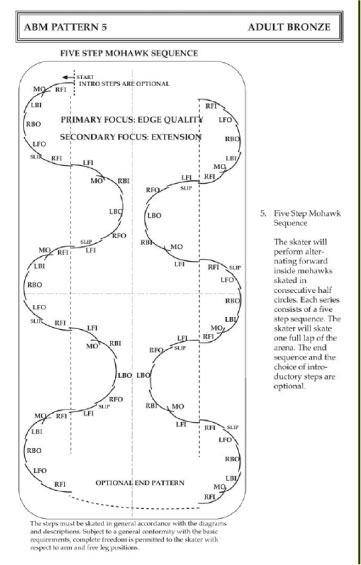
5step

To give you a sense of the terminology, RFI = right front inside, MO = mohawk,  LBO = left back outside, etc.

Fortunately, I passed the test, and even enjoyed the experience somewhat, though I strangely find such tests more stressful than skydiving.  Now I’ll hopefully have the mental capacity to get my tenure package out of the way later this week…

In a completely unrelated note, I started playing the XBox360 game Batman: Arkham Asylum this weekend.  The game is really, really good; I’ll probably review it in its entirety once I finish it.  I’ve you’ve ever wanted to be Batman, this game is the closest you’ll probably ever come!

Posted in Personal, Sports | 6 Comments

ResearchBlogging editor’s selections: Adaptive optics, adaptive mimicry, and adaptive freeloading

  • Binocular adaptive optics simulator: the future of vision assessment now! (or the end of phoropters?) At Optics Confidential, Pablo Artal discusses his own research on adaptive optics, which could in the end finally change the 100-year old use of the phoropter in eye exams.
  • Mimicry: survival or flattery?… Most of us are familiar with animal mimicry, in which one species is ‘disguised’ as another.  Jim Caryl at mental indigestion reports on fascinating research on mimicry at the molecular level, which allows bacteriophages to safely invade target bacteria.
  • Freeloading pays off, but only up to a point. While we’re on the subject of sneaky tricks tricks by bacteria, Iddo Friedberg at Byte Size Biology talks about “social behavior” amongst bacterial colonies, and how computer simulations show that some bacteria can act are “freeloaders”!
  • Posted in General science, Science news | Leave a comment

    The other meaning of “dimension” and its use in physics

    Thanks to the advent of relativity theory, and string theory in recent decades, there’s a lot of talk in physics about space having extra, unseen dimensions — up to 11 spacetime dimensions in one version of string theory!  These days, the word “dimension” in physics immediately evokes Twilight Zone imagery:

    There is a fifth dimension, beyond that which is known to man. It is a dimension as vast as space and as timeless as infinity. It is the middle ground between light and shadow, between science and superstition, and it lies between the pit of man’s fears and the summit of his knowledge. This is the dimension of imagination. It is an area which we call the Twilight Zone.

    (Fun fact: the introduction to the show changed pretty much every year it was on.  See Wikipedia for the text of all the intros!)

    The term “dimension”, however, has another meaning in physics: a more mundane one, but equally important.  This other type of dimension, used in what is known as dimensional analysis, has been used to gain surprising insight into difficult physical problems.

    Continue reading

    Posted in Physics | 14 Comments

    Happy birthday to G.W. Bailey!

    I was watching The Closer the other night, and I was observing again how much I like the character of Lt. Provenza, and the actor G.W. Bailey who plays him.  In a nice bit of synchronicity, it turns out that I looked him up only a couple of days before his birthday today!

    Bailey, who turns 65 today, has had a long and fun career.  He seems to have made a guest appearance on every classic television show of the 70s and 80s: Charlie’s Angels, CHiPs, Starsky and Hutch, Soap, Laverne & Shirley, Lou Grant, Happy Days, Benson, M.A.S.H., St. Elsewhere, Remington Steele, Simon & Simon, Newhart.

    His real mark on the 80’s was his recurring role as the cantankerous Lt. Harris in the Police Academy films.  I personally will think of him most fondly for his role as the town drunk and sidekick Peter in the underappreciated cowboy comedy Rustler’s Rhapsody.  Now he really shines as Lt. Provenza in The Closer, and I couldn’t have been happier to see him still in action.

    A very happy birthday to G.W. Bailey, and best wishes for a long and prosperous career!

    Posted in Entertainment | Leave a comment

    ResearchBlogging editor’s selections: Sleepwalking, dark energy — and urine!

    • Did sleepwalking once serve as an adaptive function? For most people, sleepwalking seems like an annoying — if not downright dangerous — disorder. William at The Quantum Lobe Chronicles explores whether or not this behavior might have served an important survival role.
    • Why we’re stuck with dark energy. In astronomy, “dark energy” is one of those ideas which at first seems to have been proposed to explain away problems, rather than explain them. However, Greg Fish at World of Weird Things describes why the idea of dark energy isn’t going away any time soon.
    • Unique urine fingerprints. With recent arguments that false DNA evidence can be manufactured in a lab, it is natural to wonder where forensic science can go next. David Bradley at sciencebase describes research that suggests that we all have a unique metabolic fingerprint — which can be detected through our urine!
    Posted in General science, Science news | 3 Comments

    Why I left experimental particle physics – a meandering story

    Some time ago, I promised that I would tell the story of my transition from experimental particle physics to theoretical optics.  With a lot of busy stuff going on at work and my research blogging efforts mired in some rather difficult reading, this seemed like a good time to share the story!

    Before I begin, though, let me make a disclaimer: none of this should be interpreted as bashing on particle physics!  I have a soft spot in my heart for the field, and the research is getting very exciting with the gradual startup of the LHC.  This is really a story of how I chose my particular field of research, and how that decision involved balancing the nature of the research with the actual day-to-day work involved.  Most of my choices and rationalizations at the time were from the perspective of an unknowingly clinically depressed graduate student who hadn’t quite figured out what he wanted to do with his life.

    Continue reading

    Posted in ... the Hell?, Personal, Physics | 19 Comments

    Roger Ebert on ‘death panels’ and the power of a phrase

    If you don’t read Roger Ebert’s blog, you probably should.  In recent years (and probably before that, but before blogs) he’s been writing some of the most thoughtful posts I’ve seen on a range of topics, from politics to science to, of course, movies.  His recent post discusses “The Big Lie” that is Sarah Palin’s “death panels.”

    Update: The comments are well worth reading as well.  Roger does an amazing job of remaining polite while concisely slapping down the rudest of the crazies who stop by for a fight.

    Posted in Entertainment, Politics | Leave a comment

    The Giant’s Shoulders #14 is up!

    The fourteenth edition of The Giant’s Shoulders is up at The Dispersal of Darwin! It’s a little tardy, but it’s got a lot of entries, and they’re all great!    Many thanks to Michael for putting it together and hosting it!

    The deadline for the next edition is September 15th, and it will be hosted at Entertaining Research.  Entries can be submitted through blogcarnival.com or directly to the host blog, as usual!

    Posted in General science, History of science | Leave a comment

    ResearchBlogging editor’s selections: Knuckle-walking, nanostars, and novel fuel cells

    (Cross-posted at ResearchBlogging.org News.)

    • Bipedalism: From the ground up or trees down? Chimpanzees and gorillas both walk on their knuckles, but do so in subtle but significantly different ways.  Brian at Laelaps discusses recent research on this subject, and its implications: did primates evolve from the ground up or from the trees down?  (For another take on the same research, see Did knuckle-walking evolve twice?)
    • Of twinkling nanostars and the possible application of stroboscopes in biological imaging. For biological researchers, studying the behavior of a single cell amongst many is like trying to keep track of a single person in the audience of a crowded stadium.  Amiya Sarkar at Physiology physics woven fine tells us about researchers who have successfully tagged a single cell with gold nanoparticles in order to keep an eye on it!  Amiya suggests how a stroboscopic effect could be used to study to movement of individual pieces of a cell.
    • Rapidly screening bacteria for clean energy production. Bacteria act, in a sense, like little power sources which could in principle be harnessed for clean energy.   Not every bacteria will work, however, and techniques are needed to separate the “hard working” bacteria from the “lazy” bacteria.  Michael at Phased discusses successful screening of good bacteria and their implementation in a bacterial fuel cell.

    Check back next Monday for more “miscellaneous” highlights!

    Posted in General science, Science news | Leave a comment

    The New York Times on celiac disease

    Via my postdoc advisor (who has been suggesting enough good stuff lately that I should probably just turn the blog over to him), The New York Times has posted a very nice article on living with celiac disease, “The Expense of Eating with Celiac Disease.”  A sample:

    Celiac disease damages the lining of the small intestine, making it difficult for the body to absorb nutrients. Victims may suffer from mild to serious malnutrition and a host of health problems, including anemia, low bone density and infertility. Celiac affects one out of 100 people in the United States, but a majority of those don’t know they have the disease, said Dr. Joseph A. Murray, a gastroenterologist at the Mayo Clinic in Minnesota who has been studying the disease for two decades. The disease can be detected by a simple blood test, followed by an endoscopy to check for damage to the small intestine.

    Seven years after receiving his diagnosis, Mr. Oram, who is married and has one daughter, is symptom-free, but the cost of staying that way is high. That’s because the treatment for celiac does not come in the form of a pill that will be reimbursed or subsidized by an insurer. The treatment is to avoid eating products containing gluten. And gluten-free versions of products like bread, pizza and crackers are nearly three times as expensive as regular products, according to a study conducted by the Celiac Disease Center at Columbia University.

    The article contains quite a few money-saving tips for those trying to live gluten-free; it also hits upon most of the important facts I’ve learned about celiac since being diagnosed with it last year.  Anemia is an important thing to be tested for: I’ve recently been diagnosed with mild anemia (h/t The Wife, who also suffers) that almost certainly comes from the celiac, and is almost certainly responsible for both my low energy level over the past few years and my quite serious restless leg syndrome.  I’m now taking iron supplements to compensate, and things have improved significantly.

    The article also does a very good job indirectly pointing out how health care reform is important for the diagnosis and treatment of celiac:

    Unfortunately for celiac patients, the extra cost of a special diet is not reimbursed by health care plans. Nor do most policies pay for trips to a dietitian to receive nutritional guidance.

    In Britain, by contrast, patients found to have celiac disease are prescribed gluten-free products. In Italy, sufferers are given a stipend to spend on gluten-free food.

    Some doctors blame drug makers, in part, for the lack of awareness and the lack of support. “The drug makers have not been interested in celiac because, until very recently, there have been no medications to treat it,” said Dr. Peter Green, director of the Celiac Disease Center at Columbia University. “And since drug makers are responsible for so much of the education that doctors receive, the medical community is largely unaware of the disease.”

    In short, countries with national health care actually pay to help cover the costs of living with celiac, for which no drug treatment is available.  Perhaps more important, it suggests that the drug manufacturers have a strong influence in driving the way doctors treat, or don’t treat, diseases such as celiac.  If your disease is not one the manufacturers are interested in, it is less likely that you’ll be diagnosed and treated properly (though, I should emphasize, not through the fault of the doctors).  My own case is anecdotal evidence to this effect: I was the one, at The Wife’s urging, to ask my doctor to test me for celiac.

    In any case, the article is well-worth a read.

    Posted in Health | 5 Comments