h-index of 14!

In one of my periodic blog moments of patting myself on the back, I should note that my h-index went up to 14 this past week!

As I’ve described previously, when my h-index went to 13, the h-index (or Hirsch index) is a rough estimate of the productivity of a scientist and the impact of their work.  An h-index of N means that you have no more than N papers which each have more than N citations each.  It is a very crude measurement of productivity, as is any quantitative measurement, but one that’s relevant for decisions such as tenure.

Considering the Wikipedia article cites an h-index of 10-12 as a guideline for tenure decisions, and 15-20 a fellowship in the American Physical Society, I’m feeling pretty good about my chances.

Unfortunately, I’ll need quite a few citations to bump myself to an h-index of 15.  Unless I get really lucky, I won’t have another celebration like this for a while…

Posted in Personal | 2 Comments

Mrs. Carver’s The Horrors of Oakendale Abbey

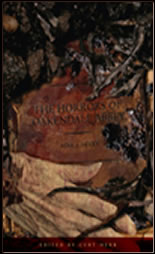
Generally, I’m a bit tired of the genre of Gothic fiction, though I have enjoyed the few that I’ve read for the blog (see The Animated Skeleton and The Witch of Ravensworth).  One other caught my eye when I was perusing books to read: The Horrors of Oakendale Abbey (1797), by Mrs. Carver:

bigoakendale

What did I think about it?  I was a trifle disappointed by the story, though it definitely is a unique Gothic novel.

Continue reading

Posted in Horror | 6 Comments

Who first suggested the nuclear atom?

Here’s a little obscure physics trivia for you: who first suggested that an atom might have a structure consisting of a positively-charged “nucleus” surrounded by orbiting electrons?

The easy, and mostly correct, answer is Ernest Rutherford.  In 1909, he supervised two of his students (Geiger and Marsden) in an experiment to probe the structure of atoms using alpha-particles.  Surprisingly, they found that occasionally one of the alpha-particles would be almost completely reflected from their sample, which should not have happened according to the Thomson “plum-pudding” model of the era.  Rutherford himself later remarked, “It was almost as incredible as if you fired a fifteen-inch shell at a piece of tissue paper and it came back and hit you.”  In 1911, Rutherford published a paper (“The Scattering of Alpha and Beta Particles by Matter and the Structure of the Atom,” Phil Mag, ser 6, 21 (1911), 669-88) in which he argued that the results suggested that the atom consisted of electrons orbiting a very small, dense, positively-charged nucleus which contained most of the atom’s mass.  This realization was a major breakthrough in atomic physics and eventually led to our modern picture of atomic structure.

When I was working on my post on “failed atomic models” some time ago, however, I encountered an off-hand remark that Jean Baptiste Perrin, another giant in atomic theory, had first proposed a nucleo-planetary atomic model in 1901.  Curiously, though, I was unable to find a reference to it, and I’ve always wondered why.

Perrin’s own Nobel lecture of 1926 provides most of the answer:

I was, I believe, the first to assume that the atom had a structure reminding to that of the solar system where the “planetary” electrons circulate around a positive “Sun”, the attraction by the centre being counterbalanced by the force of inertia (1901). But I never tried or even saw any means of verifying this conception. Rutherford (who had doubtless arrived at it independently, but who also had the delicacy to refer to the short phrase dropped during a lecture in which I had stated it) understood that the essential difference between his conception and that of J.J. Thomson was that there existed near the positive and quasi-punctual Sun, enormous electrical fields as compared with those which would exist inside or outside a homogeneous positive sphere having the same charge, but embracing the whole atom.

In other words, Perrin first proposed the nucleo-planetary model, but never pursued the idea beyond some basic speculations.  Rutherford is rightly given most of the credit for the development of the model, as he supervised the experiments which led to its verification and worked out the rigorous theory behind it.

One thing I would like to find, though, is the place where Rutherford referred to Perrin’s planetary model!  I’ve been searching through Rutherford’s papers on the nuclear model, but so far have not found any reference to Perrin.  If I find it, I’ll write an additional post on the subject…

Posted in History of science, Physics | 7 Comments

Mr. Faraday goes wild — with atomic speculation! (1844)

Michael Faraday (1791-1867), whom I’ve talked about numerous times, has a reputation as being a bit of a theoretical lightweight, namely because he had little formal mathematical training.  In spite of this, however, he had an ability to think abstractly and, yes, theoretically about problems in a way that, when examined, is nothing short of amazing.

In my previous researches on Faraday, I came across a reference to an article he wrote in 1844 in volume 24 of Philosophical Magazine, pp. 136-144, “A speculation touching electric conduction and the nature of matter.”  Faraday, already a distinguished and even famous scientist, shared some thoughts about the nature of atomic structure, based on the paucity of knowledge that was available at the time.  His observations, though still off the mark according to current understanding, were remarkably forward thinking; furthermore, they provide a lovely snapshot of the ‘state of the art’ in 1844.   Let’s take a look at his paper:

Continue reading

Posted in History of science, Physics | 7 Comments

Mary Shelley’s The Last Man

I have to admit that the collapse of the world economy has gotten me into a rather pessimistic, even doomed, mindset.  Some months ago I decided to use this mindset constructively and began reading a series of novels with a common theme of the “end of the world”.  I put the phrase in quotation marks because most apocalyptic novels really focus on the end of civilization or the end of humanity, not the literal end of the planet.

Anyway, I was rather surprised when my researches revealed that one of the earliest stories about the end of humanity (not counting various religious prophecies) was written way back in 1826 by none other than Mary Shelley, who is better known for her groundbreaking science-fiction/horror novel Frankenstein (1818).   Shelley’s The Last Man is a lengthy, tragic novel which describes the rise and fall of the fortunes of a circle of friends, set against the backdrop of a merciless plague which is inexorably exterminating humanity:

shelley_lastman

The novel, though I found it slow-going at first, builds in intensity and emotional impact to a level which eventually affected me deeply.  Though there are plenty of discussions on this book online, I thought I’d give my own humble take.

Continue reading

Posted in Horror | 13 Comments

I saw Steve Carell way back when… I think…

My mind, in particular my memory, often works in bizarre ways, especially when it comes to film and television.   I’ve regularly identified movies and television shows that I’ve never even seen from a split second clip during the flip of a channel.   I can think of two striking examples, both curiously involving Stephen King stories.  Once, I turned on the television and saw a man lying by the side of the road, critically injured in a hit-and-run accident.  A monstrous creature appeared out of the trees and approached him — and I immediately knew I was watching a story written by Stephen King.  An even more impressive instance occurred once when I turned on the TV and saw a man standing outside a small airport at night, looking up at a single-engine aircraft flying above his head.  I said to myself, “Hey, they made a movie version of King’s The Night Flier” — and I hadn’t previously known such a version existed.

Often, watching a television show, I’ll single out a particular actor and immediately identify them as someone I’ve seen in some other obscure role years before.  I may have just beaten myself for weird identifications tonight, though.

Continue reading

Posted in ... the Hell?, Silliness | 2 Comments

Back in the air!

The weather has finally been getting nice enough again to get some consistent skydiving in and not freeze one’s ass off at the same time!  The following video is actually back from January, but I finally got around to uploading it the other day.  It consists of two skydives: an eight way and a six way.  Both jumps look a little confused, as we hadn’t really gotten much jumping in over the winter months, but they allowed us to shake off some of the rust and get back in the swing of things.  Video by my friend Quincy:

“Currency”, as it’s called, is very important to a regular skydiver.  Though freefall is the most natural feeling in the world to me, it is not a natural activity and one can forget how to “fly” after a prolonged lay-off.  Most jumpers try and get out pretty much every weekend for at least a couple of jumps.

(P.S.  YouTube is getting really goofy with copyright fears!  Quincy had put together for me a DVD with a background song, and this was what I uploaded to YouTube without thinking much about it.  I was astounded to see that they now automatically scan uploaded videos for similarities to pop music, and block things that have musical clips.  I replaced it with some horse$#!+ that YouTube ‘suggested’.)

Posted in Sports | 3 Comments

The birds have fledged!

Just a quick update about the family of house finches we’ve had on our front door wreath: the babies have fledged!  This previous Tuesday, we chanced a peek into the nest and saw a little face peeking back at us:

nestlings

Cute, eh?  It looked like they still had quite a ways to go.  (Incidentally, the house finch keeps the poop of the baby finches around the border of the nest — hence the mess of white.)

Today, we heard a very raucous peeping coming from the nest, along with some rustling.  Suddenly, a flock of birds appeared on the tree in front of our house:

the-family

Our bird babies are flying!  The fiancée and I felt very lucky to have been present for what must have been one of the first flights.  (The picture is a bit grainy because I had to shoot through a screen and window.)  Soon, we’ll be able to clean the poop off of the front door!

Posted in Animals | 4 Comments

The Giant’s Shoulders #10 is up!

The tenth edition of The Giant’s Shoulders is up at Stochastic Scribbles!  Thanks to Yoo for assembling it!

The next edition will appear on May 16th at Curving Normality.

Posted in General science, Science news | Leave a comment

Levitation and diamagnetism, or: LEAVE EARNSHAW ALONE!!!

In one of my regular explorations of StumbleUpon I happened across a nice homemade demonstration of magnetic levitation on a page called spark, bang, buzz.  The demonstration is adapted from a description at scitoys.com.  The setup is illustrated schematically below:

levitationscheme1

A strong collection of permanent magnets are supported by a wooden frame above the ‘levitation’ area, and provide the ‘lift’ for the levitating magnet.  The levitating magnet itself is supported between a pair of plates made of bismuth which — and this is in fact the key point — is a strongly diamagnetic material.

It is a nice demonstration, but what really caught my eye was the following passage of the post:

It is always annoying to me when someone flashes a bunch of mathematical mumbojumbo in our faces and says something is impossible. Many times the impossibility may be true in the true sense of the mathematical definition, but mathematical definitions often fall way short when evaluating our real and practical world. Someone named Earnshaw, using mathematical mumbojumbo, said that a permenant magnet can not be levitated without using some energy input for stabilization. In the practical sense, one would be a fool to take the Earnshaw therom seriously. The picture shows that permenant magnet levitation can easily be done at home… Diamagnetism probably does not fall within the definition of the Earnshaw therom but who cares.

It’s hard to tell if the author is being snarky or really looks upon mathematical physics as a “mumbojumbo” that impedes progress.  Taking the statement at face value, it highlights an important and semi-common misunderstanding of many physics theorems, and so I thought I’d take a qualitative stab at explaining Earnshaw’s theorem and its relationship to diamagnetic materials and magnetic levitation.

Continue reading

Posted in Physics | 28 Comments