Breaking the Chains of Gravity, by Amy Shira Teitel

Over the past few years, we’ve been treated to a stunning array of achievements in space exploration, such as the Juno Mission (inserted into orbit around Jupiter on July 4, 2016), New Horizons (passed Pluto on July 14, 2015), and Rosetta (landed on a comet on November 12, 2014). These missions are all mind-boggling accomplishments, and naturally raise the question: how did we get so awesome at space travel?  I’m not even talking about the reasonably well-known early history of NASA’s manned space flight program, but even earlier, when rocket travel out of the earth’s atmosphere was considered an impossible dream by many.

Breaking the Chains of Gravity (2016), by Amy Shira Teitel, takes an in-depth, fascinating, and compelling look at this early history.

breakingthechainsofgravity

Breaking the Chains of Gravity begins with the early rocket hobbyists in Germany in the 1930s and ends with the formation of NASA in 1959.  The path to space would be driven by some of the greatest minds and boldest hearts in the world, and would take many dramatic twists and turns along the way.  Among the stories told are the dramatic escape of Wernher von Braun from the Germans and into the protective arms of the Americans, the dramatic rocket-powered flight of Chuck Yeager that broke the sound barrier, and the insane self-experimentation of John Stapp on the biological effects of high g-forces.  All these stories are woven into a compelling and enjoyable narrative that gives a clear impression of how everything came to pass.

Continue reading

Posted in History of science, Physics | 3 Comments

9 years of Skulls in the Stars

Today, it turns out, is the 9 year anniversary of my first post here at “Skulls in the Stars,” titled “Educate or Bust!”  This post title, like the title of the blog itself, came from a story by Robert E. Howard.

Posting has been light the past couple of months due to stresses at work and in my personal life, but I should hopefully be past the worst of it over the next month and back to some detailed physics, optics and history posts!  Thanks for putting up with me and reading all these years.

First appearance of Robert E. Howard's Solomon Kane, in Weird Tales, August 1928.

First appearance of Robert E. Howard’s Solomon Kane, in Weird Tales, August 1928.

Posted in Personal | 1 Comment

Twitter Weird Science Facts, Volume 12

Time for another summary of weird science facts, as posted by me on Twitter!  Read below to see the devilish secret held within this innocent-looking cup. (Which I own, btw.)

pythagorascup

Continue reading

Posted in General science, Weirdscifacts | Leave a comment

Hiroshi Yamamoto’s MM9

I don’t recall how I came across Hiroshi Yamamoto’s fun monster-hunting novel MM9 (2007).  Perhaps it was a recommendation for me on Amazon, based on my more recent forays into translated science fiction, such as Metro 2033 and Roadside Picnic?  In any case, I’m glad I read it: MM9 is a delightful and clever novel with surprising twists and turns.

mm9

Continue reading

Posted in Horror, Science fiction | Leave a comment

Twitter Weird Science Facts, Volume 11

Time for another round-up of weirdscifacts from Twitter!  Read below to find out what this creepy 1873 woodcut is depicting.

The_Burial_of_Captain_Hall

Continue reading

Posted in General science, Weirdscifacts | Leave a comment

Twitter Weird Science Facts, Volume 10

On a personal note: still going through a rough patch of life, and so I’m still on a sort of unofficial hiatus from writing substantial posts — though I may write one here or there. Hopefully will be back and active in a month; in the meantime, I will continue updating my weirdscifacts.

Welcome to the 10th volume of Twitter Weird Science Facts! Read below to discover the sinister secret of this otherwise adorable bird.

1280px-Vampire_finch_(4229090408)

Continue reading

Posted in General science, Weirdscifacts | 1 Comment

Twitter Weird Science Facts, Volume 9

Been a rough couple of weeks for me personally, and I haven’t had the time or the energy to write some solid science posts.  In the meantime, please take a look at the latest weird science facts posted on twitter.

Let’s see what the last two weeks of weird science facts on twitter have revealed!  Click below the fold to learn more about wombat poo than you probably ever thought you would want to know.

commonwombat

Continue reading

Posted in General science, Weirdscifacts | Leave a comment

Valley of the Flame, by Henry Kuttner

Henry Kuttner (1915-1958) may be referred to as “one of the most important science fiction authors you’ve never heard of.”  He was incredibly prolific and versatile, writing countless short stories of science fiction, fantasy, horror, thriller, and adventure, as well as over a dozen novels.  Many of his works have been adapted into movies and episodes of television shows, including The Twilight Zone. One of my favorite science fiction stories of all time, “Private Eye,” was written by “Lewis Padgett,” the pen-name of Henry Kuttner and his equally talented writing wife, C.L. Moore.  I’ve blogged about a number of his novels before — The Time Axis, Destination Infinity, The Well of the Worlds — and I’m always eager to read more of his bibliography, though it isn’t always easy to find it.

I recently came across a reprint of Kuttner’s novel Valley of the Flame (1946), and jumped at the chance to read it.  The cover below is that of the first book edition, from 1964.

ValleyOfTheFlame

The story is a somewhat standard “lost world” adventure story, with a few twists.  One of those can be seen on the cover of the book: the lost world, the titular Valley of the Flame, is inhabited by intelligent, hyper-evolved cat people!

Continue reading

Posted in Adventure fiction, Weird fiction | Leave a comment

Twitter Weird Science Facts, Volume 8

Time for another recap of weird science facts from Twitter! Click below the fold to see how the system pictured below provided entertainment for Victorian folks.

theatrephone

Continue reading

Posted in General science, Weirdscifacts | Leave a comment

Optics by hot air balloon?

The first in a (hopefully) series of posts inspired by topics covered in my upcoming textbook on singular optics.

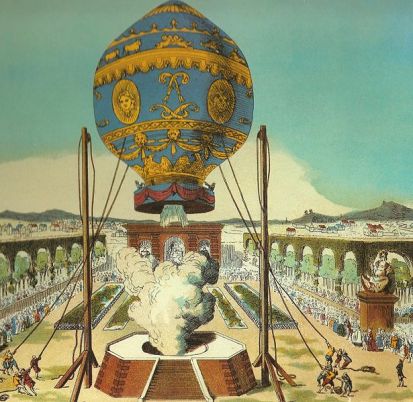
Crewed balloon rides have a surprisingly large role in the history of science.  The first untethered balloon flight was performed in Paris on November 21, 1783, and the achievement of human flight opened up new possibilities for scientific measurement and, indeed, exploration.

The first untethered balloon flight, November 21, 1789.

The first untethered balloon flight, November 21, 1783.

Primarily, ballooning offered a novel opportunity to study the chemical properties of the upper atmosphere and the wind currents at high altitudes, and it filled this role for over a century.  Unfortunately, many early flights were deadly: I’ve blogged before about the fateful 1875 flight of Gaston Tissandier, Joseph Croce-Spinelli and Théodore Sivel, in which 2 of the 3 balloonists succumbed to oxygen deprivation.

Other discoveries awaited the adventurous at high altitudes.  Half of the 1936 Nobel Prize in Physics went to Victor Francis Hess for the discovery of extraterrestrial radiation (cosmic rays) from a balloon in 1913 (though hints of cosmic rays appeared even earlier).

In the 21st century, one wouldn’t think that there would be any physics left to be observed by balloon.  Recently, however, I came across a 2002 paper¹ by scientists from Hungary and Switzerland, titled “First observation of the fourth neutral polarization point in the atmosphere.”  In this paper, the researchers describe how they used measurements from a hot air balloon to verify a prediction of optical science that had remained untested for over 150 years!

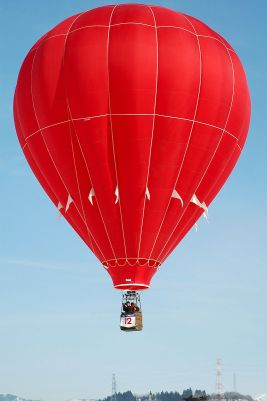
A modern hot air balloon, from Wikipedia, because it seems like I should have one in this post. Photo by Kropsoq.

A modern hot air balloon, from Wikipedia, because it seems like I should have one in this post. Photo by Kropsoq.

The discovery is not, admittedly, Earth-shattering, so to speak, but it is a fascinating epilogue to an extended period of the history of physics and a testament to the ingenuity of scientists!

Continue reading

Posted in Optics, Physics | 2 Comments