
The 2nd century BCE marked an unusual milestone in the history of civilization. As the Greeks had conquered most of the civilized world, its citizens were more or less free to travel widely through Europe and the Middle East, to see different cultures and their accomplishments. Soon, travel guides — the Fodors of their time — were written, providing a list of “must see” attractions throughout the world.
Today, of course, we refer to these as the Seven Wonders of the World. Not every list was the same, but the most commonly-listed attractions were the Great Pyramid of Giza, the Hanging Gardens of Babylon, the Temple of Artemis at Ephesus, the Statue of Zeus at Olympia, the Mausoleum at Halicarnassus, the Colossus of Rhodes, and the Lighthouse of Alexandria.
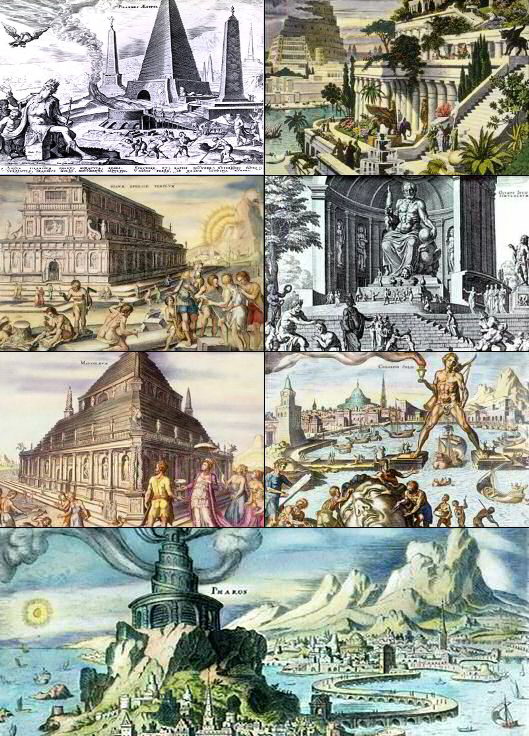
The Seven Wonders of the World, as imagined by Maarten van Heemskerck in 1572 (w/ exception of Gardens picture). Via Wikipedia.
Of course, nothing lasts forever — all seven wonders existed at the same time only over a short span of sixty years. Then, one by one, they succumbed to natural disasters and deliberate destruction, and now only the Great Pyramid of Giza survives.
Blog carnivals can’t last forever, either! The Giant’s Shoulders has been ongoing for six years now, an eternity in internet time, and the decision has been made to bring it to a close. This will be the final edition, and what better way to send it off than to take a tour of the history of science along with the Wonders of the World?






 Skulls in the Stars
