Twitter is a great place to waste time, but it is also a great place to get inspired with really ridiculous ideas. After I pointed out that a sequel to the movie Prometheus is in the works, PZ Myers of Pharyngula responded with this tweet:
THERE IS NO GOD. Or his name is Loki. RT @drskyskull: "Prometheus 2 is (probably) arriving on March 4th, 2016" http://t.co/hCfxdtlvD0
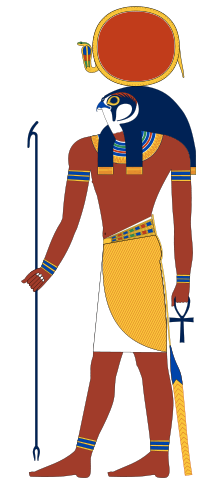
And a new meme was born! Ra, for those unfamiliar, is the ancient Egyptian deity of the midday sun, a major god of Egypt from somewhere about 2500 BC onwards. He was typically represented with a falcon head, and sun disk on top of it, as pictured below.
The ancient Egyptian god Ra is a powerful, benevolent deity, responsible for the creation of life and the one who protects and sustains it. On the other hand, Asshole Ra is petty, annoying, and pretty much, well, an asshole.
Taking classic Egyptian artwork of Ra from around the web, I produced my own conception of Asshole Ra. Go below to see his glory…
One of the tragedies of STEM education is the seemingly eternal perception by the general public that mathematics is boring and repetitive. Most people, of course, end their math education with algebra at most, though some work their way through a calculus course before leaving for good.
This is a tragedy because mathematics is one of the best fields to find incredibly beautiful objects, experience mind-blowing concepts that challenge ones imagination — or sometimes both simultaneously.
A wonderful example of this is the geometric object constructed by the Italian mathematician Giuseppe Peano and described in his 1890 paper “Sur une courbe, qui remplit route une aire plane.” This beautiful and mind-boggling object is illustrated below.
Uh… wait a minute…
*shuffling of papers as I check my notes*
No, that is correct! The object above is obviously a square, which at first glance would seem to be the most boring geometric figure possible. What Peano did, however, was demonstrate a new way to fill the square, inventing a mathematical construction that allows the square to be completely filled in with a single, continuous line! This “Peano curve” was the first example of what is now known as a space-filling curve, which has surprising and insightful connections to modern mathematics.
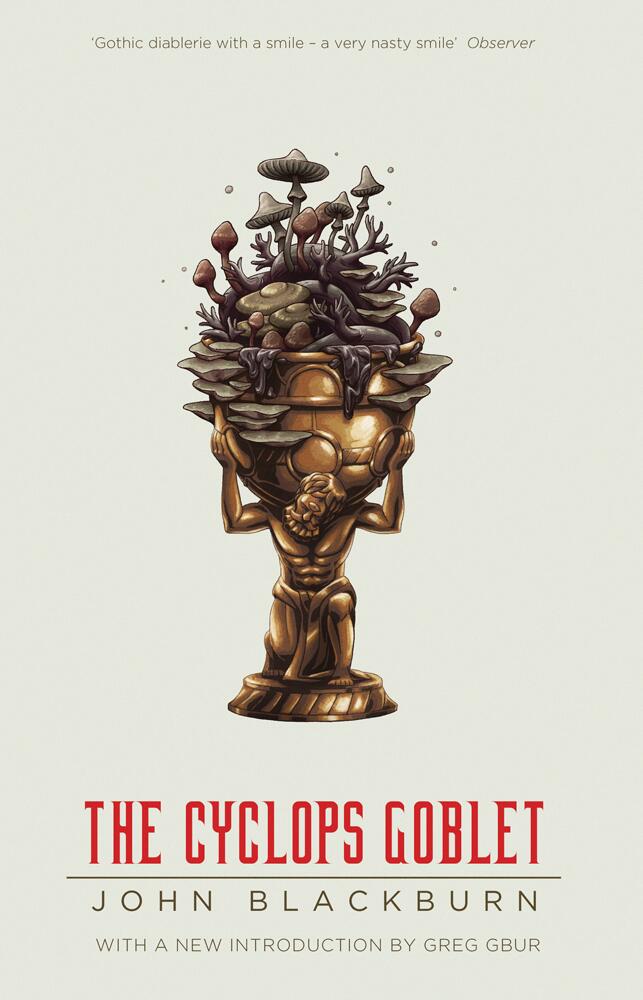
Another new Valancourt Books edition of a classic John Blackburn book has been released, and it includes another masterful* introduction by me! This time, the book is John Blackburn’s 1977 novel The Cyclops Goblet.
John Blackburn (1923-1993) was a prolific author of books containing a unique blend of thriller, science fiction and horror, producing some 25 novels over the course of his career (I talk about a number of them on this blog). His work was also extremely popular in his time, but was sadly almost completely forgotten after his death — until Valancourt started reprinting his books over the past year.
The Cyclops Goblet marks an interesting departure from Blackburn’s usual fare. It can be considered a classic “caper” story, in which a series of crooks attempt to pull off a spectacular heist — and try to double-cross each other in the process!
While I was at ScienceOnline 2014 last week, I received some great news: the 2013 edition of “The Open Laboratory,” an anthology of the “best science writing online,” was published! It is available as an e-book from The Creativist, and it includes my blog post on “The Barkhausen Effect” as one of the entries!
It really is a great collection, and I feel proud to have made it in once again, especially in light of the company I keep there, which includes Deborah Blum, Jennifer Ouellette, Maggie Koerth-Barker, Christie Wilcox, Melanie Tannenbaum, Jason Goldman, Krystal D’Costa, Blake Stacey and many more! The full list of authors and articles can be read at this blog post, and the collection can be ordered through The Creativist at this link.
The more I research, the more it becomes clear that cats caused all sorts of mischief in the scientific community in the late 1800s! The source of this mischief is the feline ability to turn themselves over in freefall and land on their feet, even when released at rest with no rotational motion. As I have noted in a previous post, this ability is, at a glance, seemingly at odds with the conservation of angular momentum — though in reality it is not! In a rigid body, the angular momentum of the object is directly proportional to its rotational speed. In a flexible body such as a cat, however, different sections can rotate in different ways, producing a net overall rotation even if the cat’s total angular momentum remains zero.
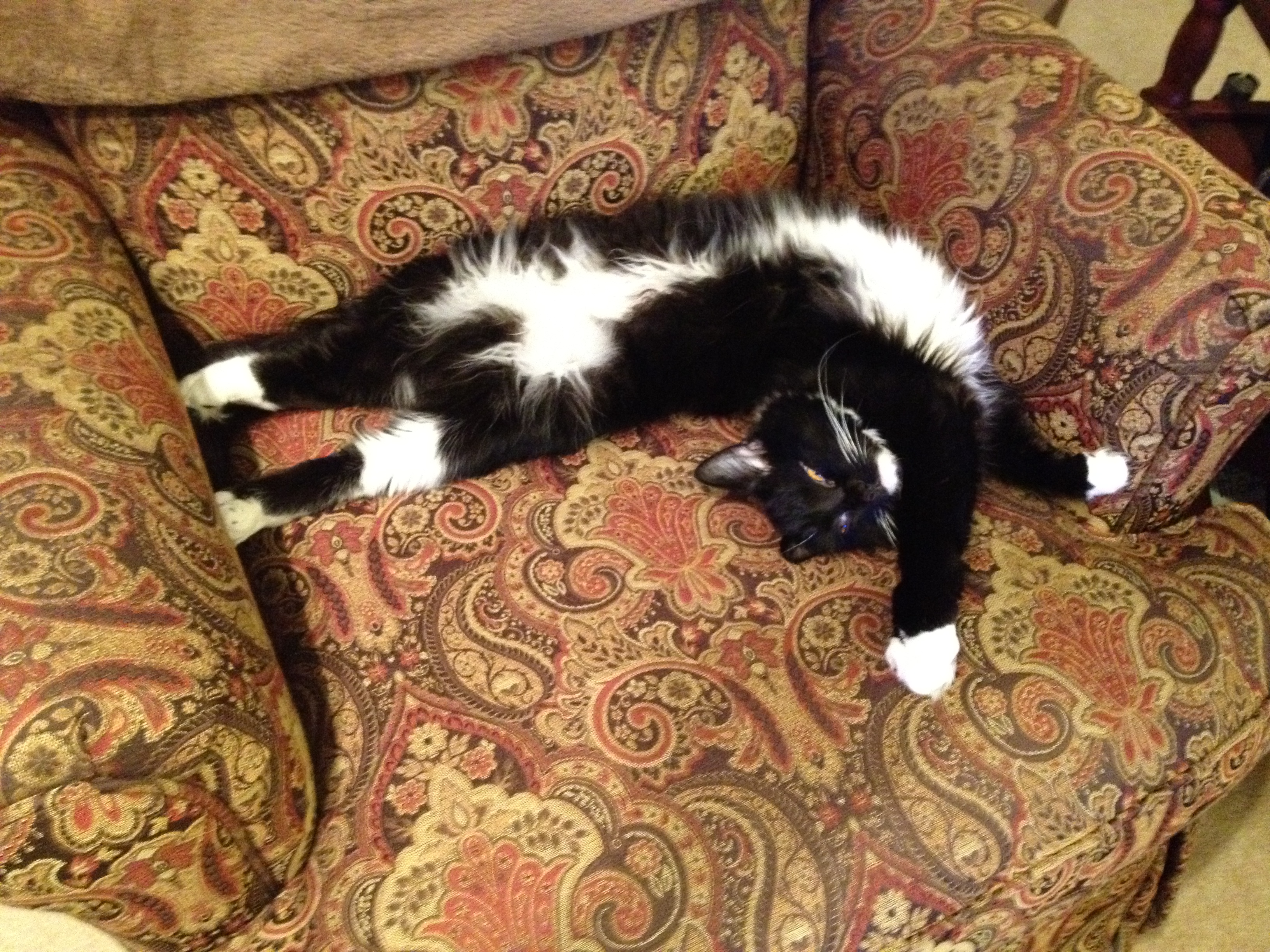
Resident feline fluidity expert Cookie demonstrates the bendy-ness of cats.
The debate, and confusion, was sparked in 1894 when Étienne-Jules Marey presented a sequence of photographs to the Paris Academy showing a cat flipping over at rest. As was later reported in the New York Herald, Marey’s observations were met with hilarious incredulity at the meeting:
When M. Marey laid the results of his investigations before the Academy of Sciences, a lively discussion resulted. The difficulty was to explain how the cat could turn itself round without a fulcrum to assist it in the operation. One member declared that M. Marey had presented them with a scientific paradox in direct contradiction with the most elementary mechanical principles.
Fortunately for the dignity of the scientific community, researchers quickly realized that Marey was correct: non-rigid bodies can flip over, even starting from rest, while conserving angular momentum. This led to a century-long investigation into how, exactly, a cat achieves this feat (you can read about the history in another blog post of mine).
Side view of a falling cat, by Marey. Images chronological from right to left, top to bottom.
Other researchers, however, found immediate inspiration in the cat’s newly-appreciated ability and its implications for physics. Inspired by Marey’s work, mathematician Giuseppe Peano in fact argued that the cat’s flipping talent provided a lesson and a solution for a problem in the most unlikely of places: geophysics!
One of the things I love about using Twitter is the opportunity to connect with people whose work I admire, from writers to scientists to artists to actors to musicians. Those connections can then lead you to new “discoveries” that you would otherwise not have come across.
Case in point: about a month ago, while my wife was out of town, I broke out my DVD copy of The Lost Skeleton of Cadavra (2001), a delightful spoof of low-budget science fiction from the 50s, and The Lost Skeleton Returns Again (2009), its very silly sequel. Both movies, and others, were written, directed, and starred in by the all-around auteur Larry Blamire; on a whim, I checked to see if he was on Twitter, and to my delight, he is, and to my further delight, he graciously acknowledged my existence!
While following him on Twitter, I recently learned that Blamire has also written a compilation of horror stories, Tales of the Callamo Mountains (2008):
Blamire also drew the cover of his book, continuing his efforts to make the rest of humanity look like the lazy talentless slaggards that we are.
Tales of the Callamo Mountains compiles 13 previously unreleased stories of horror, focused in and around the fictional Callamo Mountain Range. Set in the turbulent time following the Civil War, the tales feature settlers, marshals, laborers, soldiers, cowboys and others who, traveling in the remote and untamed West, find themselves up against nature and forces far more diabolical.
These stories are good. I was immediately hooked once I starting reading the first of them, and could hardly put the book down until I had finished it a couple of days later. A couple of the tales are absolutely brilliant, in my opinion.
This post is an exploration of some ideas I put together for a proposed magazine article. Will link to the article if and/or when it becomes available!
Last year, I wrote a blog post about the history of “cat-turning”: the ability of cats to turn themselves over in free-fall and land on their feet. The subject has a long, long history: scientists such as James Clerk Maxwell were investigating how cats do it back in the 1850s, and a complete model of “cat-turning” did not appear until 1969, over a hundred years later!
So what intrigued and, quite frankly, baffled physicists for so long? The surprising observation is that cats can still turn over in free-fall even when they are released at rest, i.e. with no initial rotation! Ironically, this probably freaks out physicists far more than non-physicists, because at first glance it appears to be a violation of the conservation of angular momentum. In fact, when Étienne-Jules Marey first presented his photographic evidence of the phenomenon to the Paris Academy of Sciences in 1894, a number of extremely distinguished researchers argued that his claim was flat-out impossible! The cats must, they argued, push off of the hands of the person holding them at the momento f release. (Others, however, sided with Marey, and at least some of the doubters quickly changed their opinions.)
Side view of a falling cat, by Marey, c. 1894. Images chronological from right to left, top to bottom.
Fortunately, though the “complete” model of cat-turning is quite complicated, it is possible to explain the basic idea in an elegant way — without using any math! How, you may ask, can I accomplish this wizardry?
Ever since reading author Basil Copper’s The Great White Space (1974) and Necropolis (1980), both of which were recently reprinted by Valancourt Books, I’ve been binge-reading the works of Basil Copper. I’ve read two of his short story collections so far, From Evil’s Pillow (1973) and And Afterward, the Dark (1977), and have been ordering other books as I find relatively inexpensive editions.
Last week, I finished reading The Black Death (1991), which was Copper’s final horror/mystery novel (though not his last book, as he continued to write mysteries for over a decade):
At the time of The Black Death’s writing, Copper was in his late 60s. Though it is not a deterministic rule, it is not uncommon to see the quality of an author’s writing decline in his or her later years. With this in mind, I didn’t know what to expect from The Black Death!
I shouldn’t have worried. Copper’s novel is a fascinating mixture of mystery, horror, and period Victorian drama. It is probably my favorite among all the Basil Copper stories I’ve read so far.
Updated with a third footnote clarifying my use of the term “diverge,” thanks to suggestion by Evelyn Lamb, who has also written an excellent discussion of the problem with the video. At the end of this post I list all the critiques I’ve found so far.
I feel like one of those grizzled action heroes who, having given it all up, is dragged reluctantly out of retirement for one more big mission. Over the past month or so (honestly, I forget how long I was working on things), I wrote a series of blog posts on the “weirdness” of infinity in mathematical set theory. Hopefully, there were two things that I got across in those posts: (1) infinity can be very weird, but (2) it can be comprehended, and even reasonable, once one understands the assumptions and limitations built into the mathematics.
Having retired from writing those posts, the other day I came across the following video:
So, using a seemingly simple series of mathematical manipulations, they “prove” the following astounding result: the infinite sum of increasingpositiveintegers equals a finite, fractional, negative number. In short:
.
This video was picked up by Phil Plait at Bad Astronomy, who called* it “simply the most astonishing math that you’ll ever see.” It has already spread far and wide across the internet, including making it to the popular site Boing Boing.
But is it true? The video makes it seem so simple, and uncontroversial, almost obvious. But there are some big mathematical assumptions hidden in their argument that, in my opinion, make it very misleading. To put it another way: in a restricted, specialized mathematical sense, one can assign the value -1/12 to the increasing positive sum. But in the usual sense of addition that most human beings would intuitively use, the result is nonsensical.
To me, this is an important distinction: a depressingly large portion of the population automatically assumes that mathematics is some nonintuitive, bizarre wizardry that only the super-intelligent can possibly fathom. Showing such a crazy result without qualification only reinforces that view, and in my opinion does a disservice to mathematics.
I’ve actually discussed this result years ago on this blog, talking about the Riemann zeta function and how -1/12 isn’t really equal to the infinite sum given. But even that discussion is probably a little too abstract, especially since I don’t discuss in any detail how the result -1/12 could be physically accurate. As it has been noted (and I’ve noted myself), the -1/12 result can be used with surprising accuracy in physics problems. But even there, things are much more subtle than they appear.
So let’s take a closer look** at the “proof” that an infinite increasing sum can equal -1/12. We will explain why the answer is not so simple as the video makes it appear, and why it is also not quite so simple to say that physics justifies the answer. We have a lot of ground to cover, so let’s go!
The history of science provides me with a practically never-ending set of delightful surprises! Case in point is a set of articles I found while browsing through volume 17 of Current Literature, “A Magazine of Record and Review,” published in 1895. Current Literature was an eclectic compilation of writings from a variety of other publications, including literature, science, and news magazines. I not only found exactly the bit of physics history that I was looking for (more to be said in a future post) but also a bunch of other weirdness.
The first one that caught my eye was an article with the rather curious title “With a telephone in his hat.” Reprinted from The Electrical Review, it turns out to be a very early, and in retrospect silly, true story of electronic eavesdropping! I reprint it in its entirety below, with only short comments appended.
The author of Skulls in the Stars is a professor of physics, specializing in optical science, at UNC Charlotte. The blog covers topics in physics and optics, the history of science, classic pulp fantasy and horror fiction, and the surprising intersections between these areas.





 .
.

 Skulls in the Stars