The Kaye effect after dark!

I’ve talked in some detail before about the Kaye effect, in which a shear-thinning fluid such as shampoo or liquid soap can be made to “bounce.”  Well, I did one final experiment with the Kaye effect, in order to show that the shampoo can be used as a light guide, as was demonstrated in 2006 by a Dutch research group.

My video result is posted below: nearly 3 glorious minutes of a cascading stream of shampoo with light glowing from within!  I was never able to get a truly stable Kaye stream, but the effect is almost more fun with the stream erratically bouncing.

Posted in Physics | 2 Comments

The Giant’s Shoulders #59 is out!

I hereby declare that the 59th edition of The Giant’s Shoulders, the history of science blog carnival, is up at Something by Virtue of Nothing!  This edition, centered around the theme of the Antikythera Mechanism, includes posts about:

  • Did Isaac Newton slash the portrait of Robert Hooke?
  • The Haunt of the Resurrection Men!
  • Views of the dangers of masturbation for women,
  • The weirdest weapons of history,
  • and much more!

Many thanks to the hosts for an excellent carnival!  The next edition, the five-year anniversary of the carnival (has it really been that long?), will be hosted by The Renaissance Mathematicus.  As always, submissions can be sent to me, ThonyC, or the host blog — the latter two of which are the same this time!

Posted in General science, Science news | Leave a comment

A gallery of my fantasy miniatures

Time for a little break from physics and fiction!  Though I haven’t been very active recently, for many years I was a hardcore gamer, playing both role-playing game and board games.  In fact, I credit much of my early aptitude in mathematics to the amount of time I spent crunching numbers in Dungeons & Dragons.

I’m hoping to get back into some more gaming at my local game store, but I’m also planning to get back into painting fantasy miniatures.  For those unfamiliar, role-playing games and fantasy wargames can be played on tabletop with 25mm miniatures, and there is a vast collection of high-quality unpainted minis available for purchase.  Though I haven’t played games for quite some time, I’ve been painting on and off in the interim.

I thought I would share some images of my best paint jobs, with a little bit of a description to go with each one!  I should note that, being my best work, for every miniature you see here there are at least two more that didn’t turn out quite so well.  I should also note that these miniatures were painted for display, as opposed to being painted for gaming.  This means that I spent much more time on each paint job and used light coats to allow for finer detail.  Paint jobs for actual gaming are necessarily cruder and use thicker coats.

Without further ado, here are my best fantasy miniatures!

This slideshow requires JavaScript.

Posted in Personal, role-playing games | 4 Comments

All about rainbows, double rainbows, circular rainbows!

Do not all charms fly
At the mere touch of cold philosophy?
There was an awful rainbow once in heaven:
We know her woof, her texture; she is given
In the dull catalogue of common things.
Philosophy will clip an Angel’s wings,
Conquer all mysteries by rule and line,
Empty the haunted air, and gnomèd mine—
Unweave a rainbow, as it erewhile made
The tender-person’d Lamia melt into a shade.

-John Keats, Lamia (1820)

Poet John Keats (1795-1821) once famously — and infamously — joked that Isaac Newton had destroyed the poetry of the rainbow by “reducing it to the prismatic colors.”  This statement has been quoted often whenever someone wants to argue that scientific knowledge dulls the beauty and poetry of nature.

Keats was being an idiot, though: a true understanding of the science behind a phenomenon  only adds to its beauty.  There are so many subtle aspects to even the simple optics of a rainbow that make it a fascinating and lovely subject of contemplation.  Once you get past the basic science of a rainbow, you are well-prepared to study more sophisticated and unusual phenomena such as this double rainbow that my wife and I saw from our house last July.

Double rainbow.  It was, in fact, all the way.

Double rainbow. It was, in fact, all the way.

I’ve had rainbows on my mind since I was recently asked to explain some of the optics by a journalist.  Surprisingly, standard optics textbooks such as Born and Wolf’s Principles of Optics and Hecht’s Optics have no discussion of the phenomenon.  This is likely due to the fact that most optical scientists have no need to understand rainbows in their research, but this does not mean they are not objects worthy of study.

So let me endeavor to explain all about rainbows: how they form, how double rainbows form, when fully circular rainbows form, and anything else I can think of.  This isn’t just trivia: a lack of knowledge of rainbows can lead to truly humiliating consequences.

Continue reading

Posted in Optics | 15 Comments

Jack Finney’s The Body Snatchers

This post continues a long-neglected series of posts about classic novels of science fiction and horror that were adapted into movies of the 1950s and 1960s.  Years past, I talked about John Wyndham’s The Midwich Cuckoos and The Day of the Triffids, as well as John W. Campbell’s Who Goes There?  In this post I consider an equally iconic novel that was adapted into four movies so far, and likely more to follow!

The 1950s and 1960s must have been a wonderful time to be a science fiction writer.  Not only was the genre at the height of its popularity, but its novels were readily tapped for screen adaptations.  Growing up, I was completely unaware that many of the films I watched on Sunday afternoon “Creature Features” were based on novels, but now I find it fascinating to go back and see how the movies compare to their original inspirations.

One of these that I believe almost everyone on the planet must have heard of at one point or another is Jack Finney’s The Body Snatchers (1955), later revised to Invasion of the Body Snatchers.

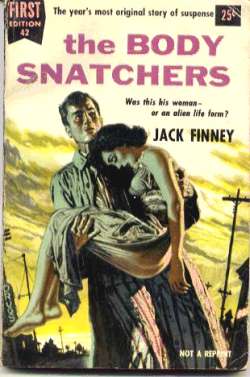
First edition cover via Wikipedia, which actually accurately depicts a scene in the book.

First edition cover via Wikipedia, which actually accurately depicts a scene in the book.

Finney’s book was an immediate sensation, and was quickly turned into the instant classic 1956 film Invasion of the Body Snatchers.  Three other adaptations followed, in 1978, 1993 and 2007.  But what of the original novel, and how does it compare to the films?  Let’s take a look!

Continue reading

Posted in Horror, Science fiction | 2 Comments

Physics demonstrations: Chladni patterns

A good demonstration of a physical phenomenon should be both insightful and exciting.  Sometimes, a demonstration succeeds at both so well that it is practically awe-inspiring.  Such is the case, for me, with the demonstration of Chladni patterns, exotic and beautiful vibration figures that can be displayed with the help of just a little sand.

The demonstration of a couple of Chladni patterns are shown in the video below.  A metal plate, supported by a post in its center, is vibrated at a single frequency by use of a mechanical driver.  For most frequencies, nothing at all happens; when certain special frequencies are hit, however, standing waves appear on the plate, driving the sand away from the points of large vibration to the points of no vibration.  By varying the frequency of oscillation, we can find a large number of the so-called resonance frequencies and their accompanying patterns, which become increasingly complex and beautiful as we up the rate of oscillation.

Chladni figures are a lovely examples of resonance, an important concept in almost all branches of physics, including vibration.  Rigid and semi-rigid bodies possess an (in principle) infinite number of natural frequencies of vibration at which the object “wants” to move.  In this post we look at resonance, as illustrated by Chladni’s demonstration, and the role it plays in numerous phenomena.

Continue reading

Posted in Physics, Physics demos | 4 Comments

Physics demonstrations: cloaking device?

I’ve spent a lot of time on this blog talking about the optics of invisibility, both hypothetical and actual.  Though a number of forms of invisibility have been considered in both science and fiction for over a hundred years, the study of the subject really exploded in 2006 with the publication of two theoretical papers introducing designs for “invisibility cloaks.”

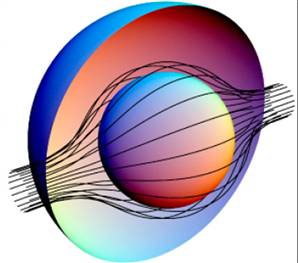
The principle behind one of these cloaks is illustrated below, taken from the original paper by Pendry, Schurig and Smith.   The cloak guides light around the central region and sending it along its original path, like water flowing around a boulder in a stream.  The lines in the illustration represent rays of light being deflected and returned to their original trajectories.

originalcloak

The device is passive; it “works its magic” by virtue of the materials it is built out of, and guides light around the hidden region by what amounts to refraction.

It is fun to talk about the unusual implications of optical invisibility, but it is hard to show it!  Cloaks are complicated, and there are relatively few experimental realizations to date — and those that do exist are not easily reproducible without a lot of resources.

Fortunately, there exists a simple trick, suggested by my colleagues*, that can be used to demonstrate the principle of cloaking in a striking way!  I assembled a version of this trick myself for use in a recent popular talk on invisibility physics that I gave; a short video of it is shown below.

A finger placed behind the device is readily visible, but a finger placed within the cloak vanishes!

For about $50, you too can make your own “cloaking device”, albeit an oversimplified and crude one!  Let’s take a look at how it is done.

Continue reading

Posted in Invisibility, Optics, Physics demos | 7 Comments

John Blackburn’s The Face of the Lion

I won’t have many more of these to announce in the future (I swear!), but I wanted to point out that another book by John Blackburn has been released recently that contains an introduction by me — The Face of the Lion!

face_of_the_lion


Written in 1976, The Face of the Lion is a rather unusual novel — it can be considered an early novel that contemplates the possibility of a “zombie apocalypse,” so popular in horror fiction today.

When a remote region of the Scottish Highlands is cordoned off by mercenaries working for the laird James Frasier Clyde, the British government suspects that Clyde is planning to test a home-made atomic bomb in a bid for Scottish independence.  It becomes quickly clear, however, that Clyde is not seeking to keep people out as much as keep something in: a horrible disease is spreading among the people of the area, turning them into mindless raging beasts that can spread their contagion with a touch.  As the infection spreads beyond the restricted region, bacteriologist Sir Marcus Levin and Colonel Lawrence of the Internal Security Service race to understand and contain it before the entire country, if not the world, is devastated.

The Face of the Lion is very much a classic style of Blackburn novel: part horror and part mystery.  There is a sinister and complicated force behind the plague, and discovering its origin is just as much a part of the plot as is stopping it.  True to all of Blackburn’s fiction, the story contains many twists and turns, all the way up to its final shocking revelations.

This is not one of Blackburn’s strongest novels: by 1976, he had been writing horror — and about plagues in particular — for nearly 20 years, and the story doesn’t “click” as much as his earlier works.  In fact, the story is reminiscent of even his first novel, A Scent of New-Mown Hay, in which a sinister disease threatens to wipe out the world.  Nevertheless, The Face of the Lion is well-crafted and works well as an introduction to Blackburn’s work, which was hugely popular in his time and had a significant influence on later British horror authors.

I had a lot of fun with the introduction to this book, trying to fit it into the broader genre of “zombie apocalypse” novels.  This gave me the opportunity to present a short history of such novels, stretching back hundreds of years to the first “last man” story in 1805.  The Face of the Lion was very much ahead of its time and I think readers will be fascinated to see how much Blackburn anticipated future developments in the genre.

It’s also worth noting that I had a small part in the design of the cover of this edition!  I provided the basic structure of the lion and biohazard sign and Valancourt crafted it into the excellent cover that is pictured above.  Hopefully it gives the right feeling of sophisticated menace that John Blackburn’s books so rightly deserve.

Posted in Horror | Leave a comment

J.B. Priestley’s Benighted

Valancourt Books, traditionally specializing in fiction of Edwardian era and older, has recently started printing new editions of excellent but forgotten 20th century novels.  I, of course, have written introductions for a number of the books of John Blackburn (Bury Him Darkly, Broken Boy and Nothing but the Night for starters), but there are plenty of other intriguing books that Valancourt has been releasing, as well.

One that caught my eye was J.B. Priestley‘s short 1927 novel Benighted.

benighted

Cover of the Valancourt edition, reproduced from the original.

This was the second novel of J.B. Priestley (1894-1984), a prolific author who published 26 novels during his lifetime.  It was with his third novel, The Good Companions, that Priestley achieved major success, but Benighted was significant in its own right, being made into the 1932 film The Old Dark House, starring the iconic Boris Karloff.

What is it about?  The movie title is rather perfect, as the story is of a genre of what may be called “old dark house” stories.  In such stories, a group of people are gathered by design or fate in a old sinister house, are trapped within it together by circumstance and subjected to unspeakable horrors.

Continue reading

Posted in Mystery/thriller | Leave a comment

The Giant’s Shoulders #58 is out!

I was a little slow in posting about it, but the 58th edition of the history of science blog carnival, The Giant’s Shoulders, is up at Asylum Science!  In this edition, you can read about:

  • cosmonauts who had to survive the Siberian forest after surviving space,
  • fixing astronomical equipment with earwax,
  • Victorian issues with masturbation,
  • Margaret Thatcher’s dubious connection with soft-serve ice cream,
  • and much more!

Many thanks to Mike Finn and Jenn Wallis for putting together an excellent carnival!

The next edition of The Giant’s Shoulders will appear at the Something by Virtue of Nothing blog on 16th May 2013.  Posts are due for submission by May 15, and can be submitted directly to the host, to  ThonyC at The Renaissance Mathematicus or to me right here!

Posted in General science, Science news | Leave a comment