How to become invisible by “hiding under the carpet”

Since the first theoretical cloaking papers in 2006, the topic of optical invisibility has just gotten stranger and stranger.  There have been proposals of optical wormholes, perfect optical illusions, space-time cloaks, and more.  Perhaps even more surprising, however, is the speed at which practical implementations of a number of ideas have been achieved.  Consider, for instance, this short video of a macroscopic optical invisibility cloak, a small-scale version of an object demoed at TED 2013 by physics professor Baile Zhang:

Impressive, is it not?  This device is the implementation of a cloaking idea introduced in 2008* and described colorfully as “hiding under the carpet!”  It holds the most promise in the short term for being able to effectively hide macroscopic (larger than microscopic) objects.

But what is a “carpet cloak,” and how does it work?  To answer this, we delve back into the weird optics of cloaking devices, and their design using theoretical warpings of space!

Continue reading

Posted in Invisibility, Optics | 4 Comments

John Blackburn’s “Bury Him Darkly” and “Broken Boy”

Part of why I love writing this blog is rediscovering classic weird fiction that has been lost through misadventure and misfortune.  Happily, others share this interest, and some of them are in an even better position to do something about it!

Over the past week, my favorite publisher Valancourt Books released two new editions of classic horror novels by British author John Blackburn.  The novels are excellent, but these are of personal significance to me: I wrote new introductions for them!

blackburncovers

Valancourt is releasing a series of Blackburn’s works, beginning with Broken Boy (1959) and Bury Him Darkly (1969).  But who is John Blackburn, and why did I call his works “classics?”

Continue reading

Posted in Horror, Personal | 7 Comments

The Giant’s Shoulders #56 is out!

The 56th edition of the history of science blog carnival, The Giant’s Shoulders, is up at The Dispersal of Darwin!  In this edition, you can read about:

  • How a (sort of) believer in ancient astronauts almost became U.S. President,
  • The searchers of the dead: the unappreciated 16th people who collected and inspected the bodies of plague victims,
  • Forgeries, lies, and deception in history,
  • Charles Darwin’s geological studies,
  • Macaque and dagger in the simian space race: how espionage and science crossed paths in early space exploration,
  • and much more!

Many thanks to Michael Barton for putting together a really interesting and large carnival!

We’re still looking for more hosts for the carnival, but next month I will host The Giant’s Shoulders right here at Skulls in the Stars, posting on the 16th!  Submissions can be sent directly to me via email, blog comment, or twitter.

Posted in General science, Science news | Leave a comment

The mirror that (didn’t really) make it rain! (1713)

In my last post, I talked about the remarkable career of Etienne-Gaspard Robert aka “Robertson”, who became famous in debunking the supernatural by revealing how ghosts and phantoms could be faked.  Remarkably, even today there are still places in the world where superstitious fear can be deadly, as two recent stories, here and here, demonstrate.  It seems to be ingrained in human nature to be credulous, and science-minded people must be vigilant in explaining away the supernatural before it gets out of control. Robertson himself had many experiences to drive this point home before he started his phantasmagoria.

One story that Robertson heard that clearly left a great impression on him was told to him by his early mentor, Monsieur Villette, an optical instrument maker.  Villette’s father was a maker of large concave mirrors, and at one point the local villagers became convinced that this mirror was producing excessive rain that was ruining their crops!

Continue reading

Posted in ... the Hell?, History of science | Leave a comment

Phantasmagoria: How Étienne-Gaspard Robert terrified Paris for science

Scientists are so often imagined to be bland and unimaginative, slaving away at research and taking away the joy of nature.  I’m no longer so irritated by this perception as I used to be, but rather surprised by it: going through the history of science, there are countless colorful characters whose personalities and activities almost defy description.

A great example of such a character is Étienne-Gaspard Robert (1763-1837), a Belgian physics teacher who was also a pioneer of ballooning and, of interest in this post, a stage magician known as “Robertson.”  Using his knowledge of physics and optics, Robertson perfected the optical stage illusion known as “Phantasmagoria,” which he used both to educate and terrify the Parisian public!

His activities were succinctly described in an 1855 biographical article (to be called BA1855 in this post):

He was a charmer who charmed wisely,– who was a born conjurer, inasmuch as he was gifted with a  predominant taste for experiments in natural science,– and he was useful man enough in an age of superstition to get up fashionable entertainments at which spectres were to appear and horrify the public, without trading on the public ignorance by any false pretence.

Robertson’s exploits could fill up several books — indeed, he filled two himself with his own memoirs!  Here we will take a look at some highlights of the remarkable man’s life, focusing particularly on his optical endeavors — and his phantoms!

Continue reading

Posted in History of science, Horror, Optics | 15 Comments

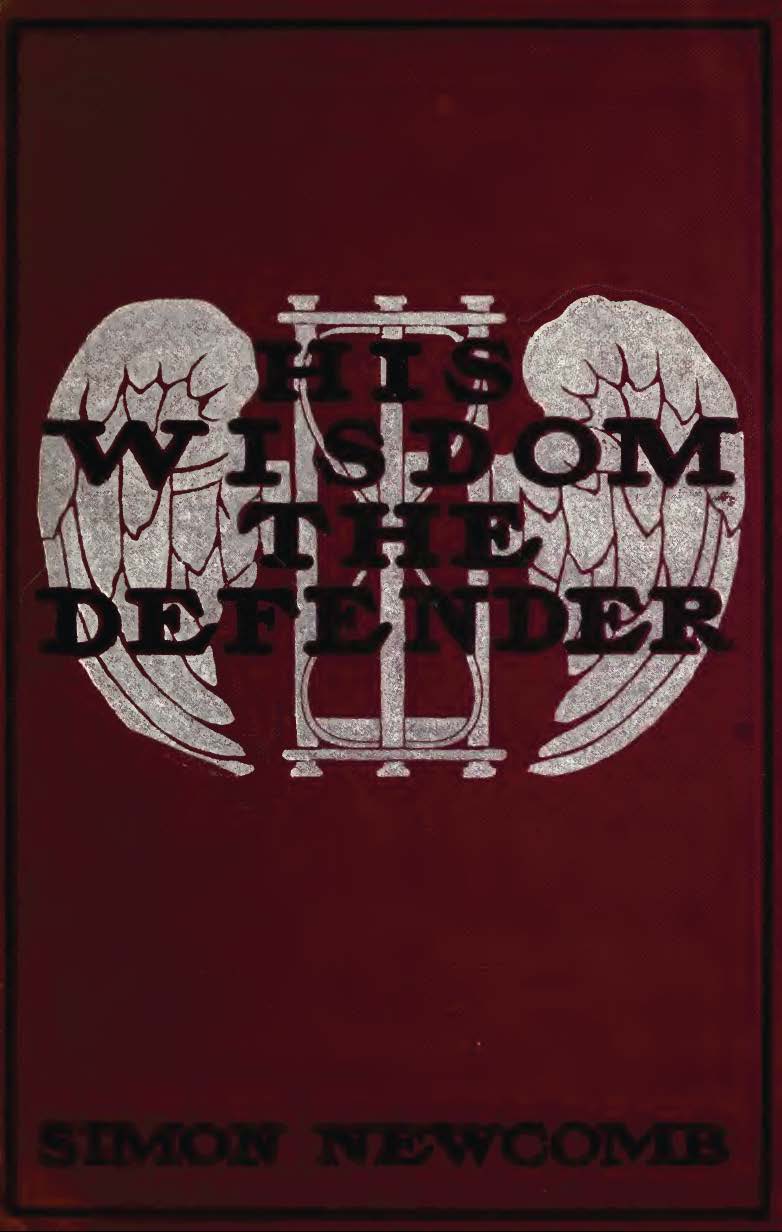
His Wisdom The Defender: A Story, by Simon Newcomb (1900)

My explorations of the early history of science fiction and horror has turned up a surprising number of scientists or people with scientific training who have dabbled in speculative fiction.  Optical scientist Robert Williams Wood coauthored a pair of science fiction novels, The Man Who Rocked the Earth (1915) and The Moon-Maker (1916).  Millionaire inventor John Jacob Astor wrote the space exploration novel A Journey in Other Worlds in 1894.  Many people are likely unaware that science fiction master H.G. Wells was a trained biologist and worked as both a science teacher and science journalist for short periods of time.  (There are more modern examples such as my friend Blake Stacey’s book Until Earthset.)

Scientists are often envisioned as passionless people whose scientific endeavors drain the beauty out of life: “unweaving the rainbow,” so to speak.  The examples above put the lie to that accusation.  Some time ago I found another example of a famous scientist trying his hand at science fiction: in 1900, the astronomer Simon Newcomb (1835-1909) published His Wisdom The Defender: A Story.

hiswisdomthedefender

In Newcomb’s book, a brilliant scientist makes an Earth-shaking discovery that can change the world, and he sets out to do just that!  The heroic antics of the scientist were, to me, actually rather reminiscent of another famous fictional scientist, as I describe below…

Continue reading

Posted in History of science, Science fiction | 3 Comments

A(nother) visit to the Duke Lemur Center!

One of the best-kept secrets that shouldn’t be a secret at all in North Carolina is the wonderful Duke Lemur Center, situated in Durham, NC.  A research facility for the adorable but sadly endangered prosimians, it has the largest collection of lemurs in one place outside of their native home of Madagascar!

This past week I was participating in ScienceOnline 2013 (#scio13) in neighboring Raleigh, NC.  Visits to the Lemur Center have been offered for conference in almost every year of the meeting, and almost every year I’ve tried to take the tour (see here and here, for instance).  I skipped it last year to give others a chance to see these wonderful animals, but this year it seemed to have plenty of space available and I happily went along.

I got some of the best photographs of lemurs that I’ve ever gotten before while at the center!  Follow me below to see the lovely lemurs, and learn a bit about of them.

Continue reading

Posted in Animals, General science | 2 Comments

Artologica at ScienceOnline (and online)!

Update: Michele will be showing off her work tonight, Friday the first of February, in the Marriott hotel lobby between 5:00 pm and 7:30 pm!

This week I’m attending ScienceOnline 2013, the yearly online science communication conference in Raleigh, NC.  I’ll have plenty of things to say about the meeting when it ends, but while I’m here I wanted to give a shout out to my friend and excellent artist Michele Banks, who goes by the name @artologica on Twitter!

I wanted to note two things: for those attending the meeting, please make sure you talk to Michele about her artwork: she has a variety of it for sale with her but can’t sell at the meeting, but will be happy to show you what she has.

More generally, I would like to point out that Artologica has both a blog and an etsy shop where you can see and purchase all of her work!  As of this writing, her shop is closed while she’s at the meeting here, but be sure to check back soon to see her amazing work.

I purchased one of Michele’s pieces last year at ScienceOnline 2012, and it is hanging in my office right next to my desk for easy viewing when I need inspiration or a break from my headache-inducing research:

artologicaMore on ScienceOnline to come soon!

Posted in Entertainment, General science | Leave a comment

The Thing From the Lake, by Eleanor Ingram (1921)

I am continually astonished at the number of truly wonderful books that have been neglected and then forgotten as the years go by.  Sometimes the books are simply ahead of their time, sometimes the authors die, leaving no one to advocate for them, and sometimes simple bad luck makes them disappear from the shelves.  Fortunately, many of these books are being reprinted by quality publishers (such as Valancourt Books, who I’ve raved about for years and am now writing some introductions for); other can be uncovered freely available on internet archives.

Archives don’t really advertise, though, and sometimes it’s just dumb luck that I learn about an overlooked and exquisite novel.  I was recently reading Sinister House by Leland Hall, which was reprinted by Hippocampus Press, when such luck hit.  The introduction by Lovecraft scholar S.T. Joshi includes a mention of the 1921 novel The Thing From the Lake, by Eleanor Ingram.

A “Thing” from a lake?  How could I resist such a title?  I immediately scared up an electronic copy and set myself reading.

thingfromthelake

In spite of the title, I wasn’t necessarily optimistic about the book, considering my search came across another recent review that was decidedly not positive.

I was pleasantly surprised, however!  I found The Thing From the Lake to be a charmingly atmospheric haunted house story, albeit one that is also an early 20th century romantic drama.

Continue reading

Posted in Horror | 4 Comments

The Resurrection Men: when people would kill to get into cemeteries

Government has always played, and hopefully will continue to play, a necessary role in scientific and medical research.  Many important discoveries have been made through the use of government funding and in government labs, and many of those would never have been made in the private sector due to lack of marketability.

However, government can also play a negative role in science, as is clear looking at any number of examples through history.  One that really stands out are the Acts of Parliament in England starting in the 1500s related to the use of cadavers for dissection; these acts, and the failure to revise them quickly, led to an epidemic of grave-robbing that lasted until the early 1800s!

Numerous and increasingly desperate attempts were made by people to protect their loved one’s bodies from unlawful removal; one of the most dramatic was the use of a “cemetery gun,” an automatic spring-tripped weapon that would shoot anyone who tampered with graves.  As I understand it, these guns might be stationed above the grave, at the entrance to the cemetery, or even inside the coffin itself.  Their tendency to accidentally shoot innocent people, however, eventually led to their being outlawed.

There is very little information such weapons online.  Recently, when I was searching for information, I came across a 1905 article in the John Hopkins Hospital Bulletin by G. Canby Robinson*, “The development of grave robbing in England.”  This article provides an overall history of how the practice started in England and how extreme things became before its eventual demise; some of the tidbits are so fascinating that I had to share them here.

Continue reading

Posted in ... the Hell?, History of science | 2 Comments