Two days until The Giant’s Shoulders #11!

Here’s one last reminder that the deadline for The Giant’s Shoulders #11, to be held at Curving Normality, will be here in 2 days!  Entries can be submitted through blogcarnival.com or directly to the host blog, as usual!

Posted in General science, Science news | 3 Comments

Optics in the Haunted Mansion!

During our visit to Walt Disney World, the new wife and I made sure to hit all the classic rides in the Magic Kingdom: Pirates of the Carribean, The Tiki Room, The Haunted Mansion, even It’s a Small World (though, alas, not Space Mountain, which is under renovations until November).  The Haunted Mansion is one of my favorites, with its classic Gothic ghost story atmosphere and dark sense of humor.  As a child, I was terrified of the essentially harmless attraction.  This trip, as a professor of optics, I was delighted to not only see the clever special effects, but deconstruct them — to “peek behind the curtains”, so to speak.

I suppose some would think that this peek would “ruin the magic” or “unweave the rainbow“.  For me, though, I find it a joy to see how people’s ingenuity can lead to wonderfully fun, even beautiful, attractions.  The Haunted Mansion is filled with clever applications of very simple optics, and I can’t resist explaining one of them.

SPOILER ALERT!  IF YOU FEEL THAT UNDERSTANDING HOW AN ATTRACTION WORKS RUINS IT, DON’T READ ANY FURTHER…

Continue reading

Posted in Entertainment, Optics | 18 Comments

Thanks to all!

Well, I’m back from the honeymoon!  Thanks to all who gave well-wishes and congratulations in my previous post.  I should get back to detailed blogging this week, but in the meantime, here’s a picture from Epcot at night:

epcotatnight

Yeah, we went to Disney World for our honeymoon!

Posted in Personal | 2 Comments

Just Married!

If all went well, I got married to the fiancée within the past hour!  (Obviously, this is a post I scheduled in advance.)

For obvious reasons, I won’t be blogging much, if at all, over the next week.  After that, I’ll be back in the swing of things!

Posted in Personal | 15 Comments

Destroying the planet… with science!

When the Large Hadron Collider was fired up for the first time back in September, it caused much wailing and rending of clothes by people who were convinced that the device would create miniature black holes which would destroy the Earth, even though the initial test wouldn’t come close to the energies hypothetically required for such an unlikely event.  After the test, others were irrationally convinced that the LHC had spawned earthquakes around the globe; I did a rather thorough criticism of that idea here.

It’s interesting to note that such fears have been cropping up since the dawn of atomic physics, sometimes seriously and sometimes as a joke.  A physics professor I had as an undergraduate shared the story of his research on neutrinos in the 1960s, which took place in a shack outside the grounds of a nuclear reactor.  He said that he and his classmates were tempted to leak a story to the press that they were working on a “neutrino bomb”, which was so effective because it could pass through anything.  They realized, though, that the public wouldn’t realize that, if neutrinos pass through everything without any significant effect, that they couldn’t hurt you!

Continue reading

Posted in ... the Hell?, History of science, Physics | Leave a comment

13 days until The Giant’s Shoulders #11!

This is your regularly scheduled reminder that the deadline for The Giant’s Shoulders #11, to be held at Curving Normality, will be here in 13 days!  Entries can be submitted through blogcarnival.com or directly to the host blog, as usual!

Posted in General science, Science news | Leave a comment

h-index of 14!

In one of my periodic blog moments of patting myself on the back, I should note that my h-index went up to 14 this past week!

As I’ve described previously, when my h-index went to 13, the h-index (or Hirsch index) is a rough estimate of the productivity of a scientist and the impact of their work.  An h-index of N means that you have no more than N papers which each have more than N citations each.  It is a very crude measurement of productivity, as is any quantitative measurement, but one that’s relevant for decisions such as tenure.

Considering the Wikipedia article cites an h-index of 10-12 as a guideline for tenure decisions, and 15-20 a fellowship in the American Physical Society, I’m feeling pretty good about my chances.

Unfortunately, I’ll need quite a few citations to bump myself to an h-index of 15.  Unless I get really lucky, I won’t have another celebration like this for a while…

Posted in Personal | 2 Comments

Mrs. Carver’s The Horrors of Oakendale Abbey

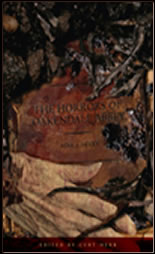
Generally, I’m a bit tired of the genre of Gothic fiction, though I have enjoyed the few that I’ve read for the blog (see The Animated Skeleton and The Witch of Ravensworth).  One other caught my eye when I was perusing books to read: The Horrors of Oakendale Abbey (1797), by Mrs. Carver:

bigoakendale

What did I think about it?  I was a trifle disappointed by the story, though it definitely is a unique Gothic novel.

Continue reading

Posted in Horror | 6 Comments

Who first suggested the nuclear atom?

Here’s a little obscure physics trivia for you: who first suggested that an atom might have a structure consisting of a positively-charged “nucleus” surrounded by orbiting electrons?

The easy, and mostly correct, answer is Ernest Rutherford.  In 1909, he supervised two of his students (Geiger and Marsden) in an experiment to probe the structure of atoms using alpha-particles.  Surprisingly, they found that occasionally one of the alpha-particles would be almost completely reflected from their sample, which should not have happened according to the Thomson “plum-pudding” model of the era.  Rutherford himself later remarked, “It was almost as incredible as if you fired a fifteen-inch shell at a piece of tissue paper and it came back and hit you.”  In 1911, Rutherford published a paper (“The Scattering of Alpha and Beta Particles by Matter and the Structure of the Atom,” Phil Mag, ser 6, 21 (1911), 669-88) in which he argued that the results suggested that the atom consisted of electrons orbiting a very small, dense, positively-charged nucleus which contained most of the atom’s mass.  This realization was a major breakthrough in atomic physics and eventually led to our modern picture of atomic structure.

When I was working on my post on “failed atomic models” some time ago, however, I encountered an off-hand remark that Jean Baptiste Perrin, another giant in atomic theory, had first proposed a nucleo-planetary atomic model in 1901.  Curiously, though, I was unable to find a reference to it, and I’ve always wondered why.

Perrin’s own Nobel lecture of 1926 provides most of the answer:

I was, I believe, the first to assume that the atom had a structure reminding to that of the solar system where the “planetary” electrons circulate around a positive “Sun”, the attraction by the centre being counterbalanced by the force of inertia (1901). But I never tried or even saw any means of verifying this conception. Rutherford (who had doubtless arrived at it independently, but who also had the delicacy to refer to the short phrase dropped during a lecture in which I had stated it) understood that the essential difference between his conception and that of J.J. Thomson was that there existed near the positive and quasi-punctual Sun, enormous electrical fields as compared with those which would exist inside or outside a homogeneous positive sphere having the same charge, but embracing the whole atom.

In other words, Perrin first proposed the nucleo-planetary model, but never pursued the idea beyond some basic speculations.  Rutherford is rightly given most of the credit for the development of the model, as he supervised the experiments which led to its verification and worked out the rigorous theory behind it.

One thing I would like to find, though, is the place where Rutherford referred to Perrin’s planetary model!  I’ve been searching through Rutherford’s papers on the nuclear model, but so far have not found any reference to Perrin.  If I find it, I’ll write an additional post on the subject…

Posted in History of science, Physics | 7 Comments

Mr. Faraday goes wild — with atomic speculation! (1844)

Michael Faraday (1791-1867), whom I’ve talked about numerous times, has a reputation as being a bit of a theoretical lightweight, namely because he had little formal mathematical training.  In spite of this, however, he had an ability to think abstractly and, yes, theoretically about problems in a way that, when examined, is nothing short of amazing.

In my previous researches on Faraday, I came across a reference to an article he wrote in 1844 in volume 24 of Philosophical Magazine, pp. 136-144, “A speculation touching electric conduction and the nature of matter.”  Faraday, already a distinguished and even famous scientist, shared some thoughts about the nature of atomic structure, based on the paucity of knowledge that was available at the time.  His observations, though still off the mark according to current understanding, were remarkably forward thinking; furthermore, they provide a lovely snapshot of the ‘state of the art’ in 1844.   Let’s take a look at his paper:

Continue reading

Posted in History of science, Physics | 7 Comments