Slan, by A.E. van Vogt

Yet another story that features the physics of invisibility, continuing my series of posts inspired by the research into my upcoming book on the history of invisibility physics!

A secret race of mutant humans, gifted with superpowers, hides out from the bulk of humanity that hates and fears them and seeks to exterminate them utterly.

If this sounds familiar, you might be thinking of the classic Marvel comics series X-Men, but in this case I’m referring to the much earlier novel by A.E. van Vogt, Slan, first published in serial form in 1940 and then made into a book in 1946. (Image from the contemporary edition that I read.)

Slan is a classic of science fiction, and A.E. van Vogt’s first novel. Like many serialized stories of the time, it is a fast-paced tale with lots of twists and turns (and things that don’t completely makes sense if you think about them too much). I was drawn to read it because it includes a description of a spacecraft with what amounts to a cloaking device!

Continue reading
Posted in Invisibility, Science fiction | 3 Comments

The Shadow of the Beast, by Robert E. Howard

Another post about an invisibility story, from my researching into my book on invisibility physics.

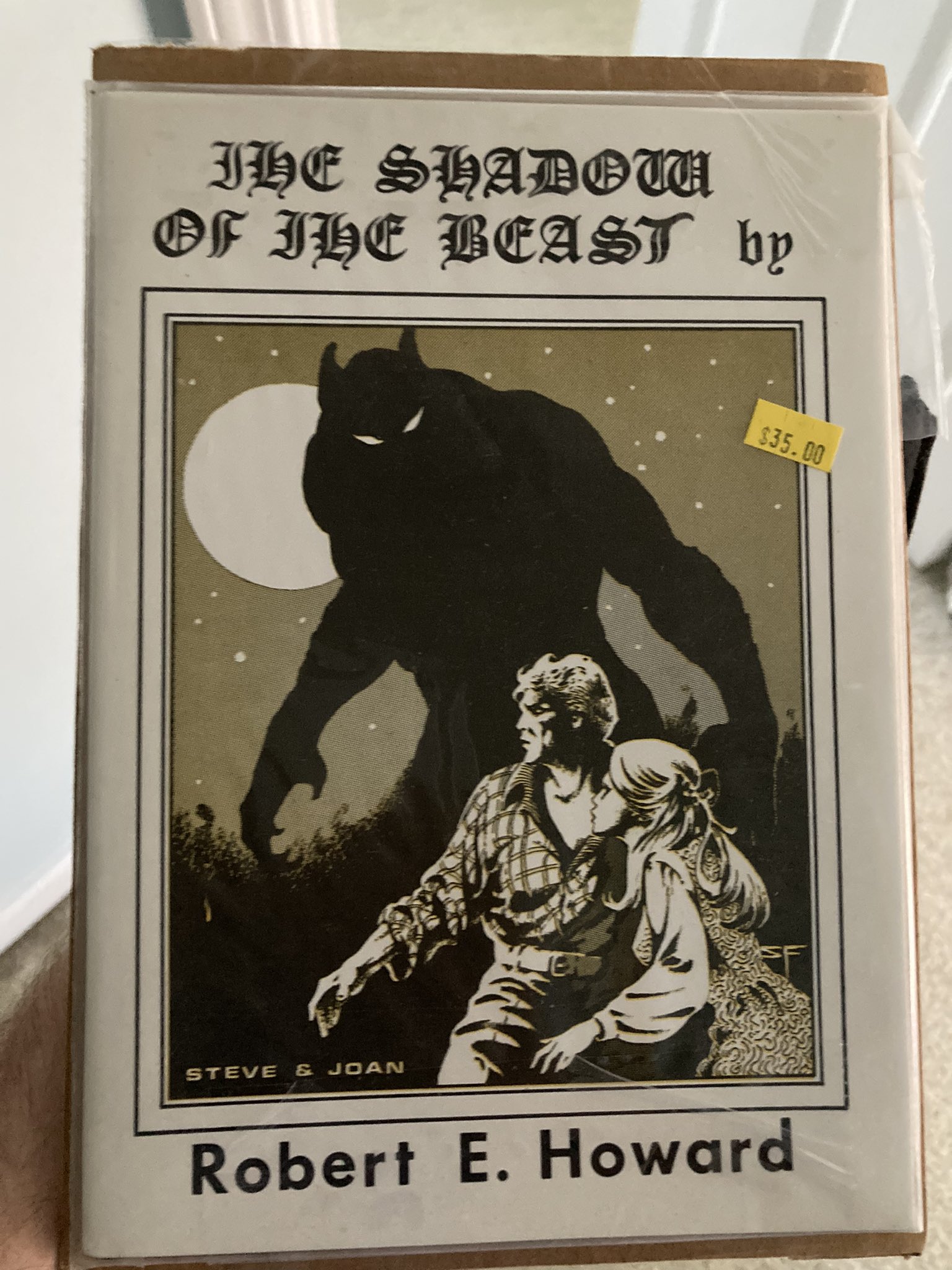
Sometimes a little bit of bad luck can turn into some good luck. To fill out my bibliography on invisibility fiction, I wanted to include The Shadow of the Beast, a thrilling little story by Robert E. Howard, creator of Conan the barbarian and author who inspired the title of this blog. However, I realized that I had apparently given away my one REH book that includes The Shadow of the Beast (TSB), which turns out to be quite a rarity in the Howard oeuvre.

TSB was one of REH’s early stories, and was unpublished in his lifetime. In fact, it was first published in a chapbook that was published in 1977, and was copyrighted that same year, meaning that unlike other REH stories, it is not in the public domain, and hasn’t been reprinted often. I managed to read it in Cthulhu: The Mythos and Kindred Horrors, and apparently got rid of my copy because there was a lot of overlap with other REH books I owned.

But this bad luck led me to search online for the story, and to my delight I found that the original chapbook can be purchased quite inexpensively, for $35! Owning a first edition REH, even one published some 40 years after his death, was too good an opportunity to pass up.

So this post is a short spoilery summary of that story, followed with a little digression into the views of REH on race. That may seem like an odd transition, but bear with me…

Continue reading
Posted in Horror, Invisibility, Robert E. Howard | 6 Comments

Old School Dungeons and Dragons: Part 22

Time for another compilation of my twitter OldSchoolDungeonsAndDragons threads! I’ve done 22 posts of these and still have tons of things to talk about.

To begin: a small riddle! What are these mysterious, faux-leather bound tomes, inscribed with the TSR logo?

Continue reading
Posted in Entertainment, Fantasy fiction, role-playing games | 3 Comments

The Sea Demons, by Victor Rousseau

Continuing a discussion of odd stories of invisibility in fiction that I came across in writing my book on the history of invisibility physics.

Pulp stories are sometimes quite a ride. They can be filled with bizarre ideas and twists and turns that are often largely nonsensical, tailored to bring people back to read what happens in the next issue.

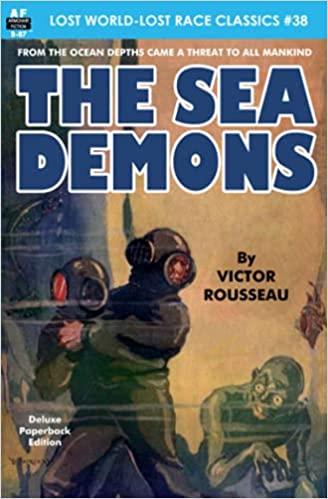
One spectacular example of this is The Sea Demons, by Victor Rousseau Emanuel, first serialized in All Story Weekly starting in January of 1916 and then published as a novel in 1924. In August of this year, Armchair Fiction released a reprint of this otherwise hard to find novel:

This book is a wild ride and, relevant to my interest, features an undersea species of near-invisible humanoids, who threaten to destroy the surface world!

Continue reading
Posted in Invisibility, Weird fiction | 1 Comment

The Secret of Wilhelm Storitz, by Jules Verne

My book on the history and physics of invisibility is off to the publisher for final approval, though there’s still some little stuff I want to add, including a comprehensive bibliography of stories about invisibility. Along the way, I’ve read a lot of stories about invisibility in science fiction, and I thought I’d share some thoughts about some of those books, since there wasn’t enough space — or excuse — to go into detail on all of them in my own text.

With my cat physics book, I was surprised at how many little things I learned even up to the final weeks before sending it to the publisher, and with my invisibility book, it has been no different. I did a last-minute literature search to see if there were any interesting stories about invisibility I had missed, and came across a novel written by none other than the famed Jules Verne (1828-1905), author of Journey to the Center of the Earth (1864) and Twenty Thousand Leagues Under the Sea (1870).

The novel is The Secret of Wilhelm Storitz, written in 1897 but not released until after Verne’s death. It was first published in 1910 after heavy editing by Verne’s son Michel. Remarkably, an English version of Verne’s original manuscript was not published until 2011, by The University of Nebraska Press.

I snapped up a copy as soon as I learned of its existence, and read it in a few days. What did I think of Verne’s last manuscript?

Continue reading
Posted in Invisibility, Science fiction, Weird fiction | 1 Comment

James Clerk Maxwell – Vampyre poet?

So James Clerk Maxwell was one of the greatest theoretical physicists of the 19th century, even perhaps the greatest. He is most famous for compiling a system of equations in the 1860s that describe the interactions of electricity and magnetism, and showed that these equations predict the existence of electromagnetic waves. He then boldly — and correctly — went on to hypothesize that these electromagnetic waves include visible light. (We would later find that Maxwell’s theory unified a whole family of rays and waves, all seemingly different: light, infrared, ultraviolet, radio, X-rays and gamma rays are all electromagnetic waves of different wavelengths.) The equations he formulated are now known as Maxwell’s equations.

James Clerk Maxwell (1831-1879).

Maxwell also did pioneering work in the kinetic theory of gases, did studies of color vision, and produced the first durable color photographs — in 1861! He also did some of the earliest scientific work to try to understand how a cat lands on its feet when it is dropped, a subject I have studied somewhat extensively.

What I did not know, until recently, is that Maxwell was also a poet! Not only that, but he wrote one poem in his youth about a “vampyre.” Maxwell is another scientist who I can add to my list of science-horror connections.

Continue reading
Posted in History of science, Horror | 1 Comment

Halloween Treats 2021: Invisibility edition

Every year since starting this blog, I’ve done a post near Halloween linking to a bunch of public domain horror stories to read to get into the season. It so happens this year that I also just finished the draft of my book on the history and physics of invisibility, so I thought I would celebrate by making this edition of Halloween Treats an invisibility-themed one! Linking below to some of the stories that I talk about in my upcoming book.

Happy Halloween!

What Was It? by Fitz James O’Brien (1859). As far as I know, the earliest story to give a scientific explanation for invisibility, as two guests at a reportedly haunted house encounter something not-quite-a-ghost!

Continue reading
Posted in Horror, Horror Masters, Invisibility, Lovecraft | Leave a comment

Fake Book Titles Extravaganza, Part 5!

Time for another round of Fake Book Titles that I’ve done, compiled from twitter!  You can see compilation 1compilation 2compilation 3 and compilation 4 at the links. It’s been a while since I compiled these, so there’s a lot to catch up on…

Original title: “To Please the Doctor.” Honestly almost as bad as my selection.
Continue reading
Posted in ... the Hell?, Silliness | 1 Comment

The oldest cat selfie? (1904)

I’ve said before that old illustrated magazines are a treasure trove of fascinating stuff. From the same 1904 issue of The Strand where I found the vintage math puzzle in my previous post, I found this amazing reader-submitted photograph:

In case you can’t read the text:

I did not take the photograph which I send you, because my cat did! I tied a piece of wood to my magazine camera and fixed a piece of meat at the end thereof, so that when the cat started eating the meat it would release the shutter and take a photograph of itself. A large mirror had to be used, of course, and this photograph was the result.

I find this image fascinating not only because it is probably the first “cat selfie” ever taken, but it shows that our obsession as a species with finding weird and novel ways to do things for attention is not new! This is the sort of thing that would have been posted on TikTok, if TikTok had existed in 1904.

The earliest surviving photographs of cats date back to the mid-1800s, and I included one of these in my Falling Felines and Fundamental Physics book. But now I am just frustrated that, after spending years researching and writing a book on cats and photography, I only now find this perfect image!

Posted in ... the Hell?, Animals, History of science | Leave a comment

A vintage math puzzle!

Over a decade ago, at the beginning of this blog, I wrote a blog post about some classic math puzzles where a nonsensical result is arrived at by seemingly plausible mathematics; in the post, I challenged folks to figure out the mistake before reading the answers! That post went viral, and was for a while the main driver of traffic to my blog. (Now the main driver is a post about how to hook up a PlayStation 2 to a modern TV.)

This week, I’ve been finishing up my next book project, on the history of invisibility, and in hunting down some references, I had to go to a 1904 issue of The Strand magazine. This led me down a rabbit hole of weirdness, and I wrote a long viral twitter thread about everything I found.

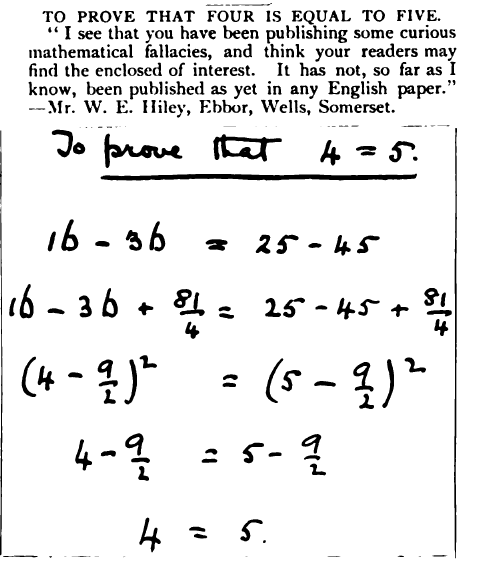
This included another math puzzle, which I post below!

Image

The solution to this puzzle is similar to one from my older post, but I thought I would share it anyway and let people figure out where the math went wrong! A hint, and then the answer, given below the fold.

Continue reading
Posted in Mathematics | 1 Comment