1975: Neutrons go right round, baby, right round

Some time ago, I wrote about a fascinating 1975 experiment in which the relationship between quantum mechanics and gravity was tested.  The experiment was made possible by the new — at the time — technique of neutron interferometry, in which the wave properties of matter are exploited to test quantum effects.  The experiment confirmed a very odd theoretical prediction: that the particle-like aspects and the wave-like aspects of matter are effected differently by a gravitational field.  What, exactly, this implies about the nature of the universe is still, as far as I know, unclear!

Not long after this work was done, further investigations using essentially the same neutron interferometer tested, and confirmed, what I consider to be one of the strangest aspects  of quantum mechanics, and another powerful illustration of how the universe obeys really different rules on the atomic scale.

Continue reading

Posted in History of science, Physics | 11 Comments

Metro 2033, by Dmitry Glukhovsky

It’s a pretty rare occurrence when a videogame inspires and moves me enough to read a book, but it happened recently.  The videogame — actually, videogames — are Metro 2033 (2010), and its sequel, Metro: Last Light (2013).  Both were inspired by the quite remarkable novel Metro 2033 (2005), by Russian author Dmitry Glukhovsky.

metro2033

The novel is set in a post-apocalyptic Moscow, in which the only known survivors — tens of thousands of them — of a devastating war in 2013 now live in the massive underground metro.  Which, incidentally, was in fact built with the nuclear holocaust in mind.  Though human beings have literally wiped themselves from the face of the Earth, they continue to make the same mistakes, forming violent factions that strive for power and control.  The surface is now uninhabitable to humans, but new and deadly forms of life have taken its place.  And one of these new forms of life poses a greater threat than all of the others…

Continue reading

Posted in Horror, Science fiction | Leave a comment

Twitter Weird Science Facts, Volume 4

Time for another summary of Twitter #weirdscifacts! Click below the fold to see how similar Steve Buscemi’s character in “Con Air” is to a particular species of caterpillar.

conair

Continue reading

Posted in General science, Weirdscifacts | Leave a comment

Optics and infinity at American Scientist!

I’ve been kind of quiet here lately, partly due to my job and partly due to writing blog posts and essays for other venues.  Happily, one of these blog posts is now available to read over at American Scientist, on the manifestation of weird infinite mathematics in optical systems.  A sample:

This specter of unattainability has changed over the past year, as two papers—including one I wrote—demonstrated that infinite mathematics can be realized in optical systems possessing swirling vortices of light. In particular, both demonstrations showed how particular systems mimic exactly a paradoxical thought experiment known as Hilbert’s Hotel, in which the occupancy of a hotel consisting of an infinite number of rooms shows very strange behavior. These examples seem to be the first ever showing that infinite mathematics not only manifests in some real world systems, but is essential in explaining them.

In it, I not only talk about some of my own recent bizarre theoretical discoveries, but related work by other researchers.  This is a consolidation, update, and improvement on blog posts I’ve written previously on curious relationships between optics and infinity.

Please go and read the whole thing!  Hopefully, I’ve written it well enough to explain how the extremely colorful figure below relates to mind-boggling and paradoxical mathematics.

infinityfigure

Posted in Mathematics, Optics, Personal | 1 Comment

Twitter Weird Science Facts, Volume 3

Here’s the latest summary of Twitter #weirdscifacts!  Click through below the photo of Hedy Lamarr to learn about her contributions to science and technology, among many other surprising science and nature related facts.

Hedy_Lamarr_in_a_1940_MGM_publicity_still

Continue reading

Posted in General science, Weirdscifacts | Leave a comment

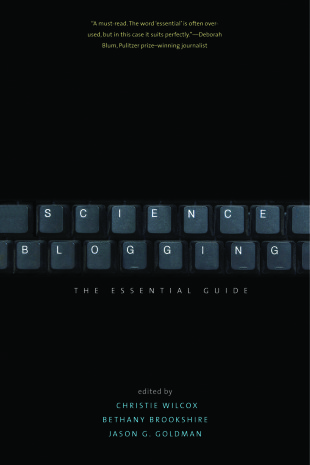
Coming soon! Science Blogging: The Essential Guide

Have you ever wanted to start a blog to write about science, but don’t know how to get started, or how to build an audience for your blog, or just how to survive the rough-and-tumble nastiness that the internet can often be?  Well, wonder no longer — on March 1st, Yale University Press will be releasing Science Blogging: The Essential Guide!

scienceblogging

Edited by the extremely talented science bloggers Christie Wilcox (Nerdy Christie), Bethany Brookshire (Scicurious) and Jason Goldman, this guide collects essays from many of the best online science communicators in the business on a variety of topics.  And it includes one by me, as well!

Continue reading

Posted in General science, Personal | Leave a comment

Dead Reckonings #18 is available!

For those who are interested in reading thoughtful analyses of the latest tales of horror in literature and cinema, issue 18 of Dead Reckonings is now out!

deadreckonings18

The newest edition includes reviews and commentary by some of the best authors and scholars in the horror field, including S.T. Joshi and Ramsey Campbell.  As always, editor June Pulliam has put together a fantastic collection.

This issue again includes several pieces by me: 3 reviews of new horror fiction, and a reprint of a retrospective I wrote about Ramsey Campbell’s work… which, since he will get copies of this issue, he will probably read. *gulp*

Posted in Horror | 1 Comment

Hilda Hänchen and the Goos-Hänchen effect

Today, the United Nations declared February 11 to be the “International Day of Women and Girls in Science,” starting a new effort to get more women into science and keep them there.  In honor of this new day, I thought I would talk about the major discovery of Hilda Hänchen (1919-2013) who, for her PhD, co-discovered what is now known as the Goos-Hänchen effect, a peculiar and strange effect in optics that was first observed some seventy years ago and has presented many surprises since its discovery!

Continue reading

Posted in History of science, Optics, Women in science | 5 Comments

While the Black Stars Burn, by Lucy A. Snyder

Though it has been almost a century since H.P. Lovecraft essentially invented and championed the genre of cosmic horror, it remains an incredibly popular source of inspiration for writers.  I suspect this is the case because authors have taken Lovecraft’s basic premise and extended it in ways that were beyond his capabilities.

A great example of this can be found in the recent collection While the Black Stars Burn (2015), by Lucy A. Snyder.

whiletheblackstarsburn

Snyder’s stories uses cosmic horror, among other ideas, to explore concepts of vulnerability and betrayal.  They are remarkably effective and often difficult to read, due to their intensity.

Continue reading

Posted in Horror | Leave a comment

Twitter Weird Science Facts, Volume 2

Continuing to post a #weirdscifacts a day on Twitter; here’s the latest summary since my last posting!

16. (January 16). Project A119, when the US almost nuked the Moon to boost domestic morale.  The Cold War was a really scary time, when “mine’s bigger than yours” mentality was rampant, except on a national level with nuclear weapons.  This won’t be the last time we’ll hear about Cold War nuclear insanity in these facts.

17. (January 17). The 1982 movie “Tron” inspired an important computer algorithm, Perlin noise.  The movie itself was a bit of a flop, but it nevertheless resulted in a really important graphics algorithm.  The connection between entertainment and science is stronger than most people realize!

18. (January 18). Glacial earthquakes, up to 5.1 magnitude quakes where glaciers move “fast.”  These days, most people are aware that fracking can cause non-tectonic earthquakes, but relatively few are probably aware that glaciers can, too.

19. (January 19). Did you ever imagine a fish could use a tool? Well, the blackspot tuskfish can.  I personally find it quite amazing that, when I was growing up, we were taught that humankind is above the animals because we can use tools.   Now, tool use in the animal kingdom is so obvious that I’ve even seen it at the zoo. But even fish using tools? That is surprising. But, as Jason Goldman pointed out, even the tuskfish isn’t unique in this.

20. (January 20).  Badgers and coyotes can work together and play together to catch prey.  As long as I’m talking about scary smart animals, how about different species working together as a team to get food?

21. (January 21). The newest quantum puzzle: an impossible mixture of three pigeons in two holes?  Many people have heard of the idea of Schrodinger’s cat by now: a cat, placed in a box in which the release of poison is tied to the decay of a single quantum particle, will seemingly end up in a quantum state in which it is simultaneously living and dead.  In this new puzzle, the paradox is that three pigeons can be fit in two holes in a quantum way in which no two pigeons are in the same hole!

22. (January 22). Venus flytraps actually can count — in order to better trap their prey.  By keeping track of the number of hairs touched by prey, the flytraps can eliminate “false positives,” in which a hair gets accidentally tripped but no prey is present.

23. (January 23). The deep-sea shrimp Acanthephyra purpurea spews bioluminescence at predators as a defense!  Ever see a movie where the bad guys are using night vision goggles and the good guys take them out by suddenly switching on the lights? (For example: Patriot Games.)  Well, this is what A. purpurea basically does.  Evolution has resulted in an incredible number of defense — and offensive — strategies for living creatures.

24. (January 24). The mysterious elliptical Carolina Bays, whose origin is still not understood.  A mystery right in my backyard, so to speak!  There is still so much we don’t understand about our planet.

25. (January 25). The red-cockaded woodpecker keeps tree sap flowing in its nest as a sticky protection vs. snakes!  Speaking of animal defenses — as well as tool use, of a sort — the woodpecker pecks at the tree to keep the sap flowing around the entrance to its nest, in order to block snakes.

26. (January 26). Smoke rings play a peculiar role in the history of atomic theory in the mid 1800s. The link here is to one of my old blog posts, in which I talk about how the stability of rings of smoke, and their interactions, caused a number of physicists to seriously consider a model of atoms as linked and knotted vortices.

27. (January 27). In 1504, Colombus used a lunar eclipse to frighten Jamaican natives and keep his crew fed.  This story used to seem quite funny and clever; in hindsight, knowing how horribly Colombus treated native Americans, it now feels a bit cruel.

28. (January 28). Ancient Babylonians were further along the way to developing calculus than we ever thought! This is very new research, just published in Science, and it will be interesting to see if it holds up under further peer scrutiny.  It is an intriguing possibility, however.

29. (January 29). In 1975, J.H. Hetherington co-authored a physics paper with his Siamese cat, F.D.C. Willard!  As a huge cat-lover, I just adore this story! Be sure to read the whole article, which is a mix of the whimsical and absurd.

That’s all for this post! More to come in a couple of weeks!

Signature of F.D.C. Willard, via WIkipedia.

Signature of F.D.C. Willard, via Wikipedia.

Posted in General science, Weirdscifacts | 1 Comment