Beautiful equations of math and physics: my picks

A few days ago, the BBC introduced a series of posts in which they asked mathematicians and physicists to share their favorite equations.  It’s a fun list, and the original post can be found here.

One of the equations selected is known as Euler’s identity, and is written as:

\displaystyle e^{i\pi}+1 =0.

In this equation, “i” is a so-called imaginary number, defined such that i^2 = -1.  This expression, which is a special case of a more general one known as Euler’s formula, is often considered to be mathematically beautiful because it includes five of the most important mathematical constants: 0, 1, i, π, and e.

An interesting discussion arose on Twitter when Evelyn Lamb posted the following in response:

I kinda agree with her, though maybe not for exactly the same reason!  For me, as a researcher who sort of balances on the line between theoretical physics and applied mathematics, “beauty” in mathematics comes from an expression that really shows you something, and leads to insights and a sense of wonder.  Euler’s identity doesn’t really do it for me anymore; it contains some insight, but its main attraction is the fact that it happens to include many mathematical constants.

This led to a gauntlet of sorts being thrown down by On This Day in Math!

https://twitter.com/OnThisDayinMath/status/690569843913940993

A fair question, and I thought I would share some of the equations that I find beautiful, taken from both math and physics.

Continue reading

Posted in Mathematics, Physics | 12 Comments

The return of the “Weird science facts!”

Those who have been around this blog for a while will remember that I did a two year nonstop marathon of “weird science facts” (hashtag #weirdscifacts), with at least one fact a day.  It got pretty darn hard to keep it up after that long a stretch, and I finally wound down the series.

But, several years later, I’ve decided to give #weirdscifacts another run!  I have a lot more followers than I did in 2012, and there has been a lot more weirdness since then.  Twitter has changed a lot since then as well, adding unlimited searching and linked tweets which makes it much easier to keep track of what I’ve already done.

So here we are! I started the new run on January 1st, and will try and keep it going at least a year.  I’ll provide a mixture of previously-tweeted facts and new ones, and will post a list of those tweeted here every week or so.

Without further ado, here’s the first two weeks!

Continue reading

Posted in General science, Weirdscifacts | 1 Comment

1801: Fraunhofer gets research funding in the worst possible way

It is rather unsettling to think that scientific careers are often made by simple luck.  For example, eventual Nobel Prize winner Albert Michelson (1852-1931) only got an education thanks to the literal last-minute intervention of none other than the President of the United States, as I’ve blogged about before!

For modern scientists, one of the biggest bits of anxiety is securing funding to undertake research in the first place, as I can personally attest!  Funding has been hard to come by in recent years, thanks to government cuts and budget crises. Nevertheless, I don’t think I would be eager to get a career and research support in quite the way that Joseph Fraunhofer (1787-1826) did!

Joseph Fraunhofer, via Wikipedia.

Continue reading

Posted in ... the Hell?, History of science, Physics | Leave a comment

Emmie Mears’ Storm in a Teacup

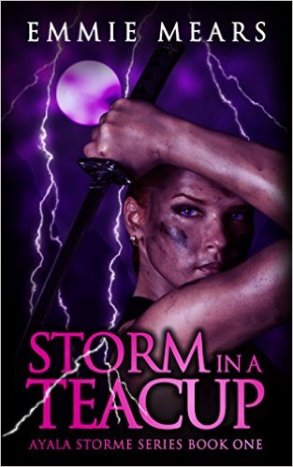
It’s a new year, and time to get back on the blogging train! (It is a train, right?  I am so bad with metaphors these days.)  Some time back, I realized that I was definitely not reading enough fiction by women and minority writers, so I put out a call for suggestions for new reading material.  My twitter friends directed me to Emmie Mears’ early 2015 novel Storm in a Teacup, the first in a series of books about Mediator Ayala Storme, slayer of demons.

storminateacup

Mears has been releasing Ayala Storme novels at a rapid pace: Storm in a Teacup was released in February, Any Port in a Storm in June, and Taken by Storm just came out in December.  I started reading right away, before I fell even further behind!

Continue reading

Posted in Horror, Weird fiction | Leave a comment

Spoiler-filled Star Wars thoughts and open discussion thread

So — I saw it last night.  It was amazing.  In fact, I saw it just in time, as this tweet of mine indicates:

And the kid wasn’t even leaving the theater — he was coming with his mom into the theater to see another movie!

Fear of spoilers has been rampant amongst Star Wars fans, only topped by a fervent desire to talk about the movie.  With that in mind, I thought I’d write a blog post to share some of my SUPER SPOILER-Y thoughts about the movie, and also use this as a thread where folks can share their own thoughts, if they want.

WARNING: Below the break I share my incredibly spoiler-filled thoughts about “Star Wars: The Force Awakens.”  Do not read further until you have seen the movie.

Continue reading

Posted in Entertainment, Personal | 54 Comments

The Gun-Fight Before Christmas

Been busy at work and struggling to finish new science posts for the blog.  In the meantime, here’s some silliness that I did on twitter.

So what does Christmas mean to you? Birth of the savior?  A day to strive for peace and love on earth?  A time to spend with one’s family and loved ones?

Well, you’re all wrong.

According to elected official Michele Fiore (R-psychopath), the holidays are a good time to show off how much your family, from venerable Lil to little Jake, are in love with murder weapons!  This is the actual 2015 family Christmas card:

MicheleFiore

Nice how they give a list of the weapons on display, in case the birth of the Prince of Peace inspires you to shop for some implements of death yourself!

Well, this appalling absurdity — I can’t think of anything less Christmas-y that doesn’t end with a “-cide” suffix — inspired me on twitter to pen an appropriate Christmas carol for this sad family.  I was originally writing it on the fly while in the car at night with the wife heading to an event, and wanted to touch it up a little past the Storify I did right after.  Also, I figured some of my blog readers may not have seen it on twitter.

Without further ado, I present…

Continue reading

Posted in ... the Hell?, Politics, Silliness | 2 Comments

Marguerite O’Loghlin Crowe steps from the shadows

Update: Additional images provided by Alice Zent at the end of the post!

Some five years ago, I shared an intriguing anecdote from the biography of Albert A. Michelson, in which Michelson — who had a reputation of being incredibly difficult to work with — began a friendship and tutelage of a talented young woman in physics, “Margarite O’Laughlin Crowe.”  The snippet from the biography is reproduced in its entirety below.

Upon resuming his classes after his return from Sweden, Michelson became aware of a girl in one of them. As a rule his students were male. As Edna [his second wife] had implied in their first conversation, he had never been much impressed with female students. They tended to radiate an earnest air which his generation did not associate with feminine charm, or they became hysterical during the Friday recitation and burst into tears. But Margarite O’Laughlin Crowe was an exception. Their friendship began when he caught her toasting marshmallows over her Bunsen burner in the laboratory. In his most severe tone he told her that the penalty was a fine of two golden-brown marshmallows which she must bring to his office at teatime. After the ice was broken she grew bolder. On St. Valentine’s Day, Michelson walked into Ryerson to find his name plaque decorated with hearts and cupids. Margarite Crowe had arranged a party. Fred and Julius Pearson had helped her trim the somber hall with red and white twisted streamers. Michelson relaxed his usual severity and joined in, even managing to drink with apparent relish the sweet punch she had concocted.

Not long after the party he heard that Margarite’s mother, with whom she had been living, had died rather suddenly, and that Margarite was thinking of giving up her career in physics. Sending for her immediately, he counseled her against such action. He suggested a change in her studies, advising her to go to Yerkes Observatory to work under the supervision of his friend Edwin Frost. He showed her a stellar map and suggested a part of the sky that might interest her. This was a turning point for Margarite, who later made some original scholarly contributions. In the spring after her graduation, she came to Michelson’s office to say good-by. As a keepsake he gave her the broken fragment of the grating that he had used at his Nobel lecture.

I found this description really charming, and it highlighted something I’ve noticed time and again: even when women were for the most part not taken seriously in physics, the smartest scientists knew better, and supported that often ignored talent.

At the time, I was unable to find any further information about “Margarite,” leaving me to wonder what happened to her. About a week ago, though, I was contacted by Alice Zent, a descendant of Crowe’s, who filled in a lot of information about her Great Aunt!  With her permission, I share below her comments on my blog as well as a few documents that show what an exceptional career Marguerite O’Loghlin Crowe¹ had.

Continue reading

Posted in History of science, Women in science | Leave a comment

Christine Campbell Thomson’s Not At Night (1925)

When I started to think about it recently, it occurred to me that I didn’t know much about horror fiction between the time of Edgar Allan Poe (1809-1849) and H.P. Lovecraft (1890-1937).  There are a  number of obvious standouts — Bram Stoker’s Dracula (1897), Richard Marsh’s The Beetle (1897), Marie Corelli’s Ziska (1897), Henry James’ The Turn of the Screw (1898), the works of Ambrose Bierce (1842-1914) and M.R. James (1862-1936) — but I don’t have a great handle on what topics interested other writers of the macabre, especially in the time leading up to Lovecraft’s revolutionary “cosmic horror.”

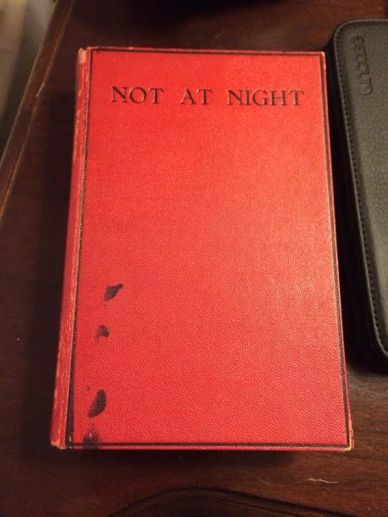
I gained an opportunity to learn more, recently, when I learned about the 1925 anthology Not At Night (1925), edited by Christine Campbell Thomson.  I found an inexpensive copy online, and soon had it in my hands.

notatnight

The series was immensely popular in its time, leading to 11 volumes in total between 1925 and 1936.  The first volume alone went through at least 7 reprints; mine is from October of 1927.  The stories were all drawn from the magazine Weird Tales, which was for decades the preeminent source of weird and horror fiction, as well as a regular publisher of Lovecraft’s work.  In 1928, Weird Tales published The Call of Cthulhu, the story that really launched the genre of cosmic horror and transformed horror fiction forever.

In Not At Night, then, I saw an opportunity to get a snapshot of the field as it stood just before this monumental change.  What scared people in the 1920s?  What sort of horror stories did they write?

Continue reading

Posted in Horror, Weird fiction | 8 Comments

“Science Chamber of Horrors” talk at the Schiele Museum

On October 29, 2015, I was invited to present a Science Cafe at the Schiele Museum in Gastonia, NC, based on my “Science Chamber of Horrors” Tumblr!  I think it went well and I appreciated the invitation to speak there.  Though I didn’t have a chance to tour the museum on my visit, it looks great — I encourage anyone in the area of Charlotte or Gastonia to pay a visit.

They didn’t record the talk, but I brought along my camera and recorded it myself.  The audio and visual quality isn’t great, but it seems to have turned out okay!  This was the first time I gave this presentation, so I was a bit nervous and there were things that I will fix for the next iteration, but if you want to see my first “science horror” talk, click on “play” below!  (Warning: the entire talk is an hour long!)

Entrance to the Schiele Museum.

Entrance to the Schiele Museum.

Posted in General science, History of science, Horror, Personal | 1 Comment

Halloween Treats 2015

Once again it’s time to post a collection of “Halloween Treats”: classic ghost and horror stories to be read in the dark of night!  I’ve been doing this since 2007, and you can read the old editions here:   2007200820092011, 2012, 2013, 2014 and my 2010 post on the true story of the “Lady of the Lake“. It is likely that not all of the links in those old posts work, but the lists are there.

This year, I’ll start with a couple of recent entries.  One is a webcomic that is now a true classic, even though it only appeared in 2010! Another is generally acknowledged as the best example of “creepypasta” out there.  Read on — you won’t be disappointed.

His Face All Red, Emily Carroll (2010).  Emily Carroll almost instantly became an recognized master of horror with His Face All Red, a story that starts with an incredible twist and builds an almost unbearable level of dread.  Carroll’s illustrations, and use of the flexibility of the web page, make it a true work of art.

Candle Cove, Kris Straub (2009).  This brilliant creepypasta takes the form of an internet chat, in which a group of people gradually remember a local-access children’s show that they used to watch.  This is a nearly perfect story.

Count Magnus, M.R. James (1904). I’ve included one story by the masterful M.R. James every year I’ve done ‘Treats!  Count Magnus is one of his most famous, and for good reason. When one Mr. Wraxhall visits the mausoleum of the infamous count, he makes a rash declaration — which is followed by horrifying consequences.

The Horror-Horn, E.F. Benson (1923).  E.F. Benson is another classic master of the ghost story. In The Horror-Horn, however, he tells a quite different tale, about a man who vacations in a remote area of the Swiss Alps and has a terrifying encounter with beings who are not quite human.

Berenice, Edgar Allan Poe (1835).  One of Poe’s lesser-known stories, it captures all of his familiar themes — obsession, madness, death — and wraps them up with a truly ghastly ending.

The Hill and the Hole, Fritz Lieber (1942).  In a story clearly inspired by the weird curvatures of space and time in Einstein’s general relativity, a surveyor comes to a rural area to measure a hill.  However, a local little girl tells him that it is, in fact, a hole.  With things in it.  Things that don’t want to be seen.

Murder on Dogenzaka, Edogawa Rampo (1924).  Finally, something not quite horror, but rather twisted in its unfolding.  A murder has taken place in a bookshop, a seemingly impossible crime.  The narrator follows in the footsteps of Sherlock Holmes and C. Auguste Dupin in attempting to solve the crime through rational deduction, but learns that reason alone cannot always bring one the answers.  (Tip o’ the hat to Justine Howe for pointing me to the story!)

That’s all for this year — Happy Halloween!

Posted in Horror | 3 Comments