Relativity: Ten minutes to Alpha Centauri?

Einstein’s special theory of relativity is arguably the most amazing physical theory ever conceived.  It utterly transformed our view of the universe, completely eradicating the view that space and time are independent quantities and giving us a new unified fabric of space-time.  It led us to the revelation that energy and mass can be converted into one another, and resulted in the world’s most famous physical equation,

E=mc^2,

which tells us that a mass m, times the speed of light c squared, is equivalent to (and can be converted into) an amount of energy E.  This observation forms the basis of nuclear energy, and it paved the way to all of modern particle physics such as the experiments being done at the Large Hadron Collider.

Perhaps the most fascinating thing about Einstein’s special relativity is that it leads to a collection of “paradoxes” that seem to violate our common-sense nature of the world.   Resolution of these false “paradoxes” demonstrate that the theory is wonderfully and incredibly consistent — and the best part is that many can be resolved using at most high-school algebra.

There are a variety of seeming contradictions in special relativity that turn out to be quite the opposite: the most famous of these is the “twin paradox“, in which one twin brother does a round trip to a distant star at high speed and returns to Earth, and there is a discrepancy in the ages of the twins when they return.

I’ve talked about the “twin paradox” in the context of another post; I thought for this one I’d discuss another unusual aspect of special relativity.  If you know anything about relativity, you probably know that it implies that nothing can go faster than the speed of light, which happens to be

c = 3 \times 10^8\mbox{ meters/second} = 186,282\mbox{ miles/second}.

In fact, the only thing that we know that can even match the speed of light is light itself!  As far as we know at this stage, no massive particle can achieve c, though it can come arbitrarily close to that speed.

With that in mind, if you were to jump into a rocketship and blast off to Alpha Centauri, which is 4.37 light years away from Earth, what is the fastest possible time that it could take you to get there with the fastest spaceship possible?
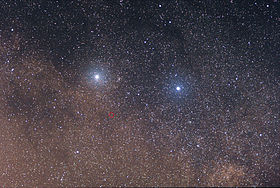
Image of Alpha Centauri (left) and Beta Centauri (right), via Wikipedia.

A natural first guess would be to say it would take approximately 4.37 years, since I can go no faster than the speed of light.  In fact, however, it turns out that with a fast enough spaceship, you could get to Alpha Centauri in as little time as you like — even 10 minutes or less!

How is this possible?  In explaining it, we will have to probe to the heart of two fundamental and surprising results from Einstein’s theory: time dilation and length contraction.  An important piece of the puzzle is noting that I asked how long it takes you to get to Alpha Centauri, not how long someone on Earth says it takes for you to get there…

Continue reading

Posted in Physics, Relativity | 11 Comments

Weird science facts: July — August 2012

Though I stopped doing a Twitter weird science fact (#weirdscifacts) a day early this year, I’m still occasionally posting facts as I come across them.  Here’s a collection of a few tidbits I came across over the past couple of months!

753. July 6: 1 shaft, 4 heads: The echidna’s penis.  This post is NSFW if you happen to work with a bunch of echidnas.  (post by @PygmyLoris, with a  h/t to @scicurious: who else?)

754. July 7: Behold the Boötes void, the spookiest place in the cosmos!  Space is really, really empty, but there are regions of space that are even emptier than that!

755. July 27: Clever ants have hooks on their babies to hang them from the walls.  (post by @myrmecos, h/t @bug_girl)

756. July 30: In 1968, there was an experiment to see if an astronaut can imitate falling movements of a cat.  This may sound weird, but it was a great way to study how astronauts can move in space wearing bulky suits. (h/t @astVintageSpace)

757. August 13: Sand on the beaches of Normandy is up to 4% shrapnel.  This WWII “war sand” is a haunting reminder of the deadly carnage that occurred there.

758. August 17: The primary sensory neuron in the giraffe can be up to 15 feet long! We tend to think of neurons as microscopic things, but the giraffe has a truly gigantic one. (via @GainesOnBrains)

758a. August 17: Rock formation bigger than Connecticut found floating in Pacific.  This is a remarkable testament to the power of volcanic activity.  (h/t @leafwarbler)

758b. August 17: There is a remarkable almost forgotten history of “atmospheric railways” powered by air pressure. (h/t @seelix & @mcshanahan)

759. August 20: Excuse me but this butterfly can see with its butt.  I think that last sentence speaks for itself.  (post by @j_zimms)

760. Aug 31: Project Orion: the 1950s-era idea to power a spaceship with nuclear bombs.  In that era, people had all sorts of ideas for nuclear bombs that didn’t involve nuking Russia.  See, for instance, my previous #weirdscifacts on Edward Teller’s “Operation Chariot“. (h/t @encephalartos)

Posted in Weirdscifacts | 4 Comments

Physics demonstrations: vortex cannon!

As I’ve said before, some of the best scientific demonstrations are things that can be put together with simple everyday components and exhibit surprising, even counter-intuitive, phenomena.

One of my all-time favorite demonstrations is of this form!  All one needs is a plastic garbage can, a plastic shower curtain, and a bungee cord that hooks snugly around the top of the can.  Optional but quite useful is a fog machine.

What happens?  We cut a roughly 4-5” diameter hole in the bottom of the garbage can, and use the bungee cord to seal the shower curtain to the other end.  Fill the garbage can with fog, strike the shower curtain and — voila! — smoke rings!

These are actually vortex rings — circulating masses of air (and fog) that can persist and travel over a surprisingly long distance.  They also carry enough “oomph” to knock over a stack of plastic cups or scare the heck out of one’s housepets*.

So how does this “vortex cannon” work, and what does it demonstrate?  There is a surprisingly amount of physics and history behind such vortices, and they can be a lot more powerful!

Continue reading

Posted in Physics demos | 20 Comments

Dennis Wheatley’s To the Devil a Daughter

Occasionally, I just have a feeling about a book.  I’ve read a number of novels by the author Dennis Wheatley (1897-1977) and have generally been impressed.  Way back in 2008 I favorably reviewed Wheatley’s supernatural thrillers The Devil Rides Out (1934) and The Haunting of Toby Jugg (1948) as well as his bizarre adventure novel They Found Atlantis (1936).  Not long afterwards I picked up a copy of one of Wheatley’s most famous novels, To the Devil – a Daughter (1953):

Oddly, however, though To the Devil – a Daughter looked to be another entertaining Satanic thriller like Rides Out and Toby Jugg, I found myself curiously unable to dive into the book.  On numerous occasions when I’ve been looking for something new to read, I passed over Daughter or even picked it up off the shelf and started to read the first chapter.  I never got very far, however: was it intuition, or was I just not in the mood for that sort of story?

Continue reading

Posted in Horror | 1 Comment

The Giant’s Shoulders: The Fiftieth Anniversary edition is out!

The fiftieth edition of the history of science blog carnival The Giant’s Shoulders is up at From the Hands of Quacks!  In this lovely edition, you can read about science history in the Olympics, new blogs on women in science, and posts that put the historic Mars Curiosity rover in perspective.  Among the excellent submissions:

  • The athlete in 1913 who drank too much Coca-Cola,
  • A frustrating search for the “truth” about decapitation,
  • How a fragmentary Ichthyosaur skull inspired Jules Verne,
  • and much more!

Thanks to Jai Virdi for putting together a lovely and intriguing carnival!

It looks like we’ll be keeping the carnival going for the near future: The Giants’ Shoulders #51 will be hosted by David Bressan at his History of Geology blog on 16 September 2012. Submissions can be made till 15 September 2012 either directly to the host, to The Renaissance Mathematicus or to me directly via email.

Posted in General science, Science news | Leave a comment

My 5-year blogiversary!

I almost missed it!  It turns out today, August 14th, 2012, is the 5-year anniversary of the founding of this blog!

I would have in fact missed my “blogiversary” entirely if Jason Goldman of The Thoughtful Animal hadn’t tweeted congratulations to Ed Yong yesterday for the 6th anniversary of his blog!

My very first post on August 14th, 2007 was titled, “Educate or Bust” and that title describes the purpose of this blog just as well today as it did back then.  (Though, hopefully, the writing has improved over the years.)

To celebrate, I thought I’d share links to some of those science blog posts I’ve written that I am particularly fond of.  I hope you enjoy this trip back through my blog’s history!

  • Optics in the Haunted Mansion! (May 12, 2009).  One of the perks of being a scientist is being able to peek “behind the scenes” at places like Disney World without actually being behind the scenes! While on our honeymoon at Disney, my wife and I took numerous trips through the Haunted Mansion.  I had never thought about how its illusions worked before, but once I thought about it I was able to correctly deduce the answer.
  • Faster than a speeding photon?  Precursors test whether light can be faster than light (October 9, 2011).  Last year, there was a media frenzy when it looked, briefly, like neutrinos might have been detected moving faster than the speed of light (they weren’t).  At nearly the same time, researchers were performing independent experiments to see whether light could violate its own speed limit while traveling in matter.  I was quite happy with my explanation of the difficult physics behind the experiment, and managed to get a mention on “Boing Boing”!
  • Attack of the giant squid! (August 4, 2010).  After I blogged an old paper describing a sighting of a “kraken”, Sarah Kavassalis asked if I could find the most famous paper about the giant squid: an 1874 incident in which a recklessly curious fisherman ran afoul of a squid bigger than his boat!  I found not only the original paper, but a wonderful story and a significant moment of scientific history.
  • The saga of the scientific swindler! (February 24, 2011).  Speaking of wonderful stories: some of the most remarkable stories of scientific history have been forgotten through the years, just waiting to be rediscovered in technical journals!  When I started to browse through the first issues of Science in the late 1800s, I kept finding mentions of a “swindlers” of geologists and paleontologists.  The con man’s story is a fascinating one, and basically forgotten until I rediscovered it.  Also got featured in Boing Boing!
  • The gallery of failed atomic models, 1903-1913 (May 27, 2008).  One of my first major posts on the history of science was one of my most elaborate!  Before the structure of the atom was elucidated by the experimental work of Rutherford and the theoretical work of Bohr, many physicists guessed wildly at it.  Tipped off by a vague comment in a book on the history of atomic physics, I tracked down the original papers describing pretty much all of these early atomic models and explained them all in some detail.  Not my best writing (one of my earliest science blog posts), but one of my favorite posts.
  • So, what is a “temporal cloak”, anyway? (January 7, 2012).  I actually did my PhD on the physics of invisibility before it was a “cool”, and still remain actively interested in the subject.  In this post, I explained how a new form of cloaking known as “temporal cloaking” works, and related it back to its more famous counterpart.

Here’s hoping I have many more years of science (and weird fiction) writing ahead of me!

Posted in Personal, Physics | 10 Comments

What’s the difference between “transparency” and “invisibility”?

In writing my previous post on The Murderer Invisible, I started thinking again about the relationship between something being “transparent” and something being truly “invisible”. Most of us can appreciate that, under the right circumstances, a transparent object like a glass window can be very hard to see, but most of us also appreciate that glass is not even close to fitting the popular perception of invisibility.  In fact, though we encounter plenty of transparent things in nature, we don’t encounter invisible things.

What’s the difference?  In this short post, I thought I’d try and clarify things.

Continue reading

Posted in Invisibility, Optics | 8 Comments

Philip Wylie’s The Murderer Invisible

If it were a mystery novel, The Murderer Invisible would be a failure right off the bat, as the plot twist is explained right there in the title!  As science fiction and horror, however, this 1931 book by Philip Wylie is eerily effective, and the title is in fact an understatement of the acts that transpire within its pages.

Perhaps the best short description of The Murderer Invisible is to call it “H.G. Wells’ The Invisible Man on crack cocaine.”  The villains of the two stories have similar backgrounds and similar goals; they also share in the unpleasant realization that invisibility has some unexpected and unpleasant side effects.  However, where the invisible scientist Griffin of Wells’ tale is defeated before he can carry out his plans for world domination, Wylie’s William Carpenter manages to achieve many of his goals.  The result is death, destruction and worldwide panic.

I came across a reference to this novel while researching one of Wylie’s famous stories, Gladiator, which was likely a partial inspiration for Superman!  Philip Wylie was a prolific author who made his mark on science fiction most notably with the novel When Worlds Collide, which was also turned into a 1951 movie.  Many of his other novels seem to have faded into relative obscurity — as I’ve learned through experience, however, this does not mean that they are of poor quality.

Let’s take a look at The Murderer Invisible; some mild spoilers follow.

Continue reading

Posted in Invisibility, Science fiction | Leave a comment

The Giant’s Shoulders #49: “Crisis what crisis?” edition is out!

I’m a few days late in noting this, but the 49th edition of the history of science blog carnival The Giant’s Shoulders is up at The Renaissance Mathematicus! In this edition, you can read about:

  • Sports doping, Victorian style,
  • The deadly dead!
  • Inventions of Thomas Edison you’ve never heard of,
  • and much more!

Thanks to Thony for handling this edition of the carnival!  By the way, we’re still trying to decide the future of the carnival; please read the post here.  The next edition will be held at From the Hands of Quacks on August 16th; please nominate posts by emailing the carnival hosts (me or Thony) or putting suggestions in the comments here.

Posted in General science, Science news | Leave a comment

Wackerbarth whacks Piazzi’s pyramid power! (1867)

One aspect of science that I try and emphasize time and again is that it is a community effort.  Individuals can make discoveries, but individuals are subject to mistakes (such as the recent arsenic life brouhaha), deliberate fraud (as in the fictitious MMR-autism link fabricated by Andrew Wakefield) or can simply go crazy!  Individual scientists, or even small groups of them, can give life to incredibly damaging nonsense; fortunately, there are usually other enlightened researchers out there that will boldly do battle with this misinformation.

One bit of pseudoscientific nonsense that still, sadly, remains with us today is what is known as pyramidology.  Broadly speaking, it is the belief that pyramids in general, and the Great Pyramid of Giza in particular, holds hidden secrets — lost knowledge, secret builders, even supernatural powers.

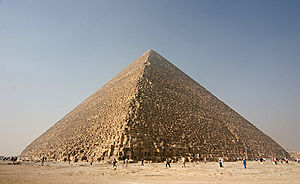
The Great Pyramid of Giza. (image via Wikipedia)

This “science” of pyramidology is surprisingly old: its biggest proponent was Charles Piazzi Smyth (1819-1900), an important astronomer who began his own pyramid researches in the 1860s and wrote a number of “scholarly” books on the subject that arguably sparked the persistent pyramid craze.  Fortunately, pyramidology did not survive long in the scientific community, thanks to a number of pointed critiques by Smyth’s scientific colleagues.    Of all the abuse that Smyth received at the hands of other scientists, however, none was more hilariously devastating than that delivered by Athanasius Diedrich Wackerbarth.  In 1867 he wrote a critique of Smyth’s work that was read before the Royal Society of Edinburgh and left the distinguished astronomer fuming!Smyth’s deluded view of Egyptology, and Wackerbarth’s rebuttal of it, are great illustrations of common scientific fallacies.  We can learn a lot about the way science is done by taking a look at Smyth’s scientific and mathematical mistakes.

Continue reading

Posted in ... the Hell?, History of science | 9 Comments