
Been a busy week for me, and posting has been light. I haven’t neglected the Twitter #weirdscifacts, however!
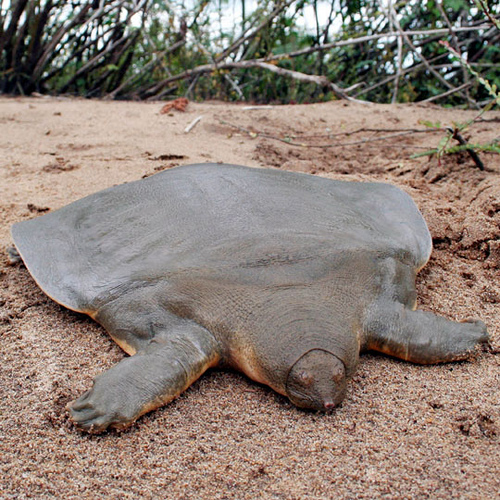
550. Sep 14: Have you ever heard of a turtle without a shell? Cantor’s giant softshell turtle is a real oddity: the absence of a shell for protection means that it spends most of its time buried under sand.
551. Sep 15: 1st t-rex skeleton ever discovered was missing a rib for yrs, recently rediscovered! An odd story of rediscovery: the historic skeleton had a rib unaccounted for that was only recently stumbled upon. (h/t @SUEtheTRex)
552. Sep 16: Escaped pet birds are teaching wild birds to speak english! I really think we should teach a bunch of parrots Rick Astley songs and set them free in the wild. We could end up having a permanent RickRoll naturally develop! (h/t @arikia)
553. Sep 17: It actually takes light from the Sun between 4 and 7 hours to reach Pluto. (8 minutes to reach Earth.) I had an overestimate of the Sun-Pluto distance in my original tweet, now corrected here.
554. Sep 18: Via @tdelene, Giant African land snails literally eating the stucco off of homes in Miami.
555. Sep 19: In 1784, Immanuel Kant declared: “There will never be a Newton for the blade of grass.” 25 yrs later, Charles Darwin was born. (via @rmathematicus) Poor predictions are infamous in the sciences! Another example we’ve discussed is Lord Kelvin’s failed guess, as he said in 1902 of aeronautics: “No balloon and no aeroplane will ever be practically successful.”
555a. Via @sarahkendrew: 1 in 5 Koreans is named “Kim”, and it’s been that way for 1500 years! The trivia that 1 in 5 Koreans is currently named “Kim” isn’t really a #weirdscifacts; the fact that researchers traced this back 1500 years places it squarely in the “weird science” category.
556. Sep 20: Macellum of Pozzuoli – due to bradyseism, this ancient ruin has submerged & raised several times. A “bradyseism” is a rather gentle raising and lowering of a region’s elevation due to underground volcanic activity. At the Macellum, it was noted that the higher parts of the columns possessed markings from mollusks, demonstrating that the area was underwater at one point — and clearly had been built while still above water!





 Skulls in the Stars