Stephen McKenna’s The Oldest God

Imagine that you were at an isolated weekend party, and people started to act aberrant, even evil.  You begin to suspect that one of the guests of the party is in fact a monster, corrupting the others.  What do you do?

This idea is the central problem of the novel The Oldest God, by Stephen McKenna, first published in 1926.  An image of an original dust jacket is shown below (source):

I learned of McKenna’s novel via H.P. Lovecraft himself, or more specifically, the catalog of his library that was made after his death.  Though the list is known to be incomplete, and has relatively few weird fiction books listed on it, there are still some little-known gems in it.  Many of them are being reprinted in nice new editions by Hippocampus Press, but others that caught my eye, like The Oldest God, have not appeared for decades.

In fact, The Oldest God isn’t available right now, well, pretty much anywhere!  It is not available on Google books, not available on archive.org nor Project Gutenberg, and no modern editions are being sold.  I ended up purchasing one of the first U.S. editions of the book, published in 1926 (due to its obscurity, it was surprisingly cheap).

So why review it at all, if it is so hard to find?  Hopefully my review will be useful to people if it is ever reprinted; perhaps it will even spur some enterprising publisher to take up the cause!

It would be nice to see it back in print; though not perfect, The Oldest God is both an intriguing weird tale and an inadvertent picture of the social mores of the 1920s.

Continue reading

Posted in Horror, Lovecraft | Leave a comment

Movie sequels that completely miss the point

The recent release of the prequel “Rise of the Planet of the Apes” got me thinking about the very odd sequels to the original 1968 “Planet of the Apes” and about sequels in general.  Sequels are common in both literature and movies these days, but they can be especially treacherous in movies because the writers and directors can completely change between films, and consequently the “vision” of the original film can be destroyed along the way.

The more I thought about it, the more I realized that there are a number of sequels out there that it can be fairly said completely miss the point of the original film.  And when I say “completely miss the point”, I mean that the sequel typically kills or undoes or ignores everything that made the original film a classic in the first place.

Since I’m already in a movie mocking mood due to recent participation in the first Twitter “Mock the Movie”: Sands of Oblivion (and the upcoming follow-up this very evening: Atom Age Vampire), I thought I’d share a short list of sequels that completely miss the point!

The usual warning: to explain why the sequels are clueless, there are spoilers below!

Continue reading

Posted in ... the Hell?, Entertainment | 6 Comments

Weird science facts, August 10 — August 16

Yet another week of Twitter #weirdscifacts!  Have a healthy amount of weird creatures at the end of this week’s list.

515. Aug 10: Werewolves do exist! Sort of. The very odd medical condition hypertrichosis

516. Aug 11: A successful treatment for leukemia — created from a modified HIV virus?  (h/t @lousycanuck)

517. Aug 12: In 1930, psychoanalyst Wilhelm Reich believed in orgone, and through it that sex could control the weather.  Albert Einstein even agreed to inspect Reich’s orgone research, and politely said that it was “inconclusive”.

518. Aug 13: Codariocalyx motorius, the world’s fastest plant — its leaf motion can be seen w/ naked eye! Of course, “fast” for a plant is relatively slow for us; check out a video here.

519. Aug 14: The ironclad beetle — so good at playing dead they’ve been adorned & sold as living jewelry! U.S. customs intercepted one such adorned beetle at the border in January 2010.

520. Aug 15: Cymothoa exigua, the parasite that replaces a fish’s tongue.  This is the only known case of a parasite functionally replacing an organ of the host.

521. Aug 16: The Harlequin filefish, the fish that pretends to be coral!  (h/t @kzelnio)

Posted in Weirdscifacts | 2 Comments

The Giant’s Shoulders #38: A Georgian Special, is posted!

The 38th edition of The Giant’s Shoulders history of science blog carnival is up at the Board of Longitude project blog! It is a Georgian special, with featured posts that take a look at science in the Georgian era (1714-1830).  Thanks to Rebekah Higgitt for posting such a nice edition of the carnival, and thanks to the Board of Longitude project for hosting!

The next edition will be hosted at John McKay’s fascinating blog Mammoth Tales, and will appear on September 16th.  Entries are due by the 15th of the month, and can be submitted directly to the host blog or through BlogCarnival.com.

Posted in General science, Science news | Leave a comment

“FOX fails physics: flaunts fool fumbling facts” on JAYFK!

I don’t do much political blogging anymore, but every now and again something incredibly stupid — and science related — really sticks in my craw and I feel compelled to rant about it.  In this case, FOX News interviewed a global warming “skeptic” who so badly blundered the laws of chemistry and physics that it should permanently remove any lingering credibility the “news” network has.

This was perfect fodder for the Journal of Are You Fucking Kidding, and so I posted my takedown of FOX’s follies there.  Check it out!

Posted in ... the Hell?, Physics | 4 Comments

Weird science facts, August 3 — August 9

Still going with the Twitter #weirdscifacts! They’re getting much harder to find, so if you have any to suggest, please let me know!

508. Aug 03: Swede held for attempting to build nuclear reactor in his kitchen.  Note the word “attempting”.  He almost certainly wouldn’t have made a working reactor, and he seems to have had no nefarious plans.  He isn’t the first to try, though!  (h/t @sciencecomedian)

509. Aug 04: Hymenoepimecis argyraphaga — the wasp that makes zombie spiders! (classic post by @nerdychristie) This fact was inspired by the fact that the wasp/spider conflict is central to Nick Mamatas’ novel Sensation, that I recently reviewed.

510. Aug 05: Fossil find shows Velociraptor eating another dinosaur. Of course, it’s not weird that Velociraptor ate dinosaurs, but it is very unusual for it to be fossilized essentially in the act! (h/t @anatotitan)

511. Aug 06: Turning wood into bones??!!  (h/t @AndreaKuszewski)

512. Aug 07: The Vegas hotel that acts as a death ray to pool-goers!  The hotel, with its massive concave mirrored surface, acts as a crude focusing reflector.

513. Aug 08: A billion-year-old piece of North America traced back to Antarctica. (via @physorg_com)

514. Aug 09: Curious attempts to build anti-gravity devices.  Though there is no evidence of the existence of anti-gravity, much less any clear path to generating it, lots of people have made a big fuss over trying to create it.  Some have been sincere, some less so!  (by @jenlucpiquant)

Posted in Weirdscifacts | 2 Comments

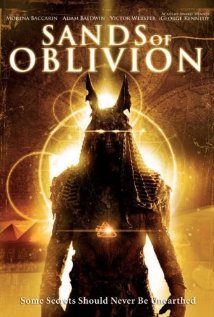
Twitter “Mock the Movie” tonight: The Sands of Oblivion!

Following in the tradition of MST3k, tonight I’ll be participating in “Mock the Movie”, a new Twitter event that involves watching a lousy sci-fi movie and ridiculing it live on Twitter!  To quote from JAYFK:

Smart-ass science fiction fans love nothing more than making fun of deliciously awful  sci-fi movies.  Join us in watching & mocking ‘Sands of Oblivion‘ tomorrow (10 August 2011) night at 9PM EST.   Sands of Obilivion has Eyptian mythology, archaeology, cursed objects, people who know better than to mess with cursed objects, and to guarantee it’s campiness – it’s a SyFy Original Movie!

Feel free to join us and add your snark on Twitter!  To participate, simply start watching Sands of Oblivion (available for free on Hulu) at 9PM EST and tweet your snarky comments with the Twitter hashtag #MTM.

How can you resist? Doesn’t the following movie poster just cry out, “Mock me”?

Posted in ... the Hell?, Silliness | 1 Comment

Isaac Newton… Father of invisibility physics?

My blog has been a good impetus to research a number of interesting scientific topics more deeply than I would otherwise have had the ambition to do.  For instance, since the blog’s inception, I’ve been pushing the origins of “invisibility physics” further and further back in time.

When I wrote my Ph.D. dissertation on the subject, I believed the earliest article connected with invisibility was a 1910 article by Paul Ehrenfest on radiationless accelerations of charged particles.  However, blog-related research eventually turned up a 1902 paper on a curious and crude invisibility device, and that paper in turn was inspired by a comment made by Lord Rayleigh in an encyclopedia article in 1884.

I’ve had a suspicion for some time, though, that the trail must go back further.  The evidence for this, albeit thin, is a weird tale written in 1859 by Irish-born American writer Fitz James O’Brien, titled “What Was It? A Mystery“.  In the story, a group of lodgers take up residence in an abandoned house that is widely reputed to be haunted.  Their initial amusement turns to horror when one of the group, the narrator Harry, is attacked by a creature that is invisible but very much of flesh and blood.  They manage to subdue the monster, alive, and tie it to the bed.  What follows is colleague Hammond’s attempt to explain the seemingly supernatural phenomenon:

We remained silent for some time, listening to the low, irregular breathing of the creature on the bed, and watching the rustle of the bedclothes as it impotently struggled to free itself from confinement. Then Hammond spoke.

“Harry, this is awful.”

“Aye, awful.”

“But not unaccountable.”

“Not unaccountable! What do you mean? Such a thing has never occurred since the birth of the world. I know not what to think, Hammond. God grant that I am not mad, and that this is not an insane fantasy!”

“Let us reason a little, Harry. Here is a solid body which we touch, but which we cannot see. The fact is so unusual that it strikes us with terror. Is there no parallel, though, for such a phenomenon? Take a piece of pure glass. It is tangible and transparent. A certain chemical coarseness is all that prevents its being so entirely transparent as to be totally invisible. It is not theoretically impossible, mind you, to make a glass which shall not reflect a single ray of light—a glass so pure and homogeneous in its atoms that the rays from the sun shall pass through it as they do through the air, refracted but not reflected. We do not see the air, and yet we feel it.”

“That’s all very well, Hammond, but these are inanimate substances. Glass does not breathe, air does not breathe. This thing has a heart that palpitates,—a will that moves it,—lungs that play, and inspire and respire.”

Though invisibility has played a large role in mythology through the ages, O’Brien’s story is evidently the very first story that provides a scientific explanation for the phenomenon.  Though O’Brien was ahead of his time, by the late 1800s/early 1900s a number of fiction authors would propose their own quasi-scientific theories of invisibility, including H.G. Wells in his famous 1897 novel The Invisible Man.

But what inspired these stories?  Clearly O’Brien and, as we will see, H.G. Wells had some specific science in mind when they concocted their tales of invisibility, but what science, and from whom?  In this post, I would like to engage in some speculation and propose that they were inspired, directly or indirectly, by Isaac Newton!

Continue reading

Posted in Horror, Invisibility, Science fiction | 2 Comments

6 days until the deadline for The Giant’s Shoulders #38!

There are only 6 days left until the deadline for The Giant’s Shoulders #38, to be hosted by The Board of Longitude Blog!  This will be a “Georgian Special Edition”, with an emphasis on posts related to 18th century science — though of course entries from all eras will still be allowed!  Please submit your entries directly to the host or Blog Carnival.com by August 15th!

Posted in General science, Science news | Leave a comment

Nick Mamatas’ Sensation

I hadn’t thought about it much before, but secret societies have long been a reliable element in weird fiction of all varieties.   These societies range from the legendary Illuminati to the very real (and less sinister) Freemasons, to fictional organizations of vampires and cults of Cthulhu worshippers.

Why is the idea of such hidden groups so compelling?  I would venture to guess that, in a modern world beset with problems, secret societies give us a simple scapegoat to focus our fear and anger upon.  It is simultaneously terrifying and reassuring to imagine that those really in charge are in fact nefarious and not stupid!

Even more drama arises when multiple secret organizations end up battling it out for world supremacy.  There are as many varieties of conflicts as there are societies: for instance, recent years have brought us werewolves vs. vampires as well as the Priory of Sion vs. Opus Dei.

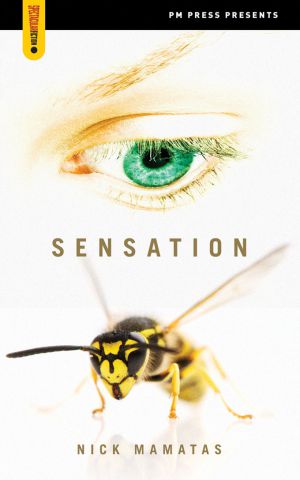
However, in terms of weirdness, I don’t think anything can beat the conflict featured in Nick Mamatas’ recently released novel, Sensation:

In this very odd and offbeat tale, a chance circumstance thrusts two people into the middle of an ancient conflict that has influenced all of human history — and none of those fighting it are human!

Continue reading

Posted in Weird fiction | 4 Comments