The Giant’s Shoulders #35 is out!

The 35th edition of The Giant’s Shoulders is up at Jost a mon!  Fëanor has put together an excellent illustrated edition of the carnival; many thanks to him!

The next edition will be hosted by Darwin’s Bulldog at The Dispersal of Darwin; entries can be submitted directly to the host blog or through BlogCarnival.com.

We’ll need more hosts for upcoming months, as well, so if you’re interested in hosting, please let us know!

Posted in General science, Science news | Leave a comment

Laird Barron’s Occultation

It didn’t take much for me to become a fan of Laird Barron’s writing.  I first encountered the horror author’s work in the wonderful anthology Haunted Legends, and Barron’s story The Redfield Girls stood out as a beautifully written and haunting story.  Soon after I read Barron’s 2007 short story collection The Imago Sequence, and it only reinforced my high opinion of his writing.  Work and life slowed down my reading for a while, but recently I finally found the time to go through Barron’s more recent 2010 collection Occultation:

What a wonderful set of stories!  Laird Barron has pretty much solidified a spot in a short list of my favorite horror authors with this collection.

Continue reading

Posted in Horror | 1 Comment

It’s not shrinkage — it’s relativity! (1889)

ResearchBlogging.orgThe best stories in the history of physics are those in which someone comes from humble origins and, seemingly out of nowhere, makes a brilliant discovery that changes everything.  Such stories, however, can give a very misleading impression of the nature of scientific progress: science is a continuous process, and a closer inspection of any incredible breakthrough always reveals that there were numerous earlier discoveries that anticipated it.

A great case study of this is Einstein’s special theory of relativity, introduced in 1905.  Einstein’s groundbreaking work transformed mankind’s perceptions of space and time, provided answers to puzzling problems and led directly to other major discoveries, including the harnessing of nuclear energy.  However, Einstein’s revelations were preceded by some twenty years of gradual progress, during which time researchers put forth tantalizing hypotheses that came closer and closer to the truth.

One such discovery was made in 1889 by George FitzGerald.  To explain a seemingly incomprehensible experimental result, he suggested that objects in motion shrink along their direction of travel.  In this post, we will discuss what is now known as the FitzGerald-Lorentz length contraction and explain how FitzGerald fell short of the astonishing ideas that would be conceived by Einstein.

Continue reading

Posted in History of science, Physics, Relativity | 17 Comments

Weird science facts, May 4 — May 10

Still going strong with the Twitter #weirdscifacts!  Here are this week’s facts.

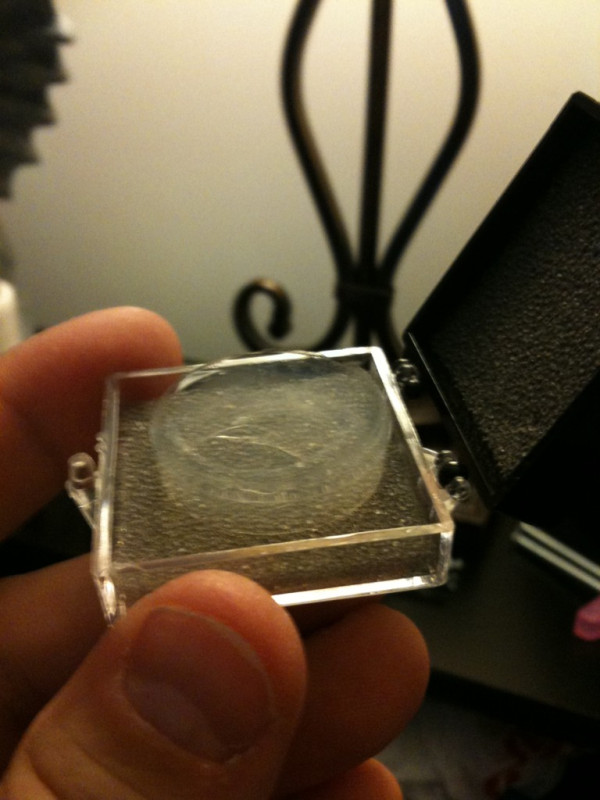
417. May 04: Aerogel: lowest-density solid with density almost as low as air: 1.9 mg/cm^3 for gel, 1.2 mg/cm^3 for air!  Aerogel is an amazing substance — it is also incredibly heat-resistant and shows Rayleigh scattering just like the atmosphere, appearing blue when looking at it with reflected light and yellow when looking at it with transmitted light.  Small disks can be purchased, as I did the other day:

418. May 05: The Malaysian ant — a suicide bomber that explodes when threatened, covering predator with poison! I happened across a couple of lists of “animal weapons” recently, so we’ll see a number of these in the ‘facts!

419. May 06: The Pythagoras cup — fill it too much, and it will completely drain from the bottom!

420. May 07: Chemist Linus Pauling did not get his high school diploma until age 61 — after winning 2 Nobel Prizes.  Pauling had enough credits to go to college at age 15, but didn’t have the required courses to graduate from high school.  As one might expect from a groundbreaking-scientist-to-be, he simply skipped out on high school!  After getting his second Nobel, for peace, he was finally awarded the long-delayed diploma.

421. May 08: The horned lizard has an unusual defense weapon — ability to squirt blood from its eyes up to 5 ft

422. May 09: Biggest fossilized poo ever discovered was found under the future site of a Lloyds Bank branch!  I leave it to others to decide on the symbolism of the discovery…

422a. Bonus fact! Venn-like diagrams go back to the mystic Ramon Llull in the 1200s!  (via @blakestacey)

423. May 10: The strange obsession in the 1920s-1930s with the invention of “death rays” by multiple researchers.  Nikola Tesla was the most famous of these “death ray” enthusiasts, but a surprising number of folks claimed to have developed prototypes, though none ever were demonstrated to a scientific audience.  I looked up the history of “death rays” after stumbling upon a commercial product dubbed such — actually a powerful infrared laser.

Posted in Weirdscifacts | Leave a comment

6 days until the deadline for The Giant’s Shoulders #35!

This is your monthly reminder to finish off those history of science blog posts!  The deadline for the 35th edition of The Giant’s Shoulders blog carnival is May 15th, only six days away.  The carnival will be hosted by Fëanor at  Jost a mon – entries can be submitted through BlogCarnival.com or directly to the host blog, as usual.

Posted in General science, Science news | Leave a comment

Weird science facts, April 27 — May 3

Whenever I think I’m running out of weird science facts, I stumble across a set of bizarre things that refills my queue!  Anyway, here are this week’s Twitter #weirdscifacts!

410. Apr 27: S. Morse (1791-1872), an art professor, built the telegraph partly with art supplies. The telegraph was such an important and practical invention in its time, it is hard to conceive that it was first constructed by a professor of art!  Morse used art and print shop materials to make his first prototype.  (h/t @amhistorymuseum)

411. Apr 28: Armadillos can pass leprosy to humans?  It is important to note, though, that people shouldn’t panic and start slaughtering the poor animals; the risks are relatively low.

412. Apr 29: Kifuka, Africa: world record holder of lightning intensity, at 158 strikes per square km per year! 

413. Apr 30: The Tully Monster — the fossil that nobody knows quite what it is!  (classic @laelaps post!)

414. May 01: Amorphous metals and the “atomic trampoline“! On an atomic level, metals typically have a crystalline structure, with regularly-spaced atoms forming a periodic array.  An amorphous metal does not possess this long-range structure, and has a disordered arrangement of atoms.  Such an unusual state of metal can be produced by, among other methods, rapid cooling of the material from its molten state.  Such amorphous metals can have unusual properties, including the “bounciness” of ball bearings.

415. May 02: Stealing… ahem… “borrowing” another #weirdscifacts from Grand Illusions: solids of constant width!  What kind of three-dimensional solid object has the same width from every direction?  If you guessed “sphere”, you know the familiar answer, but it turns out there are irregularly-shaped objects that also have the same width from all directions!

416. May 03: The pistol shrimp, which hunts with a sonic weapon that creates temperatures comparable to the sun! O_o

Posted in Weirdscifacts | Leave a comment

Rosa Praed’s Fugitive Anne (1902)

Since nearly the beginning of my blog, I’ve been a fan of Valancourt Books, which publishes a lot of wonderful and neglected works from the 19th and early 20th centuries.  I’ve blogged about a lot of them, some of which are genuinely remarkable: see Richard Marsh’s creepy The Joss: A Reversion and Bertram Mitford’s sublime The Sign of the Spider, for instance.  I have yet to be really disappointed by anything that Valancourt has reprinted.

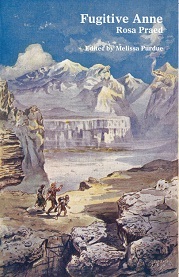
The most recent release is Fugitive Anne (1902), by Rosa Praed, an author I was unfamiliar with:

The novel, set in the wilderness of Australia, is an adventure novel in the spirit of the works of H. Rider Haggard’s King Solomon’s Mines (1885) or the aforementioned The Sign of the Spider (1896).  An adventurer wanders into the untamed wilds, encountering a variety of dangers both natural and man-made, and eventually discovers a lost tribe hidden in unexplored and forbidden territory.  The difference?  As the title suggests, the adventurer in Fugitive Anne is a woman!

Continue reading

Posted in Adventure fiction | Leave a comment

Weird science facts, April 20 — April 26

Here are the Twitter #weirdscifacts for the previous week!

403. Apr 20: 150 yrs ago today, the government gave muskets to the Smithsonian for protection against the Confederacy!  (h/t @smithsonian)

404. Apr 21: Largest genome belongs to plant Paris japonica — *50 times* larger than human!  (h/t @anthinpractice)

405. Apr 22: The “electric kiss”, Venus electrificata, a 1700s electricity demo concocted by G.M. Bose.  The link is to a German article on Bose, so I should summarize!  In short, Georg Matthias Bose ended up joining in the furor over electricity in the early 1700s, creating a number of attention-getting demonstrations.  Among these was the Venus electrificata, in which a woman standing on an electrically isolated platform gets charged up with static electricity.  A grounded paramour ends up getting a strong shock when he steals a kiss:

406. Apr 23: Can an elephant paint? Short answer: yes!  The link is to an old blog post of mine.  Though the demonstrations of elephants painting portraits are the result of careful guidance from their trainers, elephants do enjoy putting paint on canvas.  In fact, a number of zoos offer paintings for sale by their elephants! (I have one.)

407. Apr 24: Non-transitive dice: very unusual odds in dice-playing! (From an old blog post of mine.)

408. Apr 25: The spinthariscope — see atoms decay before your eyes!

409. Apr 26: The “light flash” phenomenon, in which astronaut’s eyes interact with cosmic rays. (Scroll down in this link for explanation.)

Posted in Weirdscifacts | Leave a comment

The spinthariscope — see atoms decay before your eyes!

Last week heralded the long-awaited arrival of a package I had ordered, the content of which seems rather unimpressive at first glance.  It consists of a small metal cylinder, with an adjustable lens on one end and a screw on the other:

If you look into the lens of this device, called a “spinthariscope”,  under most circumstances, you’ll almost certainly see nothing at all.  With that in mind, you might be surprised to learn that such humble devices were in fact hugely popular in the early 1900s, being carried both as toys by children and as status symbols by the learned elite!

The secret of the spinthariscope’s success comes from the fact that it allows the seemingly impossible — the ability to watch individual radioactive decays happens with the naked eye!

Continue reading

Posted in History of science, Physics | 27 Comments

Weird science facts, April 13 — April 19

Here are the previous week’s Twitter #weirdscifacts!  A lot of interesting facts appeared on Twitter, and I didn’t have to do a lot of searching for once.

395. Apr 12: “Sex with wife leads to scientific breakthrough (via @stevesilberman)  This is definitely one of the oddest ways in which a scientific discovery has been made!

396. Apr 13: The wombat’s deadliest weapon? Its ass!  As a defensive mechanism, the wombat has evolved a butt nearly impervious to predators.  When being chased, it will run face-first into its burrow and plug the hole with its hiney!  If a persistent predator foolishly tries to climb over the wombat’s back, the wombat will push up with its powerful legs and crush the attacker’s jaw against the roof of the burrow.

397. Apr 14: Chitons has eyes that are literally made of limestone! (article by edyong209)

398. Apr 15: The Blue People of Troublesome Creek.  This will be the first of a number of ways that people can turn blue!  These people were blue due to a recessive genetic trait.

399. Apr 16: Hippos are big animals — the hide of a hippopotamus alone can weigh 1/2 ton! 

400. Apr 17: Some sea stars eat mollusk prey by extending a stomach out of their body and into the prey’s shell. 

401. Apr 18: How hard is it to fold a piece of paper in half a successive number of times? World record is 13!  This is a good illustration of exponential growth!  Every fold of a piece of paper doubles its thickness, and those doublings add up quickly.  As noted in the excellent linked article, if one could do the folding 42 times — a seemingly small number — the stack of paper would reach the moon!

402. Apr 19: T.S.C. Lowe’s long distance balloon flight at beginning of Civil War got him arrested as a Union spy! Lowe was a scientist and inventor as well as a balloon flyer.  He was planning a trans-Atlantic flight, but several problems with the balloon prompted a shorter test flight, intended to go from Cincinnati to Maryland.  His timing was poor — he left on April 19th, only a week after the first battle of the Civil War!  He ended up drifting off course and landing in Virginia, which earned him the spy charges.  He was released soon after, but perhaps the South should have kept him imprisoned — he was appointed chief aeronaut by President Lincoln in the military’s Balloon Corps!  More in the Wikipedia article.

Posted in Weirdscifacts | 1 Comment