
Okay, here’s one more classic video from my regular seminar series: Forgotten Milestones in the History of Optics! This was one of the earliest semi-popular seminars I put together.
More videos and posts to come!
Okay, here’s one more classic video from my regular seminar series: Forgotten Milestones in the History of Optics! This was one of the earliest semi-popular seminars I put together.
More videos and posts to come!
Continuing my series of uploaded videos, tonight I recorded a version of my How Not To Be Seen: The history and science of invisibility seminar, which I’ve given and revised for probably close to ten years now! I’ve shared links to versions before, but this is the most recent and up-to-date version, based on a lecture I gave at the University of Chicago last fall.
I was feeling a little scatterbrained during the recording, so I fumbled my speaking a couple of times; I hope it isn’t too distracting!
More videos to come! It looks like I’ll be home for quite a while, so there’s lots of science to be shared! As I’ve noted before, my next videos will be significantly shorter.
I while ago, I shared slides from a talk I gave at the Charlotte Amateur Astronomy Club on “Vortices in beams of light and vortex coronagraphy.” Now that I, like everyone else, am more or less homebound, I thought I would record it as a video for folks to hear what I actually would say during such a talk! This will be the first of hopefully a few more popular science videos I will make and share while social distancing.
Note: This one is based on a formal seminar I gave, so it’s a bit long and a bit technical (though no math). Future videos will be shorter and hopefully sillier.
Here’s my latest wrap-up of twitter-posted old school Dungeons & Dragons threads! Going to post these more frequently, with fewer entries, because my last few posts were over 4000 words each! So without further ado…
The Dragonlance Game (1988), by Michael S. Dobson, Scott Haring and Warren Spector. Here’s a boardgame that was a huuuuge deal when it came out, but I was somehow unaware of until I saw a used copy come by recently! It probably wasn’t on my mind when I was a teen, as I was into RPGs, not board games.

This post is in belated honor of International Women’s Day 2020, March 8th, and highlights an important woman physicist who I was unaware of until recently!
I think almost everybody is familiar with the phenomenon of sunspots: relatively dark patches on the surface of the sun that come and go somewhat unpredictably and can range in size from diameters of tens of miles to diameters of 100,000 miles.

Sunspots visible during solar eclipse of October 23, 2014. By user Tomruen via Wikipedia.
Sunspots are colder than the rest of the sun’s surface, 3,000-4,500 K compared to the average surface temperature of 5,780 K, which gives them their darker appearance. You may also have heard that a large amount of sunspot activity can have effects on Earth, potentially screwing up our radio communications devices. But sunspots have also been (and remain so, to some extent) a relatively mysterious feature of the sun. A key piece of the puzzle to explaining what they are and where they come from came from experiments undertaken in the 1940s by a trio of researchers, one of whom — Ruby Payne-Scott — was one of the very first women to work in radio astronomy and an important founding member of that entire branch of astronomy. In this post, we’ll talk about Payne-Scott and her remarkable work on sunspots.
I am happy to announce that my next book signing for Falling Felines and Fundamental Physics will take place on March 18th at 6 pm at Malaprop’s Bookstore in Asheville!

Please consider coming out to hear me read from the book, show some short videos of cats falling, and personally demonstrate some of the techniques that cats use to land on their feet!
If you don’t have a copy of the book yet and can’t wait, the book can also be ordered directly from Malaprop’s at this link, and also through IndieBound at this link. I believe you can contact the bookstore to order a signed copy in advance from me, as well, if you can’t make the event personally!
I will be hyping this event for the next month, so please put it in your calendar, spread the word, and attend if you can!

I’ve been trying to get together enough focus to start reading fiction regularly again, and there was no better way to spark that interest and begin 2020 than by reading one of my favorite authors of all time, Ramsey Campbell. At the end of 2019, Flame Tree Press released a new edition of one of Campbell’s classic novels from 1988, The Influence.
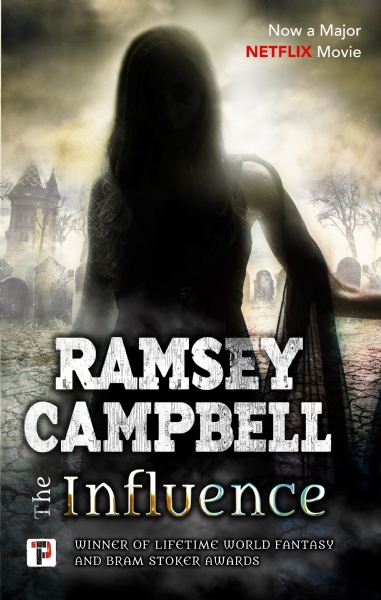
If you’re unfamiliar with Campbell’s work, he is a master of establishing an atmosphere of creeping dread. His stories are about the thing that moves out of the corner of your eye, that figure you think you see outside your window that may have just been a tree after all, that feeling you have when you’re sure you closed the basement door, but it is somehow open nevertheless. Though not all of his novels follow quite the same pattern, The Influence is a perfect example of this style, and a great tale of slowly encroaching horror.
Another post inspired by my book on Falling Felines and Fundamental Physics! I talk about geometric phases in the book in the context of falling cats, but here I focus on the polarization of light.
I regularly argue that most physics isn’t as scary and complicated as most people think. Once you get past the mathematics, which is analogous to a foreign language for the non-fluent, many of the concepts and ideas are intuitive, and even logical. This is, in fact, the motivation behind all the physics posts on this blog!
But some concepts are resistant to easy explanation, and can be quite difficult to understand, even when you are familiar with all the math involved! One topic that has vexed me, from an intuitive perspective, for a number of years is the concept of geometric phase. Broadly recognized as a general phenomenon in physics due to the groundbreaking work of Michael Berry in the 1980s, the basic idea is as follows. Some physical systems can be brought from an initial condition, or “state,” changed through a variety of intermediate states and back into its original condition, yet nevertheless have something different about it.
The easiest example of this to visualize is Foucault’s pendulum, a free-hanging pendulum on the Earth, which I have discussed in detail before. Because the pendulum is oscillating on the Earth, and the Earth is effectively turning underneath it, the pendulum changes the direction of its swing during the day.
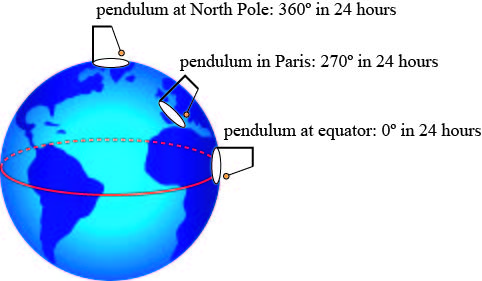
For a pendulum at the North Pole, the Earth spins 360º underneath it during a day, making the pendulum appear to change direction by 360º. A pendulum at the equator doesn’t change direction at all over the course of a day. But this means that a pendulum at some intermediate latitude, such as Paris, changes direction by less than 360º during the course of the day. Although the Earth has rotated back to its starting position, the pendulum has not ended up swinging in the same direction — that discrepancy is what we call the geometric phase. It is “geometric” because its unusual behavior is related to the spherical geometry of the Earth.
So this case is somewhat easy to understand, but there is also a geometric phase associated with the behavior of light! This phase, called the Pancharatnam phase for reasons which we explain below, is a bit trickier to explain. Recently, however, I found a very nice way to visualize this change, and how it connects to “geometry.” This is what I will (hopefully) show in this post!
Time again for another compilation of old School Dungeons & Dragons posts from twitter! I am still not tired of exploring the history and mechanics of classic RPGs and the adventures written for them.
Bughunters (1993), by Lester Smith. We begin with a look at a non-D&D roleplaying game produced by TSR in the early 90s, whose core conceit is pretty much given away in the title!

Time for another round of Fake Book Titles that I’ve done, compiled from twitter! You can see compilation 1 and compilation 2 at the links. These have proven to be a welcome distraction in stressful times. And, wow, I’ve done a lot since part 2!
As always with these, content warning for language, innuendo, and politics!
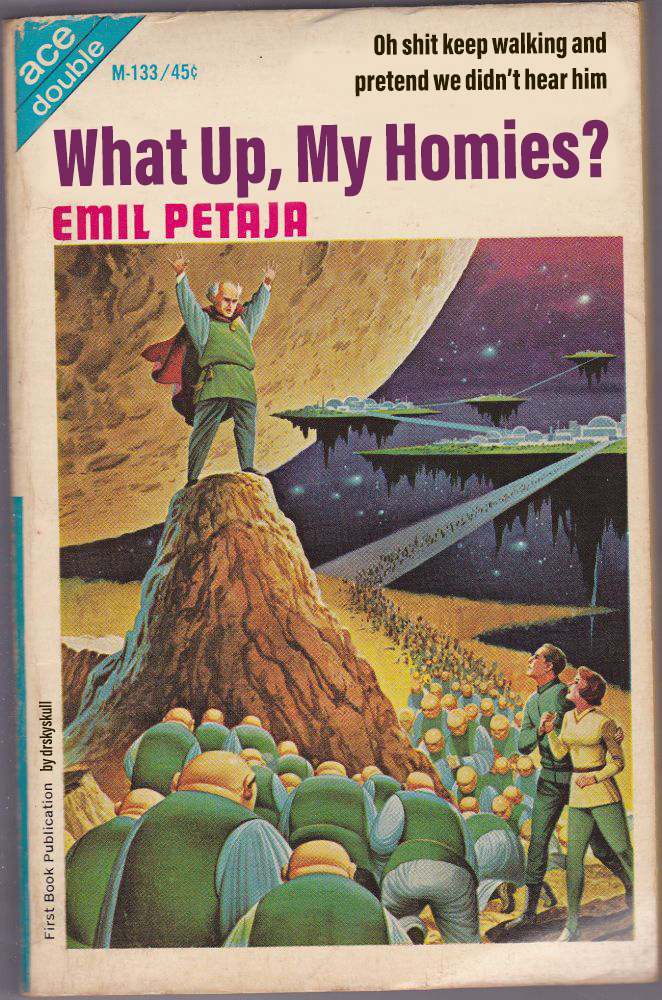
Original title: The Caves of Mars.
 The author of Skulls in the Stars is a professor of physics, specializing in optical science, at UNC Charlotte. The blog covers topics in physics and optics, the history of science, classic pulp fantasy and horror fiction, and the surprising intersections between these areas.
 Skulls in the Stars
