Weird science facts, March 28 – April 10

(I’ve been doing a daily “weird science fact” on Twitter, with the goal of doing a full 365 days of facts.  The problem is that Twitter doesn’t allow one to search further back than 1 week!  I’m going to keep a weekly log of the weird facts of the week on the blog, but will do 2 weeks at a time until I catch up.)

The Twitter #weirdscifacts from March 28 – April 10 are below the fold!

Continue reading

Posted in Weirdscifacts, [PhysicalScience] | 2 Comments

ResearchBlogging editor's selections: Phytoliths, Hubble bubbles, computer-generated hypotheses, and plasma shields

skyskull “Dr. SkySkull” selects several notable posts each week from a miscellany of ResearchBlogging.org categories. He blogs at Skulls in the Stars.

  • Past lives caught in the dust of trees. Alun at AlunSalt describes a little-discussed botanical and archaeobotanical phenomenon called phytoliths. This dust, formed in the interior of some living plants, can form a valuable record of a region’s botanical history.
  • Hubble bubble. The eponymous The Astronomist explains the concept of a “Hubble bubble” — an alternative interpretation of phenomena typically linked to dark energy — and explains why this hypothesis is unlikely to be true.
  • Can computers help scientists with their reading? Every scientist out there knows that the flood of new publications is impossible to keep up with, and is in general overwhelming! Rob Mitchum of ScienceLife describes a proposal to not only use computers to sort through the torrent of results, but pinpoint new hypotheses and identify large-scale patterns that would otherwise be overlooked.
  • Force fields and plasma shields. We’ve seen lots of science fiction ideas become reality over the past 100 years, but one that has not been realized is the “force field”. Is it possible to make a force field or plasma shield with today’s science? In an entertaining post, Ryan Anderson of The Science of Starcraft looks at what might work… and what has been proposed already!

Check back next Monday for more “miscellaneous” selections!

Posted in General science, Science news, [Etc] | Leave a comment

We’ve moved… to Scientopia!

*********************

And now, for some big news — this blog is moving!  Skulls in the Stars is relocating to be a part of a new blog collective, Scientopia.org!

This collective consists of a number of ex-Sciencebloggers and a number of independent bloggers, like myself, who were interested in joining a larger community that were bound together by a love of science and science outreach and wanting complete editorial control over their content.

Sometime this week, I’ll try to point my domain name at the new site, which means that there should be a relatively smooth transition (my posts here should also be imported to the new site sometime this week).

In the meantime, here is the direct link to my new Skulls in the Stars blog.

Update: Since I’m not checking here as often, I’ve set it so comments require admin (my) approval before posting.

Update 2: In light of recent server troubles at Scientopia, I’ve decided for the moment to dual post everything to this site, so that people can find it!

*********************

Posted in General science, Personal | 6 Comments

Optics basics: lasers!

One of my goals in blogging has been to run a series of posts covering the “basics” of optics, namely those concepts that form the basis of an understanding of the more advanced topics investigated by researchers today. Though I’ve done a pretty good job so far, I recently realized that I’ve left out a discussion of the most important tool of the optical scientist, and one of the most important technological advances of the modern era: the laser!


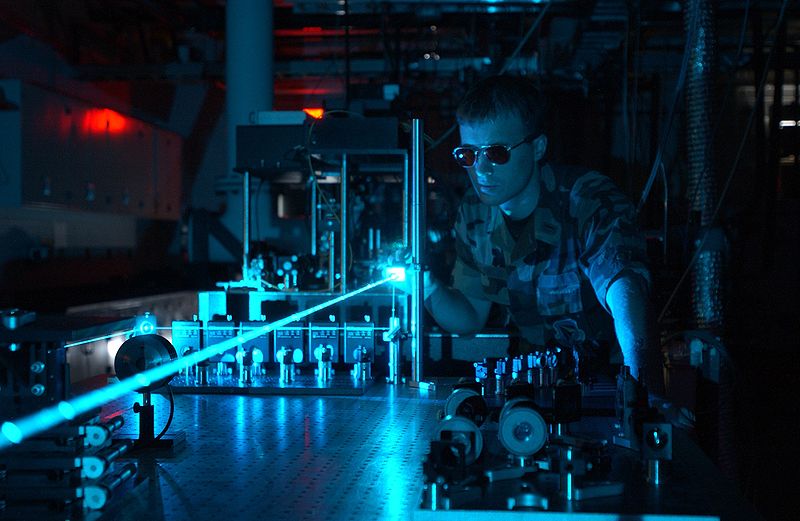
Image via Wikipedia, of an experiment at the Air Force Research Lab.

“Laser” is an acronym for “Light Amplification by Stimulated Emission of Radiation”, and it refers to a device that produces light by an unusual physical process not typically found in nature.

In fact, 2010 marks the 50th anniversary of the laser, as the first functioning device was built in 1960 by Theodore H. Maiman at Hughes Research Laboratories in California.  To draw attention to this anniversary, optics organizations have instituted a yearlong celebration called LaserFest, and many special events are planned and have already taken place; my favorite being the Lasers Rock! concert that was held in May at the CLEO/QELS conference:

Musical group “Second and Third Harmonic Generation” playing at Lasers Rock!  Picture via Ksenia’s CLEO/QELS blog.

I hardly need to describe the impact lasers have had on our society, and it is hardly possible to list all of the applications!  Among other things, lasers are used to read CDs, DVDs and Blu-ray discs, they form the basis of the fiber-optic communications systems by which you are probably reading this post, they are used in medicine both to diagnose problems as well as to perform laser surgery, they are used to cut material in industrial fabrication.  Their properties make them ideal for doing optics research of all sorts, and they are now an essential tool for researchers.

In this post I would like to describe the physics of lasers.  This is no mean feat, because there is a lot to say about how they work, and many variations on the fundamental idea that was first proposed by Charles Townes in the 1950s¹.  I will proceed somewhat carefully:

  • First, I will discuss what a laser is, and what properties a laser has that distinguishes it from “ordinary” light sources like light bulbs.
  • Second, I will describe the fundamental physics behind the lasing effect, in particular the process of stimulated emission.
  • Finally, I will explain the engineering that is used to take advantage of stimulated emission and make a laser.

Let’s take a look…

Continue reading

Posted in Optics, Optics basics | 9 Comments

The Discovery Place does optics!

This post involves a little bit of boasting!  For the past month, the Discovery Place science museum in Charlotte has been displaying a small interactive optics exhibit targeted at 8-14 year-olds as part of their “Explore More Stuff” series.  The kicker is that I played a small part in the exhibit, suggesting an idea for one of the interactive “stations”!

The museum contacted our department a couple of months ago and a few faculty, including me, went to brainstorm with their staff for their exhibit.  They did a great job quickly turning the ideas that came out of the session into kid-resistant displays.  The exhibit gets phased out next week, but I stopped downtown this week to take a few quick pics!

Continue reading

Posted in Optics, Personal | Leave a comment

Weird science facts, March 14-March 27

Several months ago, I started a “tag” on Twitter called #weirdscifacts, in which I am chronicling in short form various little oddities about the people, events, and phenomena of science.  I’ve vowed to do these facts daily for a full year, and I’m 130 in already!

Unfortunately, I didn’t realize when I started that Twitter doesn’t allow tag searches beyond the most recent week!  The only way to currently view my earlier facts on Twitter directly is to rummage through my entire set of Tweets, a tedious proposition.  So I’ve decided to post the week’s #weirdscifacts here every Wednesday, though I’ll do two weeks at a time until I catch up.

My #weirdscifacts are short blurbs that are intended to encourage people to investigate further.  Since I have more space on the blog, I’ll fill in a little more context when it will help understand the topic.

See the week’s facts below the fold!

Continue reading

Posted in General science | Tagged | 2 Comments

ResearchBlogging editor’s selections: WEIRD science, copycat suicides, square quantum mechanics, nanophobia and Mars’ oceans

  • Are most experimental subjects in behavioral science WEIRD? “Weird” here is an acronym, but also reflects the idea that the representative samples in behavioral science aren’t really that representative of humanity as a whole.  Michael Meadon of Ionian Enchantment discusses the research related to this intriguing observation, and its implications.
  • The Media Noose: Copycat Suicides and Social Learning. We’ve all heard of “copycat crimes” before, but it had certainly never occurred to me that they could be a source of cultural study!  At A Replicated Typo 2.0, wintz looks at research into copycat suicides, and the media’s role in the phenomenon.
  • Quantum Mechanics Is Square: “Ruling Out Multi-Order Interference in Quantum Mechanics”. A new test of quantum mechanics has come back with a negative result, but an important one.  Chad Orzel at Uncertain Principles explains the research and why you should find it interesting.
  • Just say no to sunscreen nanophobia! Aaah! Nanoscience!  In recent years there has been an increasing, and often unjustified, fear of nanotechnology the public’s eye (I partly blame Michael Crichton).  At sciencebase, David Bradley looks at the recent hysteria regarding nanoparticles in sunscreen, and explains why the panic is overblown.
  • New Evidence for an Ocean on Mars? A recent paper suggests that evidence for former oceans on Mars has been right there in front of us all the time!  Ryan at The Martian Chronicles describes the details.

Finally, for those who deal with reviewing for journals, a new proposal to make the process work better — “privatizing” the reviewer commons!  jebyrnes at I’m a chordata, urochordata! explains the details, and links to a petition!

Check back next Monday!

Posted in General science, Science news | 1 Comment

5-way formation skydive!

It occurred to me, after some discussion on Twitter, that I haven’t posted any skydiving videos for a while!  Part of the problem is that I haven’t had that many videos taken over the past half-year; the other part of the problem is that I often get video copies in DVD format, which requires me to first transfer the video to an uploadable format — no trivial feat on my system.

The following video is a 5-way (5-person) formation skydive I did in March of this year with my friends Mickey, Robyn, Mike, and Peanut.  Video was graciously taken by my friend Larry:

Continue reading

Posted in Sports | Tagged | 2 Comments

Release the kraken! (1790)

This is a science topic that isn’t really my field, but it’s just so charming that I had to post about it.  While browsing through the Transactions of the Royal Society of Edinburgh from 1790, I found a note titled, “letter relative to the kraken”, which describes an alleged sighting of the beast!  I quote the short note in full:

At the same Meeting, a letter was read from John Ramsay L’Amy, Esq; one of the Justices of Peace for the county of Forfar, and Mr. John Guild, one of the Magistrates of Dundee, inclosing an affidavit made before them, of Jens Anderson, master, and Mads Jenson, mate of a Norwegian ship, relating to the appearance of a supposed kraken or sea-worm, on Sunday, August 5. 1786. about 15 leagues to the eastward of the coast of Scotland, in north latitude 56.16.  The appearance was that of three low islands or sand-banks of a grayish colour, within less than a mile’s distance from the ship, and extending about three miles from the one extremity to the other.  It remained in sight about fifty minutes, and upon the springing up of a breeze, gradually sunk into the water.  The account contains no further particulars worthy of notice, and is perfectly consistent with the idea of this being nothing more than a fog-bank, of which the appearances are familiar to mariners.

Today, it is generally recognized that the legend of the kraken was inspired by actual sightings of the giant squid, genus Architeuthis, a deep ocean cephalopod that can reach over 40 feet in total length!  Giant squid are one of those rare natural phenomena that were widely believed in long before they were formally recognized by the scientific community (another example is the phenomenon of freak waves, which I discussed in a recent post).

Formal recognition of the giant squid only seems to have began in the mid-1800s, with the recovery of a partial carcass by the French warship Alecton in 1861, the characterization and naming of the species by Japetus Steenstrup in the 1850s, and a mass beaching that occurred in Newfoundland between 1870 and 1880 that provided many specimens.  It is not surprising, then, to see that the Royal Society of Edinburgh was skeptical of the 1786 sighting described above.

At least in this case, though, the Society was right to be skeptical — whatever the mariners saw on their voyage, they certainly didn’t see a 3-mile long giant squid!  It is somewhat odd to think that they simply saw a fog bank, however, as the Society itself notes, “of which the appearances are familiar to mariners.”

I have no other comment about this letter, other than to say again that one can find really interesting stuff by browsing the old scientific journals!

********************

“Letter relative to the kraken,” Trans. Roy. Soc. Edinburgh 2 (1790), 16-17.

Posted in General science, History of science | 6 Comments

Cerenkov sees the light (1937)

This particular post serves a double purpose: highlighting an important event in the history of physics and highlighting an important moment of my personal interest in said history!

The event in question is the publication of a letter in the Physical Review in 1937, “Visible radiation produced by electrons moving in a medium with velocities exceeding that of light,” by P.A. Cerenkov.  This was the first English paper published on the observation of what is now known as Cerenkov radiation, a discovery that has found numerous applications and made its discoverer a co-winner of the 1958 Nobel Prize in Physics.

I’ve talked about Cerenkov radiation before, in a previous post about “reverse” Cerenkov radiation in metamaterials.  Though I touched upon the basics of the Cerenkov effect there, it seemed worthwhile to go back and look in more detail at how it was discovered!

Continue reading

Posted in History of science, Physics | 27 Comments