900th skydive milestone!

Just a short note: yesterday I made three skydives, the third of which was my 900th!

Up until the 1000th jump, skydivers tend to treat every 100th jump as a personal milestone.  Due to work, I’ve been jumping quite irregularly, and it’s taken me two years to get from 800 to 900, but I finally made it!

There isn’t usually any “formal” celebration associated with a 100 jump milestone.  Sometimes, the jumper is rewarded with an ambush of whipped cream pies to the face.  Fortunately, nobody thought to congratulate me in that manner (though I’m also simultaneously a little disappointed).

I didn’t get video for the 900th: all the videographers I knew were busy doing tandem skydives.  I don’t feel particularly sorry, though, because typically my 100 jump milestones have been “zoo” jumps where confusion reigned and nothing got done (except a lot of fun)!  I actually told everyone on the plane ride up: “Just relax and have fun, and don’t worry about screwing up my 900th jump, because my 800th and 700th were disasters and I still enjoyed them.”  And I wasn’t wrong — chaos reigned on the 900th, and it was still fun!

Now I get to work towards my 1000th jump.  I’ll definitely get some sort of video for that occasion!
Posted in Personal, Sports | 3 Comments

Lord Rayleigh vs. the Aether! (1902)

(Note: This is an attempt to get myself rolling on my long-ignored series of posts explaining Einstein’s theories of relativity.  It’s also a really cool experiment in the history of science.)

One of the most fascinating aspects of 19th century physics is that many remarkable ideas and ingenious experiments were motivated by a physical hypothesis which we now know to be incorrect: namely, the aether.   When light was demonstrated to have wavelike properties in the early 1800s, it was natural to reason that, like other types of waves, light must result from the excitation of some medium:  after all, water waves arise from the oscillations of water, sound waves arise from the oscillation of air, and string vibrations are of course the oscillations of string.  The hypothetical medium which carries light vibrations was dubbed the “aether”, due to its unknown, “aetherial” nature.

A lot of scientists speculated on the physical properties of the aether, and sometimes this speculation produced lasting results in other fields; for instance, Earnshaw’s theorem was originally conceived to try and describe the forces involved in the aether’s oscillation.

By the late 1800s, however, more and more research cast doubt on the very existence of the aether, notably the Michelson-Morley experiment (to be discussed below).  In response, theoreticians produced more and more “patches” to the aether theory, until at last Einstein published his special theory of relativity, which eliminated the need for an aether and in fact suggested that the idea of an aether was incompatible with the experimental evidence.

Before this happened, however, at least one brilliant researcher took up the challenge of testing one of the “patches” to the aether.  Lord Rayleigh (1842-1919), distinguished physicist and eventual Nobel Prize winner, conceived of and carried out a very clever optical experiment to see whether objects shrink in the direction of motion, a phenomenon known as length contraction.

As is often the case, even though the experiment was unsuccessful, we can still learn many useful lessons about the workings of science from it!

Continue reading

Posted in History of science, Optics, Relativity | 10 Comments

Fletcher Pratt’s The Well of the Unicorn

Though I’m quite well read these days with respect to pulp fiction of the early 1900s, I’m much less familiar with those genres which followed, namely science fiction and fantasy.  Occasionally, however, my literary wanderings cross my path with something of the later genres, and I take a look.

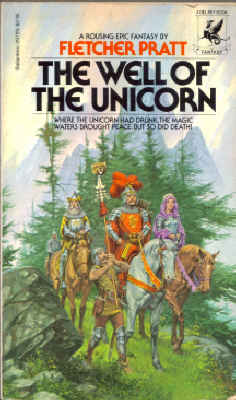
Last month, I read The Well of the Unicorn (1948), by Fletcher Pratt (1897-1956).  A colorful image of the 3rd Ballantyne edition is pictured below, though I read a more recent edition:

wellofunicorn

The novel is definitely a groundbreaking work: Pratt developed an entire fictional fantasy world and history, and it appeared before Tolkien published The Lord of the Rings (1954-1955), though not before The Hobbit (1937).   But is it as memorable?

Continue reading

Posted in Fantasy fiction | 3 Comments

Hollywood: Now officially out of ideas

Okay, now I think we can make this official:  Hollywood is completely out of novel ideas.  We started to suspect that this was the case when they started remaking very old classics such as King Kong, but at least there was an argument that those older films could use a high-tech facelift.  Then they started remaking classic films which were nearly perfect, such at The Haunting and The Day the Earth Stood Still, and completely botched them.   When Hollywood’s favorite muse became the videogame industry, one might be forgiven for assuming they had run out of ideas then.

But no, July 2009, is the official month the movie industry ran out of ideas.  From IMDB:

Classic 1980s computer game Asteroids is crashing onto the big screen – the arcade hit is set for a Hollywood movie makeover.

Universal Pictures bosses have snapped up the rights to make a film out of Asteroids, and are said to have given G.I. Joe: The Rise of Cobra director Lorenzo Di Bonaventura the job of breathing life into the project.

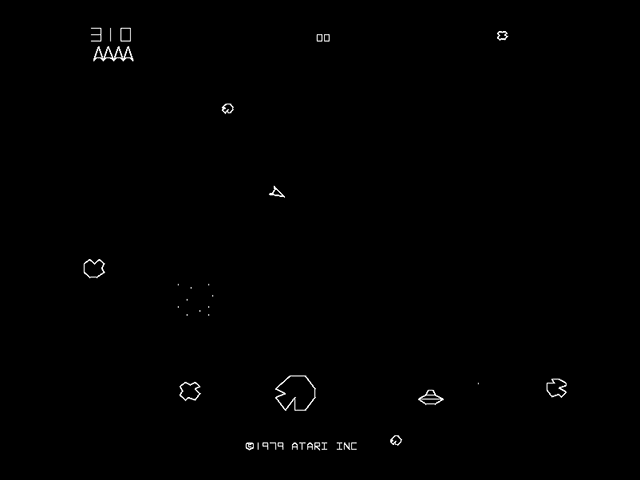
If you’d like to see an image of the project they’re “breathing life” into, look no further:

Asteroi1Yeesh… one hopes that this is some sort of surreal joke…

Posted in ... the Hell?, Entertainment | 17 Comments

Some musings on negative refraction

For a part of this past week I was at a workshop in California, and a lot of excellent theoretical and experimental researchers of metamaterials were present.  One of the points stressed by many of them is the difference between the idea of ‘negative refraction’ and a ‘negative refractive index’.  I had been vaguely aware of the issue, but it was really driven home by some of the discussion.  I thought I’d share my musings on the subject in a post.

Continue reading

Posted in Optics | 8 Comments

12 days until The Giant’s Shoulders #13!

This July 4th, if you’re celebrating the history of the United States, why not celebrate some history of science as well?  There’s 12 days left until the deadline for The Giant’s Shoulders #13, which is the first anniversary edition of the carnival, to be hosted right here.  Let’s make this one extra-special and get a lot of great entries submitted!

Posted in General science, Science news | 2 Comments

“Depression” isn’t just feeling bad

There’s been a healthy amount of discussion on the science blogs over the past few days about clinical depression, spurred on in large part by questions from aspiring academics concerning the best way to address the impact of their illness on their job and, just as important, their advisor’s perception of that job.  Dr. Isis seems to have started the current ball rolling with a question from a postdoc, PalMD posted another reader’s experience as a grad student dealing with depression, and Mark Chu-Carroll updated an old post concerning his own struggles with depression.  (If you search through the comments on the original post, you can read one of my very first blog comments, long before I had a blog of my own.)

I feel I should throw my own personal experiences in here.  I’ve been on antidepressants myself since graduate school.  I make no secret of it to anyone anymore, though I haven’t talked about it that much on the blog, except in one early post about the unjustified stigma that antidepressant drugs have. Continue reading

Posted in Health | 6 Comments

My interview on “A Blog Around the Clock”

As part of the run-up to ScienceOnline’10, Coturnix of A Blog Around the Clock has been running written interviews with the participants of the ’09 conference… including me!  You can read my interview here.

Posted in General science, Personal | Leave a comment

Happy birthday to Ray Harryhausen!

It’s a good time of year for birthdays: today is Ray Harryhausen’s birthday!  If you don’t know who Ray Harryhausen is, you should be ashamed of yourself — he’s the undisputed master of special effects.

Harryhausen pioneered the use of stop-motion animation to bring fantastic creatures to life.  If you’ve seen It Came From Beneath the Sea, The 7th Voyage of Sinbad, Jason and the Argonauts, The Golden Voyage of Sinbad, Clash of the Titans, The Beast From 20,000 Fathoms or — heaven help me — The Valley of Gwangi, you’ve seen Harryhausen’s mastery of special effects.

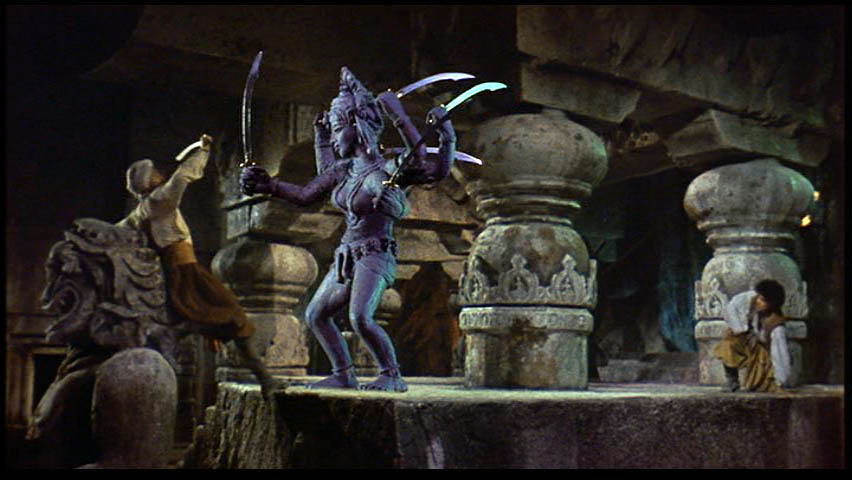
My favorite, which I still find awesome to this day, is the animated statue of Kali (via This Distracted Globe):

Goldenvoyage3

The Golden Voyage gives us this nice bit of trivia about the sequence:

In order to rehearse all the six arms with the actors in the sequence three stunt men had to be strapped together with a big belt standing and posing as Kali.

The adventure films of Harryhausen never made a whole lot of sense, but they were fun and filled with creatures more memorable than most of the throw-away CGI beasts produced today.

Most of Harryhausen’s work was done from the 50s through the 80s, but he still has an impact — numerous little “tributes” to him appear in animated films, and in 1992 he won the Gord0n E. Sawyer Academy Award “Given to an individual in the motion picture industry whose technological contributions have brought credit to the industry.”

Happy birthday, and hopefully many more, to the father of modern special effects!

(P.S. I’m honored to share a birthday with him!)

Update:  The Seventh Voyage.com, a site dedicated to Harryhausen, is fascinating!  Particularly intriguing is the section on Lost Projects, imaginative movie ideas that Harryhausen never got a chance to make.  Even more intriguing: one of these lost projects, War Eagles, was originally conceived in 1940 but is going to be released in 2010, with Harryhausen as executive producer!  From IMDB: “A publicly humiliated test pilot and a lost clan of vikings riding giant eagles are America’s only hope against a surprise Nazi attack.”  Awesome!

Posted in Entertainment | 2 Comments

Abramowitz and Stegun online!

Abramowitz and Stegun is a classic reference book which contains all sorts of information about special functions and their integrals.  If you’ve ever needed to reference something on the road and don’t have your copy with you, you will be happy to learn that the book is accessible online.

I happened across this by pure dumb luck while looking for some sort of obscure Bessel function integral some time ago…

Posted in Mathematics | 7 Comments