Best Science Writing Online 2012 is out!

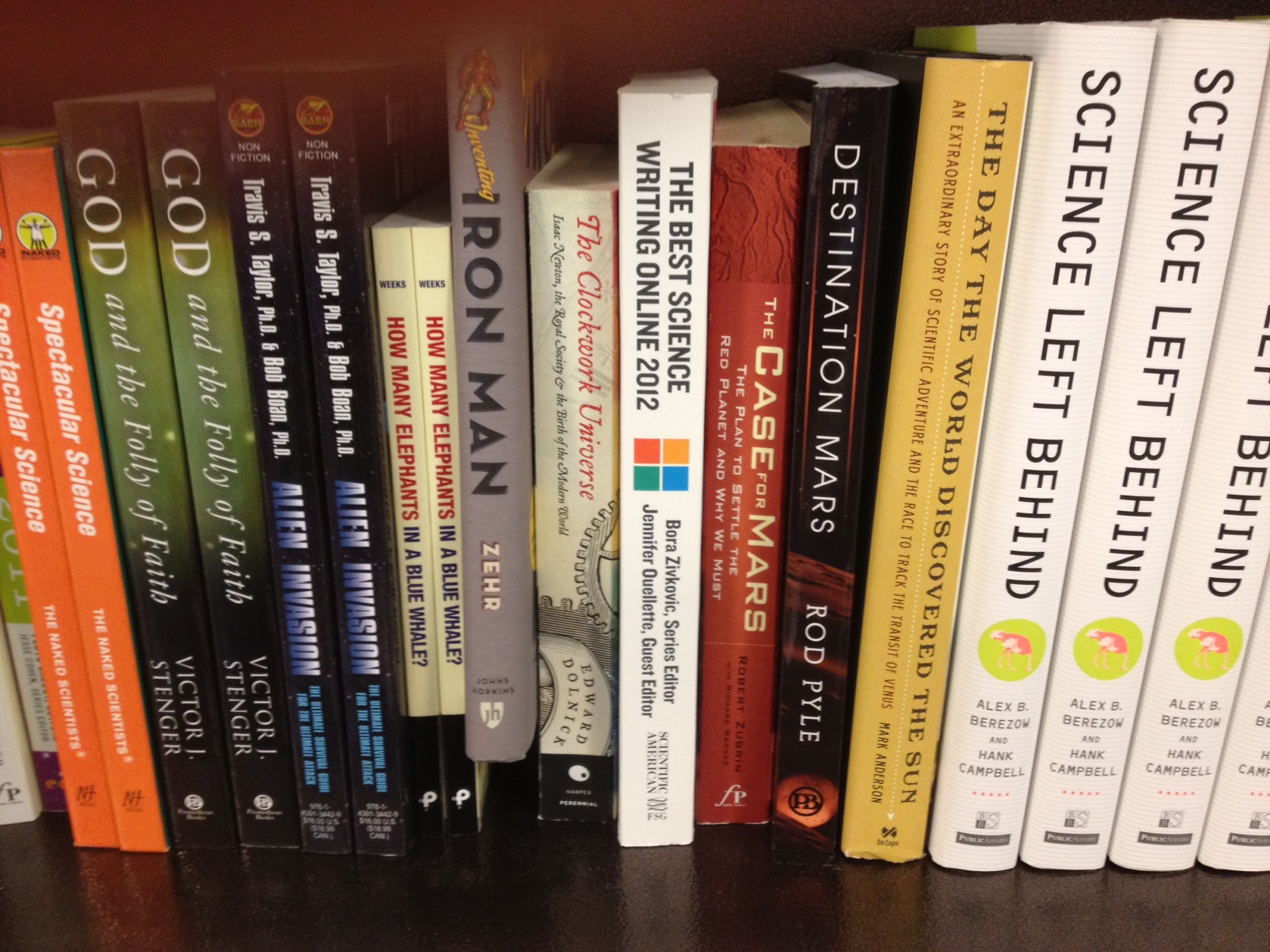
I thought I’d put up a short post letting people know that the 2012 edition of the “Best Science Writing Online” has been published — and I’m in it!  You can see my name in the right-most red column on the cover.

For those who are unfamiliar, this book is a part of a series that collects the “best” science writing of the year that was published on the internet.  I always put “best” in quotes because there is so much good stuff written every year that it is impossible to speak in absolutes — I prefer to say “some of the best”!

This volume is a continuation of a series that used to be called “The Open Laboratory”, and I was fortunate enough to have one of my pieces included in last year’s volume as well.  The 2012 edition is somewhat special, in that it is published by Scientific American and can be found in brick-and-mortar bookstores, as I verified in my local Barnes & Noble:

Even though I’ve written a textbook, this marks the first time that my writing has appeared on a regular bookstore shelf, so I’m rather excited about it!  I’ve already submitted a number of posts as candidates for next year’s volume, though the competition gets tougher every year so we’ll have to see what happens.  In any case, cheers to editors Bora Zivkovic and Jennifer Ouellette for putting together another great edition.

My contribution is based on my blog post on the curious Mpemba effect, officially discovered in 1969.  One of the nice side-effects of this book being published is that I’m actually sending a copy to Erasto Mpemba himself!  I’ll blog more details when I learn what he thinks of my writing…


Posted in Science news | 5 Comments

Bram Stoker’s The Lair of the White Worm

Bram Stoker’s name is inextricably and deservedly associated with horror fiction, thanks to his famous novel Dracula.  Of course, he wrote other novels and short stories, many of which are mostly (and undeservedly) forgotten today.  With this in mind, I recently started working my way through some of these other works.  A couple of weeks ago I read and blogged about Stoker’s The Jewel of Seven Stars (1903), a quite wonderful story about an ancient Egyptian curse and a resurrected mummy that predates modern mummy movies and the opening of King Tutankhamun’s tomb!

Emboldened, I turned next to reading what became Stoker’s last novel, The Lair of the White Worm, written in 1911.

Cover of the 1911 first edition of The Lair of the White Worm, via Wikipedia.

Well.  Um.  Hmm.  The nicest thing I can say is that The Lair of the White Worm is not quite what I expected.  What it really is, however, is a baffling, incoherent, almost impenetrable work.  Though the idea of the novel is original, it is so poorly executed that it is difficult to recommend.  However, Bram Stoker likely should be excused for this, as we will see.

Continue reading

Posted in Horror | 6 Comments

Making magnets speak: the Barkhausen effect

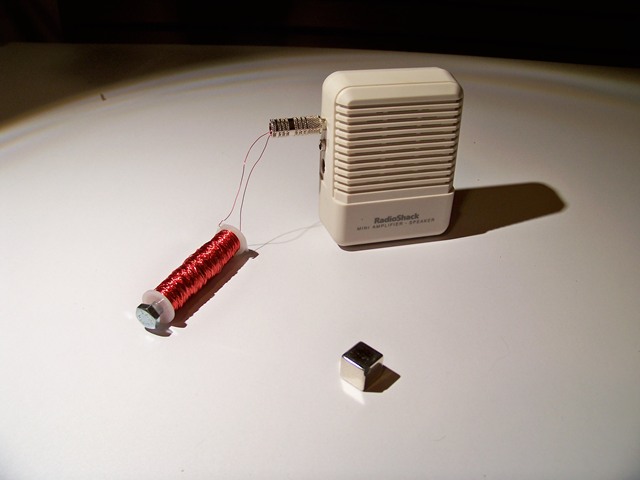
Occasionally I come across a demonstration of physics that is so simple to implement yet illustrates a phenomenon so profound that it almost takes my breath away.  I learned of one such demonstration recently, which requires only a handful of readily available pieces, shown below.

We have a helical coil of wire surrounding a steel bolt, with the wire hooked to an audio amplifier.  The final piece is a moderately strong neodymium magnet.

What can we do with this simple setup?  In fact, we can do something absolutely amazing: we can hear the sound of steel being magnetized!

The phenomenon is called the Barkhausen effect, and was first reported in 1919 by the German physicist Heinrich Barkhausen (1881-1956).  It was one of the first experimental glimpses into the microscopic processes that govern magnetization, and provided some of the earliest evidence for what is known as the domain theory of magnetization.  In this post, we’ll look at the Barkhausen effect, what it tells us about how magnets work, and describe how you can create the effect for yourself for around $40 of readily available materials!

Continue reading

Posted in Physics | 6 Comments

Weird Fiction Monday: A Vignette

It’s time for Weird Fiction Monday, when I post stories that I’ve written — both new and old — for the entertainment (hopefully) of my readers!  As always, I note that I haven’t done extensive editing of the tales here, so don’t be surprised to find the writing a little rough.

This is actually not a complete story, but rather a small vignette that is part of a larger story that I’m working on.  I thought it stood alone well enough to post it here.

She had the dream again that night.  It came to her distressingly often, at least twice a month, and always followed the same course.

She was in an underground chamber, in the sewers of the city.  She could tell this because the only light in the room came from a barred sewer grate through which sunlight streamed.  Regularly, she could see the shadows of carriages passing by, and she could hear the sounds of gentlemen out for a stroll with their ladies, engaging in jovial banter.  The street above her was filled with life, a stark contrast to the dark desolate room she was enclosed in.

Continue reading

Posted in Fiction | Leave a comment

“Hairy balls” in optics?

The title of this post certainly got your attention, didn’t it?  Don’t worry — the topic of the post is not quite as bad as it sounds!  The “hairy ball” theorem is in fact a mathematical theorem that states, in simple terms, that “you can’t comb a hairy ball flat without creating a cowlick,” a cowlick being an area of one’s hair where the directions “clash”, typically in a swirling pattern.

The back of my head, with a swirling cowlick visible. I should note that it is quite tricky to photograph the back of one’s own head.

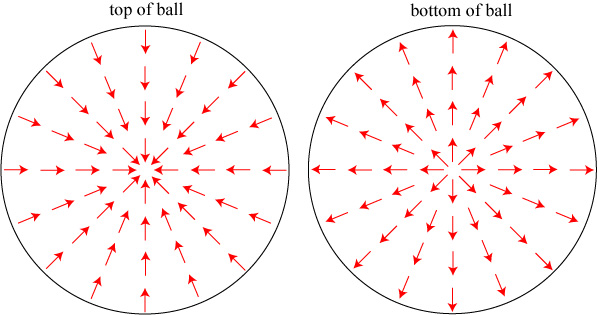
I was reminded of the hairy ball theorem by a recent intriguing post by Steven Strogatz. The theorem applies to balls which are completely covered with hair, like a coconut — it is of course possible to comb human hair without a swirl, simply by making it a gigantic comb-over!  For a fully hairy ball, however, there must be at least one cowlick, and most likely two.  For instance, suppose we try to comb a ball, starting at the top, away from a central point.  At the bottom of the ball, we will end up with an “inward cowlick”, where all the hairs converge (arrows indicate the direction the hairs point).

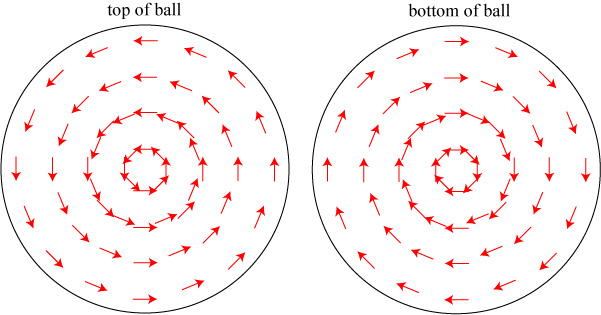
We might instead try and comb the hair in a swirling pattern, which creates a cowlick at its origin at the top of the sphere and creates another at the bottom.

The hairy ball theorem is a fascinating aspect of the subject of mathematics known as topology, which loosely speaking is concerned with the mathematical characterization of shapes.  But hairy balls are of significance in other fields, as well: in fact, many optical scientists are  unaware that a hairy ball is, in essence, right in their face every time they do experiments!  It is hidden in the polarization of light, i.e. in light’s inherent transverse wave properties.  In this post we will uncover this mysterious hairy ball of light.

Continue reading

Posted in Optics | 3 Comments

Bram Stoker’s “The Jewel of Seven Stars”

Late at night, barrister Malcolm Ross is awakened from a pleasant dream by a pounding on his door.  A policeman is waiting for him there, with an urgent summons from Margaret Trelawny, a young woman whom Ross had recently met and become enamored with.  Margaret’s father Abel, a noted collector of ancient Egyptian antiquities, has succumbed to a mysterious illness, rendering him comatose.  Worse, at the same time he has suffered an even more mysterious life-threatening injury.  In desperation, Margaret has summoned Ross, the only man she feels she can trust, to help her protect her father from an unknown threat.

So begins the novel The Jewel of Seven Stars, written in 1903 by the master of horror fiction, Bram Stoker.

Cover of the first edition of “The Jewel of Seven Stars”.

Stoker is, of course, best known for his influential 1897 novel Dracula, which really sparked the entire modern vampire craze (though there were precursors).  He wrote a number of other supernatural thrillers, The Lair of the White Worm being perhaps the next best known.  (And there’s this one that I recently acquired and am dying to read.)

The Jewel of Seven Stars is relatively unknown, which is surprising — it is one of the earlier stories about the reanimation of an ancient Egyptian mummy, and it is quite a thrilling tale!  It also uses state-of-the-art science of the time to bolster the story — with rather amusing results.

Continue reading

Posted in Horror | 1 Comment

The Giant’s Shoulders #51 is out! Tales of Patriotic Science-Nerds, Vortex Cannons and Nuking the Goat

The 51st edition of The Giant’s Shoulders is up at the History of Geology blog!  As its title suggests, within the carnival you can read about:

  • Patriotic science nerd Thomas Jefferson, who defended America’s biological honor with a moose,
  • A very old physics demonstration which has led to some unusual possible applications: the vortex cannon,
  • The role of neurotic goats as test subjects in early nuclear testing,
  • And much more!

Many thanks to David Bressan for taking the time to host and put together an excellent history of science blog carnival!

The next edition will be hosted on October 16 at the Friends of Darwin blog.  Entries can be submitted to the carnival managers, myself (Dr. SkySkull) or ThonyC via email, or directly to the carnival host, by the 15th of October.

Posted in General science, Science news | Leave a comment

How many uses for a nuclear weapon can YOU think of?

Ah, nuclear weapons!  Having grown up while the Cold War was still going strong, I can almost think about nuclear bombs with a sentimental eye — though the threat of nuclear terrorism is still a possibility, we’re much further away from complete annihilation than we were back in my childhood.  I still remember being frightened as a child at the possibility that someone, somewhere, for reasons I would never understand, might start the “big one” without warning.

Now, of course, we’ve got huge stockpiles of nuclear weapons lying around.  You might think that the only option is to dismantle the majority of them and hide the radioactive material somewhere safe and out of the way.  If you thought that, you clearly don’t have enough imagination!  Over the years, there have been quite a few suggestions as to how nuclear weapons might be used in a “productive” way.  I’ve stumbled across a few of these over the past few weeks, and thought it would be interesting to compile a list of some of the ideas suggested — and even tried — as “peaceful” uses for nuclear explosions.  I believe all of these fit the old statement, “If all you have is a hammer, everything looks like a nail.”

Continue reading

Posted in ... the Hell?, History of science, Physics | 30 Comments

Relativity: Ten minutes to Alpha Centauri?

Einstein’s special theory of relativity is arguably the most amazing physical theory ever conceived.  It utterly transformed our view of the universe, completely eradicating the view that space and time are independent quantities and giving us a new unified fabric of space-time.  It led us to the revelation that energy and mass can be converted into one another, and resulted in the world’s most famous physical equation,

E=mc^2,

which tells us that a mass m, times the speed of light c squared, is equivalent to (and can be converted into) an amount of energy E.  This observation forms the basis of nuclear energy, and it paved the way to all of modern particle physics such as the experiments being done at the Large Hadron Collider.

Perhaps the most fascinating thing about Einstein’s special relativity is that it leads to a collection of “paradoxes” that seem to violate our common-sense nature of the world.   Resolution of these false “paradoxes” demonstrate that the theory is wonderfully and incredibly consistent — and the best part is that many can be resolved using at most high-school algebra.

There are a variety of seeming contradictions in special relativity that turn out to be quite the opposite: the most famous of these is the “twin paradox“, in which one twin brother does a round trip to a distant star at high speed and returns to Earth, and there is a discrepancy in the ages of the twins when they return.

I’ve talked about the “twin paradox” in the context of another post; I thought for this one I’d discuss another unusual aspect of special relativity.  If you know anything about relativity, you probably know that it implies that nothing can go faster than the speed of light, which happens to be

c = 3 \times 10^8\mbox{ meters/second} = 186,282\mbox{ miles/second}.

In fact, the only thing that we know that can even match the speed of light is light itself!  As far as we know at this stage, no massive particle can achieve c, though it can come arbitrarily close to that speed.

With that in mind, if you were to jump into a rocketship and blast off to Alpha Centauri, which is 4.37 light years away from Earth, what is the fastest possible time that it could take you to get there with the fastest spaceship possible?

Image of Alpha Centauri (left) and Beta Centauri (right), via Wikipedia.

A natural first guess would be to say it would take approximately 4.37 years, since I can go no faster than the speed of light.  In fact, however, it turns out that with a fast enough spaceship, you could get to Alpha Centauri in as little time as you like — even 10 minutes or less!

How is this possible?  In explaining it, we will have to probe to the heart of two fundamental and surprising results from Einstein’s theory: time dilation and length contraction.  An important piece of the puzzle is noting that I asked how long it takes you to get to Alpha Centauri, not how long someone on Earth says it takes for you to get there…

Continue reading

Posted in Physics, Relativity | 11 Comments

Weird science facts: July — August 2012

Though I stopped doing a Twitter weird science fact (#weirdscifacts) a day early this year, I’m still occasionally posting facts as I come across them.  Here’s a collection of a few tidbits I came across over the past couple of months!

753. July 6: 1 shaft, 4 heads: The echidna’s penis.  This post is NSFW if you happen to work with a bunch of echidnas.  (post by @PygmyLoris, with a  h/t to @scicurious: who else?)

754. July 7: Behold the Boötes void, the spookiest place in the cosmos!  Space is really, really empty, but there are regions of space that are even emptier than that!

755. July 27: Clever ants have hooks on their babies to hang them from the walls.  (post by @myrmecos, h/t @bug_girl)

756. July 30: In 1968, there was an experiment to see if an astronaut can imitate falling movements of a cat.  This may sound weird, but it was a great way to study how astronauts can move in space wearing bulky suits. (h/t @astVintageSpace)

757. August 13: Sand on the beaches of Normandy is up to 4% shrapnel.  This WWII “war sand” is a haunting reminder of the deadly carnage that occurred there.

758. August 17: The primary sensory neuron in the giraffe can be up to 15 feet long! We tend to think of neurons as microscopic things, but the giraffe has a truly gigantic one. (via @GainesOnBrains)

758a. August 17: Rock formation bigger than Connecticut found floating in Pacific.  This is a remarkable testament to the power of volcanic activity.  (h/t @leafwarbler)

758b. August 17: There is a remarkable almost forgotten history of “atmospheric railways” powered by air pressure. (h/t @seelix & @mcshanahan)

759. August 20: Excuse me but this butterfly can see with its butt.  I think that last sentence speaks for itself.  (post by @j_zimms)

760. Aug 31: Project Orion: the 1950s-era idea to power a spaceship with nuclear bombs.  In that era, people had all sorts of ideas for nuclear bombs that didn’t involve nuking Russia.  See, for instance, my previous #weirdscifacts on Edward Teller’s “Operation Chariot“. (h/t @encephalartos)

Posted in Weirdscifacts | 4 Comments