Weird Fiction Monday: Mass Effect: Apocalypse

(Updated to add one more smart-ass comment.)

It’s time for Weird Fiction Monday, when I post stories that I’ve written — both new and old — for the entertainment (hopefully) of my readers!  As always, I note that I haven’t done extensive editing of the tales here, so don’t be surprised to find the writing a little rough.

This one is a bit special.  I’ve been a fan of the Mass Effect series of video games since the first one came out in 2007.  In this science fiction game trilogy, one takes on the persona of Commander Shepard, who ends up in a struggle to protect all intelligent life in the galaxy from a race of monstrous and gigantic synthetic beings called the Reapers.  In the third game, which came out this year, the Reapers finally arrive in force in the galaxy to wage war.  Shepard races to unify the various quarreling societies of the galaxy in a last ditch attempt to prevent annihilation.

99% of the game is beautiful, even heart-wrenching at times.  The ending, however, literally the last 15 minutes or so of a 100-hour game trilogy, has almost universally been panned as sucking.  Hard.  An early poll of the ending choices was 90% negative, and various game review websites and magazines blasted them as well.  There are many things to critique about the endings, the foremost of which is the rather contrived nature of the ending choices (which depend not at all on anything else done in the game) and the fact that they are almost identical.

For those who haven’t experienced the ending, let me make an analogy: imagine sitting through the 9 hours of the Lord of the Rings trilogy, and just as the Hobbits arrive at Mount Doom, they burst into a Busby Berkeley musical number that ends the film.

The crappy Mass Effect ending has irritated me greatly.   In order to get it out of my system, I decided to write my own.  It should be noted that I include almost the entirety of the original ending narrative, up until the trio of lame choices.  Then I introduce a new choice.

Despite my efforts, this story will probably be rather baffling to anyone who hasn’t played the Mass Effect games.  Also, be warned: it is ridiculously long — almost 11,000 words.

Mass Effect : Apocalypse

Shepard opened his eyes.  He was lying on a floor stained with blood.  He lifted up his head, ignoring the pain the movement caused, and slowly looked around.  He was at the terminus of a long and dimly-lit hallway, its other end lost in the darkness.

The hallway was cluttered with bodies, mostly human.

He was in an abattoir.

Continue reading

Posted in Fiction | 10 Comments

My own little “Higgs”-related story

The physics community is in a near frenzy today with the expectation that, tomorrow at 9 am Geneva time, researchers at the Large Hadron Collider will announce the first significant evidence that they’ve discovered the “Higgs boson”, a fundamental particle that was predicted in the 1960s and has been sought in high-energy physics experiments ever since.

What is the Higgs?  Physicists studying the fundamental forces of nature have long been concerned with understanding why matter has mass, and why some fundamental particles are so much heavier than others.  In the 1960s, a number of researchers postulated the existence of a “field” that permeates all space and, loosely speaking, creates a “drag” on matter, some types of particles more than others.  This field is now referred to as the “Higgs field”, and it is expected to be directly manifested in the form of a particle — the Higgs boson — that can be detected by smashing protons together at sufficiently high energies.

High-energy physics isn’t my field, so for those who are interested in learning more, there is an excellent video explainer at PhD Comics and a good written explanation at Cosmic Variance.  Also, Sean is hoping to live-blog the announcement, so check out his updates! (Though the news should break at 3 am EST!)

The “Higgs boson” is named for its most famous discoverer, Peter Higgs, who published a paper in Physical Review Letters in 1964 laying out the theoretical foundations of the idea. However, I was reminded today by Oliver Willis via his Twitter feed that there were in fact six physicists who, in three groups, independently and more or less simultaneously made the same “Higgs hypothesis”.  In addition to Higgs, the duo of François Englert and Robert Brout and the trio of Gerald Guralnik, C. R. Hagen, and Tom Kibble also published papers in Physics Review Letters in 1964 on what is now know only as the “Higgs”.

There are two phenomena at play here worth noting that occur quite regularly in the process of scientific discovery.  The first of these is the discovery of a new phenomenon (or concept) by multiple researchers independently at around the same time.  No discovery is made in a vacuum, and as science builds on earlier results, it is almost inevitable that many will be following the same “line of attack” in solving a scientific problem.  A good example of this is Albert Einstein’s special theory of relativity, first published in 1905.  Though Einstein is rightly credited with properly describing the new relativistic view of the universe, many other researchers such as Poincaré and Lorentz were inching along the same path.

The other thing that happens quite often in scientific discovery is the sometimes unusual and somewhat off-kilter naming of things.  Though Higgs did hypothesize the boson providing mass, others did as well, as we have noted.  Scientific discovery proceeds in a rather organic (often seemingly random) manner, and the naming of things is no different.  Sometimes, things can get credited to the wrong person.  Other times, things are named for a researcher against their wishes!  Two personal examples I know of this are the Berry phase and the Wolf shift, effects whose discoverers (Sir Michael Berry and Emil Wolf, respectively) have actively resisted having named after them.

Fortunately, in the case of the Higgs, the six authors of the original Higgs papers were acknowledged for their work in 2010 when they received the J.J. Sakurai Prize for Theoretical Particle Physics.

As it turns out, I actually know one of the other researchers who originally conceived of the Higgs!  Professor Carl Richard Hagen is a professor at the University of Rochester, where I got my PhD, and I had a number of interactions with him.  While we wait for the Higgs news, I thought I’d share my own silly little anecdote related to Hagen.  It has little to do with science, but a lot to do with life as a graduate student!

Continue reading

Posted in Personal, Physics | 10 Comments

The Giant’s Shoulders #48 is out!

The carnival was a little delayed, and my announcement of it is even more belated, but the 48th edition of The Giant’s Shoulders history of science blog carnival is up at Clerestories!  In the carnival, you can read:

  • The history of previous transits of Venus;
  • The story of Mary Lacy, a shipwright who published her autobiography — in 1773;
  • A 1936 letter from a young girl to Albert Einstein, and his response;
  • A brief, painful history of dentistry;
  • and much more!

Thanks to Sienna for an excellent carnival!

We don’t yet have any hosts lined up, as far as I know, for the next few months of the carnival — if you’re willing to host at your blog, please please please let us know!

Posted in General science, Science news | Leave a comment

An American in Spain, part 8: Granada and the Alhambra

The final part of the seemingly-endless photo travelogue of my (not quite so) recent trip to Spain with my wife and her family! (Part 1Part 2Part 3Part 4Part 5Part 6, Part 7)

Having exhausted ourselves with a very extensive visit to Seville, the very next day we hopped on a train to our last stop: the lovely Southern city of Granada!  This was an essential stop, as the whole motivation for our Spain trip was to visit niece-in-law #1, who was doing a semester abroad in Granada.  While en route, I had some fun experimenting with panorama photography to capture some of the lovely Andalusian countryside.

Panorama of the Southern Spain countryside, created by stitching together two photos taken from a moving train. I can’t believe it actually worked.

Granada, like Seville, is a beautiful city with a rich and ancient history, as we would see for ourselves on our only full day there.  The present-day city was founded in the 11th century , during a civil war that marked the end of the unified Moorish caliphate but resulted in independent Moorish kingdoms sprouting up.  The ruler of one of these kingdoms opted to move his residence to the high ground of present-day Granada, where it would be easier to defend from attacks.  He moved into a Jewish hamlet already present there, and the city grew rapidly in size.  The city remained Muslim until 1492, when it became the last city to fall in the 800 year Christian Reconquista of Andalusia.

Continue reading

Posted in Travel | 4 Comments

How well can the government spy on us via satellite?

About a week ago, NASA announced some really good and unusual news.  The National Reconnaissance Office, in operation of the United States’ spy satellites, had some extra unused “hardware” to donate to the space agency: two Hubble-quality space telescopes, initially designed to spy on the Earth!

The Hubble Space Telescope, image via Wikipedia. Thanks to the NRO, NASA now essentially has two extra ones.

This is undoubtedly a great boon for NASA, which has been suffering under budget cuts for quite some time, even resulting in a recent bake sale by scientists.  It will take years for the new telescopes to be used on a mission, but they could still be launched sooner, and for much cheaper, than comparable projects.

This raised an interesting question on Twitter, posed by Colin Schultz and John Rennie: if they had actually been used as spy satellites, what would these super telescopes have been able to see on the ground?  It’s a fascinating question, and leads into a nice basic discussion of the optical resolution of imaging systems.  In other words, what is the smallest detail that could be picked up by one of these telescopes in orbit?

Continue reading

Posted in Optics | 18 Comments

Skydives at CarolinaFest 2012!

I’ve been quite busy and having a hard time putting together some science posts.  In the meantime, I thought I’d share a video of a couple of skydives I did a bit over a week ago at CarolinaFest 2012 at Skydive Carolina, my regular dropzone!

CarolinaFest is an event known in skydiving parlance as a “boogie”, which is pretty much a skydiving convention: people come from all over to participate in special activities and to jump out of fun and unusual planes that have been rented for the event.  One of the perks of a boogie is load organizing: expert skydivers are brought in to plan and implement formation skydiving for the attendees.

My friends and I joined up with Regan Tetlow, who works at Skydive Empuribrava in Spain.  I did three jumps with him, though we didn’t have video on the first jump so only the first two jumps on the video have me in them!  I’m the one in the green and black jumpsuit and wearing the leather “frap hat”.

The two I’m in are an “8-way” formation jump and a “6-way” formation jump, both of which went pretty well.  I’ve managed to pick up an annoying habit of pulling my legs in and sinking out on the formation (going lower than I want to), so Regan ended up keeping me pretty close to him for the jumps.  (And I felt a little like an idiot by the end of the day!)

The boogie seemed really crowded this year, and in fact they had four airplanes running constantly on the day I was there!  The first jump was out of a twin otter, and the second was out of my favorite plane, the CASA.  The CASA is especially fun because it has a tail door, which allows for very easy and fun exits with a lot of people linked together.  On the second jump of the video, we actually launched six people together off the plane, though one fellow lost his grip and had to come back to the formation.

Overall, it was a really fun time!  Though my flying wasn’t at its best, I felt like I learned a few things to help improve in the future.  Special thanks to Larry and Kathy Stringer, my friends who recorded and edited these videos, respectively!

Posted in Sports | Leave a comment

Laird Barron’s The Croning

I love Laird Barron’s writing!  I first came across his work in the horror collection Haunted Legends; Barron’s story, “The Redfield Girls”, really stood out to me above all the others in terms of its eloquence and eeriness. Since then, I’ve read both of Barron’s short story collections, The Imago Sequence (2007) and Occultation (2010), and been mightily impressed with both.

This year, Barron’s first novel was published by Nightshade Books, The Croning (2012):

The Croning is a very dark and modern interpretation of a classic fairy tale (which was already rather dark to begin with).  I found the novel to be a little challenging, for reasons that I will mention below, but it is also an undeniably creepy and potent story and an excellent first novel for Barron.

Continue reading

Posted in Horror | Leave a comment

Weird science facts: April — May 2012

Though I stopped doing a Twitter weird science fact (#weirdscifacts) a day several months ago, I’m still occasionally posting facts as I come across them.  Here’s a collection of a few tidbits I came across over the past couple of months.

746. Apr 06: Pieter Zeeman was fired for doing the work that he eventually won the Nobel Prize for!  There are plenty of stories of Nobel prize research being unappreciated when first published, but it is rare to see someone get fired for doing it.

747. Apr 07: The mystery of the glow-in-the-dark Civil War soldiers.  The story of the miraculously-healing glowing wounds sounds like a supernatural story, but in fact has a scientific basis.

748. Apr 08: Versailles fountains could not be pumped all at once; gardeners watched Louis XIV and ran the ones near him as he strolled.  Interestingly, this week on Jeopardy! a contestant told a modern version of this story.  The contestant and his friend managed to hide in the Versailles gardens and sleep there overnight; they were awakened in the morning to the spray of the sprinkler system, and the sprinklers mysteriously seemed to turn on wherever they ran!  Turns out the gardeners were having a little fun with the trespassers.

748a.  Ever wanted to know how many WIMPS hit you per year?  (h/t @allinthegutter)

749. Apr 11: Dog eats scientist’s labwork. Paper ensues. (h/t @_ColinS_ and @SciencePunk)

750. May 17: Meet the sarcastic fringehead, a fish that looks like the predator!  (h/t @mcmuffinofdoom)

751. May 30: Airboats? The first one was built by a team in 1905 including Alexander Graham Bell.

752. May 31: The curious case of astrophysicist Rodney Marks, who may or may not have been murdered at south pole

Posted in Weirdscifacts | Leave a comment

Physics demonstrations: rolling uphill

Some of the best and most enjoyable demonstrations of physics principles can be put together quite readily with very cheap materials.  A good example of this was the simple version of the Magdeburg hemisphere demo I discussed previously; another example is the approximately $20 device shown below.

A pair of rails spread apart as they increase in altitude: they are 3” high on the right side, and 4” high on the left.  This is easier to see from a side view.

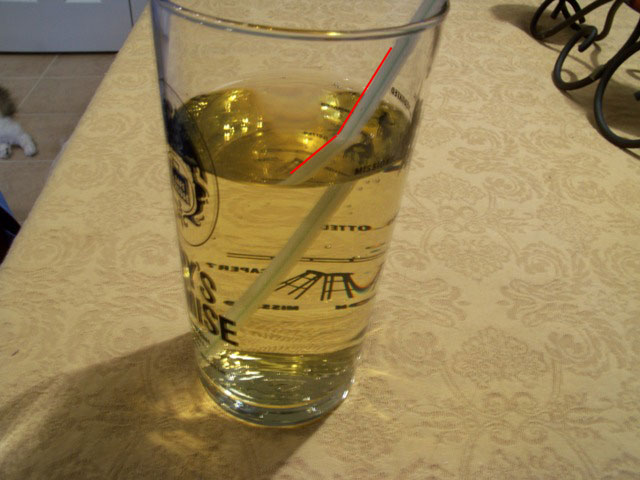
A pair of plastic funnels have been glued together at their wide ends; when the joined cones are placed on the right, lower, side of the device, they immediately roll to the left, stopping only when they hit the uprights on the far left side.  The joined cones have rolled uphill, in seeming defiance of gravity!

Of course, this simple device can be readily explained by physics, and its unusual operation can be used to highlight an important principle in the physics of forces and motion.

Continue reading

Posted in Physics demos | 2 Comments

Philip Wylie’s Gladiator (1930)

Stories of superheroes have evolved dramatically since the appearance of Superman in Action Comics #1 in 1938.  Where many of the first, like Superman, were moral, upstanding individuals striving to do good in the world, many modern heroes are flawed, struggling with a sense of purpose and with their own sense of right and wrong.  The supreme example of this modern style are the characters in Alan Moore’s graphic novel Watchmen (1986-1987), who are faced with a world with problems much greater than they can solve.

Before even Superman, however, there was a super-powered protagonist that struggled to find his place in the world: the character of Hugo Danner in Philip Wylie’s 1930 novel Gladiator.

In fact, Wylie’s Danner was likely a major inspiration for Superman!  Though Shuster and Siegel never admitted as much, the similarities are striking, and it is hard to imagine that the two Superman creators were unaware of the popular novel.

Continue reading

Posted in Weird fiction | 1 Comment